
June At Wharf Gate (AWG) prices for export logs at New Zealand ports fell by an average NZ$9 per JASm3 due to a combination of CFR log price drops in China and increased shipping costs. CFR log prices in China have stabilised, shipping costs have reduced, and the NZD has weakened against the USD through June, so AWG prices are expected to increase in July. This will provide some relief to forest owners who have been battling with below par financial returns. Softwood log inventory in China is slightly reduced with constant log demand.
Domestically, sawn timber demand remains firmer than at the same time last year. Fuel surcharges have been reduced as fuel costs ease, helping to alleviate some of the cost pressure across the supply chain.
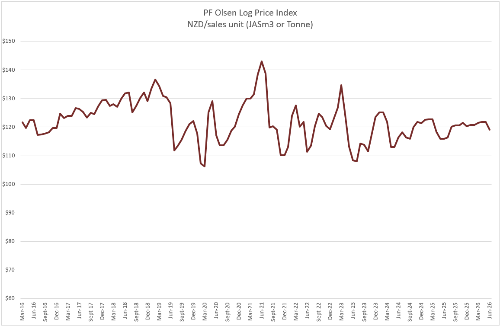
The PF Olsen Log Price Index dropped $3 to $119 in June, which is $1 below the two-year average and level with the five-year average.
Domestic Log Market
Domestic log processors have reduced the fuel surcharge on domestic sawn timber from 3–4% in June to 1% in July, with the surcharge due to be reviewed again in late July for August pricing. The reduction reflects lower fuel costs and some easing of cost pressures across the supply chain.
Most domestic log pricing has remained stable as the market enters Quarter 3. While construction activity remains below long-term averages, sawmill demand has generally held up better than expected through winter. Processors report steady demand across structural, packaging, and industrial timber grades. Revenue from export sales are improved by the weaker NZD.
The reduction in domestic processing capacity over the past two years continues to influence market dynamics. Mill closures and production curtailments have tightened timber supply and improved the balance between supply and demand. This has enabled sawmills to maintain pricing despite a subdued construction environment.
Residential construction activity appears to have stabilised following the sharp downturn experienced during 2023–2024. Building consent levels have improved from their lows and there are early indications that physical construction activity is gradually increasing. However, non-residential construction remains weak and continues to limit broader timber demand.
China
CFR prices for A-grade logs from New Zealand are currently in the range of USD 121–127 per JASm³ for the larger exporters. Prices appear to have stabilised in recent weeks, although the relatively wide trading range is expected to persist due to differences in grade mix, customer relationships, contract structures, and individual selling strategies among New Zealand exporters.
Softwood log inventories in China have reduced slightly and are now estimated to be in the 2.2–2.4 million m³ range. Daily log offtake remains steady at approximately 55,000 m³ per day, which is encouraging given that productivity and construction activity typically slow during China's hotter summer months.
Chinese buyers have noticed the recent reduction in log supply from New Zealand, which has contributed to the decline in inventory levels. New Zealand continues to supply approximately 75% of China's imported softwood logs, meaning changes in New Zealand harvest levels have a significant influence on market balance and inventory trends. However, some market participants remain cautious, believing that lower fuel prices could encourage higher harvesting activity and increase New Zealand log supply later in the year. For now, winter conditions are expected to constrain harvesting activity, although some larger corporate forest owners may increase production levels as operating conditions and economics improve.
China's Caixin Manufacturing Purchasing Managers' Index (PMI) eased slightly from 52.2 in May to 51.8 in June but remained above the expansion threshold of 50 for the sixth consecutive month. Manufacturing activity continues to expand, although growth moderated as export demand softened and input costs increased.
While overall furniture sales remain below historical averages, the hardwood furniture segment is performing better than the softwood sector. Export sales to Australia have remained relatively resilient as harvest levels reduce in Australia. Demand from Europe continues to be constrained by weak residential construction activity and subdued consumer confidence, reducing demand for higher-value furniture.
India
Seven pine log vessels will arrive in Kandla Port in June vessel arrivals in June carrying pine logs during June. This is a small reduction of approximately 5% compared with May arrivals. The lower vessel count reflects ongoing caution among importers as demand weakens ahead of the monsoon season.
CFR prices for New Zealand pine logs into Kandla remain around USD 158 per m³. Buyers continue to resist price increases as market conditions soften and the onset of the monsoon is expected to further dampen construction activity and timber demand.
The Gandhidham sawn timber market remains relatively firm, with green radiata pine trading at approximately INR 671 per CFT. However, labour shortages are becoming increasingly evident across Gandhidham and other parts of India, as many casual workers have returned to their home regions. Reduced labour availability is constraining sawmill production and limiting the supply of finished timber.
India's HSBC Manufacturing PMI declined to 54.5 in June, down from 55.0 in May and the lowest reading in three months. While the index remains comfortably in expansion territory, manufacturing activity slowed as demand softened and cost pressures persisted, limiting growth in output.
In Southern India, Tuticorin Port continues to receive pine logs in container shipments from New Zealand, South Africa, and the United States. Green pine sawn timber is currently selling at INR 800–850 per CFT, significantly above prices in northern India, reflecting the higher cost structure associated with containerised log supply and the regional supply-demand balance.
Ocean Freight
Ocean freight costs (USD/JASm3) for logs from New Zealand have reduced and the cost of shipping logs to China from the North Island of New Zealand is now in the range of 40-43 USD per JASm3.
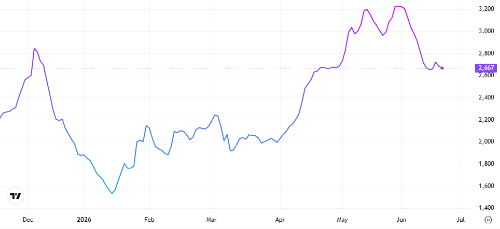
Baltic Dry Index (BDI)
Source: TradingEconomics.com
The reduction in the Brent Crude Oil Price is shown below.
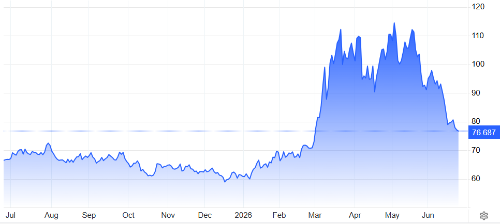
Brent Crude Oil Price
Source: TradingEconomics.com
Exchange Rates
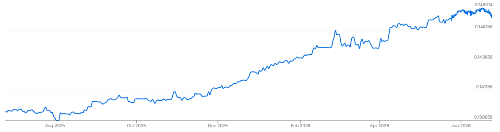
The NZD has weakened against the USD by 3.5% over the last month. This alone should increase AWG prices in New Zealand by 4-6 NZD per JASm3. Conversely, the CNY has been relatively stable against the USD, so the buying power of the CNY hasn’t been weakened against the strengthening USD.
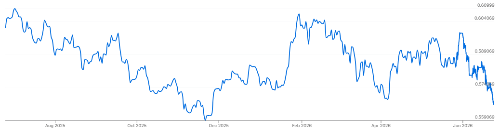
NZD:USD
CNY:USD
PF Olsen Log Price Index - June 2026
The PF Olsen Log Price Index dropped $3 to $119 in June, which is $1 below the two-year average and level with the five-year average.
Basis of Index: This Index is based on prices in the table below weighted in proportions that represent
a broad average of log grades produced from a typical pruned forest with an
approximate mix of 40% domestic and 60% export supply.
Indicative Average Current Log Prices – June 2026
| Log Grade | $/tonne at mill | $/JAS m3 at wharf | ||||||||||
| Jun-26 | May-26 | Apr-26 | Mar-26 | Feb-26 | Jan-26 | Jun-26 | May-26 | Apr-26 | Mar-26 | Feb-26 | Jan-26 | |
| Pruned (P40) | 175-202 | 175-200 | 175-200 | 175-202 | 175-200 | 175-200 | 192 | 196 | 196 | 196 | 194 | 194 |
| Structural (S30) | 120-145 | 123-145 | 123-145 | 120-145 | 120-145 | 120-145 | ||||||
| Structural (S20) | 93-100 | 95-100 | 95-100 | 93-100 | 93-100 | 93-100 | ||||||
| Export A | 118 | 125 | 125 | 125 | 123 | 123 | ||||||
| Export K | 109 | 117 | 117 | 116 | 114 | 114 | ||||||
| Export KI | 100 | 107 | 107 | 107 | 105 | 105 | ||||||
| Export KIS | 100 | 98 | 98 | 98 | 96 | 96 | ||||||
| Pulp | 51 | 46 | 46 | 51 | 46 | 46 | ||||||
Note: Actual prices will vary according to regional supply/demand balances, varying cost structures and grade variation. These prices should be used as a guide only.
A longer series of these prices is available here.
Log Prices
Select chart tabs
This article is reproduced from Stand/PF Olsen's Wood Matters, with permission.
We welcome your comments below. If you are not already registered, please register to comment
Remember we welcome robust, respectful and insightful debate. We don't welcome abusive or defamatory comments and will de-register those repeatedly making such comments. Our current comment policy is here.