
Content supplied by Rabobank.
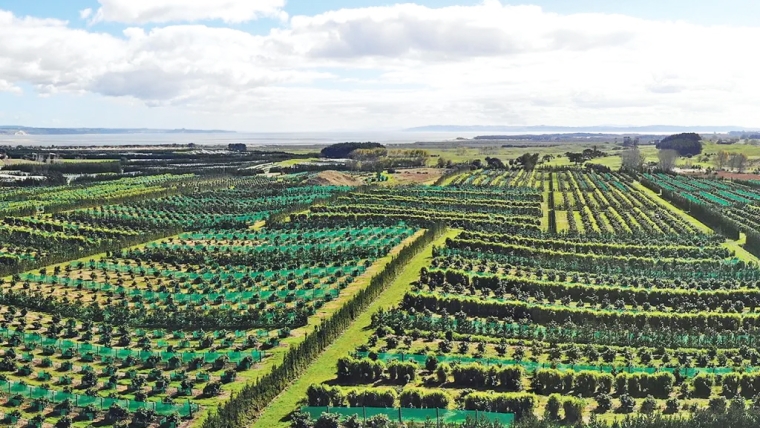
With exports to its largest international market, Australia, trending lower, New Zealand’s avocado sector is pivoting fast and rapidly growing exports into Asia, according to a new report by food and agribusiness banking specialist Rabobank.
In the report Global Avocado Update 2026, Rabobank says New Zealand’s avocado exports in the 2025/26 season – which ran from September through to March – reached 3,445 million trays, down around 9% year-on-year due to wind damage and constrained market windows.
“Australia remained our largest export market, at 750,000 trays or 22% market share, however, volumes did decline, and we are now significantly less reliant on our TransTasman counterparts than we were just five years ago when they accounted for more than two-thirds of total Kiwi avocado exports,” RaboResearch senior analyst and report coauthor Jen Corkran said.
“To offset weaker Australian demand, the sector continues to diversify, with strong growth across Asia. Exports to South Korea surged by 70% year on year to 625,000 trays in the 25/26 season, while shipments to China, Hong Kong, and India nearly doubled, and exports to Taiwan increased by 50%.”
Ms Corkran said there is also growing optimism amongst sector participants that the recent New Zealand-India trade agreement will support further export growth into the subcontinent over time.
“Avocado exports into India are already growing strongly and further growth is now expected given the new trade deal will see tariffs on avocados – and other fruit – phased out over the next 10 years,” she said.
Global Update
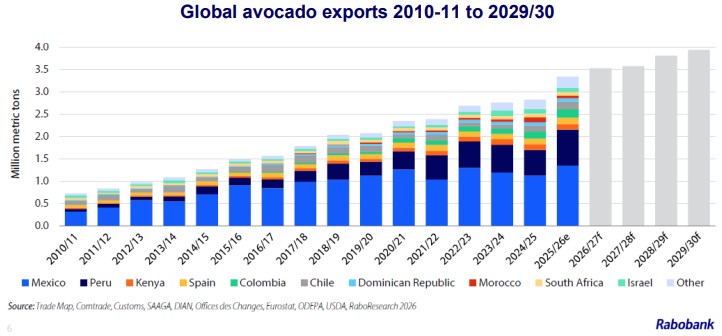
The report says global avocado exports remain on a strong growth trajectory off the back of robust output from longstanding production “heavyweights”, and rising production across a host of emerging players.
“Global exports have risen dramatically, from 0.73 million metric tons in 2010/11 to more than 3.3 million tons in 2025/26, with Mexico and Peru as the dominant contributors alongside growing volumes from others like Kenya, Spain, Colombia and South Africa,” Ms Corkran said.
The report says global avocado volumes are expected to increase further in the 2026/27 season, however the developing El Niño is expected to heighten but unevenly distribute weather risks.
“Rather than a broad supply squeeze, El Niño will likely increase variability of yields and fruit sizes across regions, thereby amplifying seasonal imbalances and market volatility,” Ms Corkran said.
On the demand side, the report says some established markets are showing signs of maturity while new players continue to increase demand.
“Global avocado demand continues to display a dual-speed dynamic, with mature markets approaching saturation, while emerging consumption regions sustain structurally higher growth,” Ms Corkran said.
“Mexico and Chile remain clear outliers in per capita/ per annum availability (standard measure used to estimate average per-person consumption) at approximately 14kg and 9kg respectively, suggesting limited headroom relative to emerging consumption regions.
“In contrast, steady expansion across large population markets like the EU, which reached 2.24kg per capita in 2025, indicates significant growth potential.
“Countries such as Italy, Germany and Turkey are also exhibiting rapid relative growth, pointing to broad-based adoption rather than niche consumption.”
We welcome your comments below. If you are not already registered, please register to comment
Remember we welcome robust, respectful and insightful debate. We don't welcome abusive or defamatory comments and will de-register those repeatedly making such comments. Our current comment policy is here.