
sign up log in
Want to go ad-free? Find out how, here.

Keith Woodford says exports and population will interact to determine New Zealand’s future in a resource-constrained environment distant from world markets. There are no easy answers

Rural News / opinion
Keith Woodford says exports and population will interact to determine New Zealand’s future in a resource-constrained environment distant from world markets. There are no easy answers
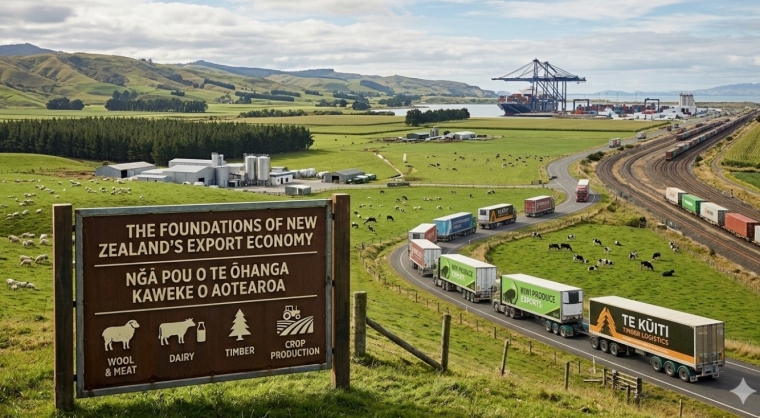
Image generated by AI

As we head into the November election, the key focus of political or parties seems to be tax, plus the need to work towards a balanced budget, plus whether election lollies can be funded. Entangled somewhere in amongst this are inflation, cost of living, unemployment and mounting infrastructure needs.

It is a story that presents a difficult and even depressing outlook. It seems that the best years could well be behind us.  Like Nero who fiddled while Rome burnt, are we missing the big picture? 

Unfortunately, the big picture includes that there are no easy answers. Neither of the main parties, nor for that matter the minor parties, are putting together the pieces of a rough-edged puzzle. It is much harder than they are acknowledging.

When I came back to New Zealand with my family at the turn of the century, after nearly 20 years overseas, I easily convinced myself that there were good years ahead.  New Zealand had just gone through 15 years of restructuring and economic pain. 

I did not like the amount of poverty that I was seeing here compared to Australia where I had been based, while also working further afield. However, I had expectations that our primary export industries were going to prosper and that this would underpin economic growth.

Until COVID arrived in 2020, things did work out that way to a large extent. It wasn’t all smooth sailing but the overall trend seemed clear. 

Between December 1999 and December 2019, national GDP grew by 77%. This gave an annual compound rate of increase of 2.9%.  After making allowance for the population increasing by 29%  over this period, per capita GDP grew by an annual compounding rate of 1.7%.

These figures are in constant value dollars after taking account of inflation, and are derived from Reserve Bank and Stats Department source data.

In the latest 6.5 years from December 2019 through to June 2026, our national economy grew by 10.0% in total, giving an annual compound growth rate of 1.5%. But our population grew by 7.8%, so per capita GDP rose by only 2.2% in total over this period.  On average, annual per capita GDP increased by only 0.3% each year.

In these recent years, the population grew rapidly, at 1.2% per year, very close to the rate at which it grew in the preceding 20 years.  But the economy has lagged behind.

Let me summarise by quoting the key outcome numbers again: per capita GDP rose, in inflation adjusted terms, by 1.7% per year for the 20 years following the turn of the century. However, it has on average only been increasing at 0.3% per year since December 2019.

This is a long enough period that we must question whether growth, at least on a per capita basis, has effectively become close to a long-term stall. We cannot explain this away as just a short-term economic cycle. 

Important questions also have to be asked as to how national income is shared among the population. A lot of working people would correctly argue that their own personal living standards have recently declined. They have not seen that 0.3 percent annual growth in GDP transferring to their own incomes. Also, they see no evidence this is going to change.

At a personal level, I have spent most of my professional life working within agriculture science and agribusiness, with a focus on the linkages between resources, economics, and value chains through to markets.   When I go to a foreign country, one of the first things I want to do is visit some supermarkets and see what people are buying.

MPI data tell us that primary industries currently comprise 82 percent of our merchandise exports. Then comes tourism and education as overseas dollars within services. There is not much else. Indeed that ‘not much else’ has been declining as a percentage of the total for the last 20 years.

I am also conscious that most agricultural product prices are currently either at or close to record levels. However, it cannot be assumed that these prices will be sustained. 

There was a time when high export prices would have flowed through into overarching economic growth, but that seems to be no longer happening to the same extent. Other things are getting in the way.

Much of the apparent growth in exports in the last ten years, when quoted in nominal New Zealand dollars, has been driven by the declining value of that dollar. Back in 2017, the New Zealand dollar was worth more than 80 American cents.  As I write this, it is worth 56.5 American cents.  Also, the New Zealand dollar was worth close to parity with the Australian dollar back in 2017. Currently New Zealand’s dollar is worth 81 Australian cents. 

If it were not for depreciation of the New Zaland dollar, our export prices in New Zealand dollars would be much lower. Of course, that same depreciation has also led to higher import prices. 

Our dollar has depreciated because economic growth has been low and inflation has been high. Our government accounts have been in annual deficit each year since 2019. As for the current account between New Zealand and the rest of the world, that has been in annual deficit every year since 1973!

These two deficits, one at government level and the other at national level, indicate that we have been living beyond our means for a long time. It’s a Ponzi structure. To date, we have ‘solved’ that problem by borrowing more and more.  We have also sold many assets. At some stage it has to stop.

With interest piling up from the deficits in both government accounts and our national current account, we use an increasing proportion of taxes to pay our internal debts, and an increasing quantity of export income to balance the financial outflows in the national current account.  We have got ourselves in a pickle.

At this point I need to reinforce the notion that in getting ourselves into a pickle, our internal economy has indeed become a Ponzi. The internal economy has outgrown our export economy, and can only survive, albeit in association with inflation, with more and more funds flowing in from overseas.  

There used to be a time when we could rightly claim our economy was export-led. However, right now, of 48 countries in the OECD, there are only four that have exports as a lower percentage of their economy than New Zealand.

There was a considerable period when our exports comprised more than 30 percent of the economy. For example, between 1998 and 2008 our exports comprised more than 30 percent of GDP each year. In 2001 and 2002 they exceeded 35 percent.   However, in the most recent five years from 2021 to 2025 they comprised an average of only 23 percent of GDP.

The decline in exports as a proportion of the economy might not matter so much if we were a large country with huge natural resources, plus a huge internal market, and huge manufacturing opportunities. But it sure matters if you are a small country at the far end of the world with an absence of critical natural resources, a small internal market, and no scale for manufacturing. 

There is simply no way we can economically manufacture cars, trucks, computers, electronic goods, television sets, most pharmaceuticals, and even whiteware. And that is just a start. There are logical reasons why our manufacturing sector is so small.

Looking forward, the big question is, with minimal manufacturing and resource-based industries constrained by nature, where might sustained growth come from in New Zealand? 

Twenty-five years ago, that question was easy to answer. 

Back then, I knew that there were considerable land-based opportunities that lay ahead for New Zealand’s primary exports.  Having first travelled through China in 1973, and subsequently undertaken commercial market research in China, I also knew that China was going to be particularly important as a market. However, I did under-estimate how quickly that might happen.

Alas, land-based opportunities are now much more constrained than they were 25 years ago. I know that because I am still closely involved in agricultural research and development. Yes, opportunities do exist, but the easy runs have all been scored.  It is going to be hard work.

At some time in the future, I will talk about the land-based work I am currently associated with, including its emphases on all of sustainability, economics, and well-being. But now is not the right time to do that.  I simply emphasise here that the easy runs have all been scored.

As for markets, much of our future remains in Asia, but many of those countries, such as China, Japan, Korea and Thailand now have declining populations. Others such as India, Malaysia and Indonesia have birth rates that have either dropped or are now dropping below long-term replacement rates. 

On the upside, India does have current economic growth in excess of six percent per annum, and Indonesia’s economy is currently growing at more than five percent. 

However, the challenges for New Zealand with India include that, despite current high economic growth, average living standards there are currently very low, with more than 60% of the population living in rural areas, plus they don’t eat beef for religious reasons, plus New Zealand and all other countries remain locked out of their dairy market. So, as for elsewhere in Asia, but for somewhat different reasons, India is going to be hard work for New Zealand.

Indonesia is somewhere that also faces huge challenges but we do need to work harder.

These facts all lead to very strong indications, that once again, there are no easy runs to be scored.

Given these facts, why is New Zealand’s population still growing rapidly? 

In part, it is because births still exceed deaths by around 20,000 per annum.  However, in recent years it has been net immigration, which takes account of New Zealanders leaving to live elsewhere, that has been the main cause of population increases.

If this situation continues, then it will have minimal effect on export volumes. This is because the major export industries are using less and less labour. It is natural resources, not labour, that are the big constraint for export products.

In contrast, the demand for imports will continue to rise in line with the population increase. This will lead to further depreciation of the New Zealand dollar and higher import prices. 

With ongoing use of the population pump, per capita increases in living standards will become close to impossible. We need to face up to this reality.

Of course, any population policy that reduces immigration will bring its own challenges. For a start, the short-term apparent benefits of a Ponzi debt-based economy will disappear. This reality will be painful. But the long-term benefits of a stable population in a resource-constrained world cannot be ignored.

I had planned to write a lot more about the significant challenges of moving to a stable population, but I have decided to leave that for another article. Here, I will finish by simply deploring the populism and partisan attitudes with which immigration policy so often gets entangled, including racist elements. 

Instead, I ask that we focus on the future realities of a small natural-resource constrained nation, distant from international markets, in a complex world of uncertainty and strife.


*Keith Woodford ONZM was Professor of Farm Management and Agribusiness at Lincoln University for 15 years through to 2015. He is now Principal Consultant at AgriFood Systems Ltd. You can contact him directly here.

We welcome your comments below. If you are not already registered, please register to comment

Remember we welcome robust, respectful and insightful debate. We don't welcome abusive or defamatory comments and will de-register those repeatedly making such comments. Our current comment policy is here.

41 Comments

It seems that the best years could well be behind us

It wasn't that long ago the economy was booming, unemployment at 3%, etc. I think it's a bit premature to assume this is permanent. 

Up
1

Once again we revert back to 2021/2022 to remember the ‘good times’. That period in time was an anomaly and likely never to be repeated.

Prior to that it was ~2006 when unemployment rate was around the 3% mark.

Up
6

Think? 

I don't associate that with your comments. Wish, is perhaps a better description. 

Keith has done very well here - getting close to the nub of the problem. Rebuttal should be somewhat more grounded in fact. 

The essence is the proportion of solar flux that society can capture, store, consume and discard (incidentally, the Andrew Coleman failure-to-grasp on a recent thread, too). Limitations are: night; clouds, angle; transmission loss; storage loss; usage efficiency; environmental repercussions; entropy. Sub-set limitations are resource-depletion/dissipation; reduction of FF EROEI; soil degradation/loss; biodiversity loss (and thus resilience loss overall). 

The best we have gotten in solar capture (ex lab) is around 25% - whether via photosynthesis or PV; mirrors/boiler/turbine; windmill or dam. Plus listed losses post-capture. This on a planet mostly water, somewhat mountainous, dually polar, etc etc. Summed up, there are hard limits, and we are an overshot population running into them. 

Waffling on about 'I think there's more growth in the system' (as I heard from a car-salesman/city councillor in Dunedin last year) is just bonkers. It just extends the overshoot and steepens the fall. 

A good read - regarding solar flux available per area, is David MacKay FRS: : Contents

On page 44, he works out that for Britain, biomass could deliver (2008 population numbers - will be worse now) 36kWh/d per person. From that, food is the priority (as Keith is getting to). He also lists the other conversion pathways. Try downloading it (it's free) and reading it. Then you might be able to opine with useful data. 

Up
5

Well, if you print $120b and spray it all over the place without creating anything productive, it is a warm fuzzy for all. Untill its not when the truth arrives (going broke and waking up owned by someone else).

Up
8

Go back before that then, it wasn't that long ago we were doing OK. And it wouldn't be the first time we've had a bad patch and come through it, they are called cycles. Perhaps this time it's different, but too early to know for sure. 

Up
0

Before Covid we were going backwards as well. August 2019 the RBNZ cut the OCR by 0.5% from memory. First time that was cut by that much for quite a while. It was only the money thrown around during/after Covid that stopped the decline, temporarily. Nothing structural has changed to improve the trajectory we were on. 

What was the "rockstar economy" predicated on? And how is that working out now?

Up
2

Keith has said what we already know, we have looked like a growing, successful economy by buying and selling housing to each other at ever increasing prices thanks to 30 years or so of lowering real interest rates, never to be repeated again. We are now in the conundrum of having a govt intent on starving the economy by trying to reduce spending, cutting jobs, failing to address the energy sector, and our dollar has tanked due to this, leading to increased input costs from fuel prices (currently surging once again), and an RBNZ who will add to the starvation with increasing the OCR. 
Until we admit that we have had 30 or so years of fake success, and lowering national resilience, we will not start coming to productive solutions. 

Up
9

We are missing an opportunity by not pushing harder to electrify. Bad actors have a way to hold the world hostage, and we have enough resources to reduce our downside from future shocks significantly. 

I think energy sovereignty is going to be key for us. 

Up
12

Agree. It might be hard to increase exports, but we could reduce imports, particularly fuel, and of course all the junk we import from China. 

Up
4

We could have "energy sovereignty" if only we'd abandon this ridiculous cult like addiction to growing like a yeast culture. 

Up
7

Agree. 

But I seriously doubt that will include a 24/7 unlimited-personal-demand grid. 

And it won't be 'cheap'. 


Up
3

Google Stump to pump!

Up
0

As always a good article from Keith. 

I do however think immigration is the only fix to an ageing population. Its not a very good fix, but I cant think of another. 

Up
0

Absolutely disagree. Continually growing population to pay for those aging before, is about the dumbest can kicking response possible. At some point when AI and robotics have removed all labour, who is going to pay all these immigrants to pay taxes to pay for ever increasing old people? 

So what is the fix? Grow up, expect, consume and waste less. Take personal resposibility for health and make junk food and other unhealthy vice prohibitively expensive, while tossing the lobbyists out on their ear!

I'm just quoting saturated media from the tech bros and their pet politicians and economists here. The real outcome will be societal collapse globally, initiated by resource depletion and overflowing waste sinks. 

Up
16

Like I said I don't think it's a good fix. But your solution of having half the country retired will be worse. What happens when the young people all leave the retirement country for somewhere better?

Up
1

Thew question isn't 'when', it is 'why'. The youth of today have the most access to the most information ever recorded, and as we humans are historically nomadic people who exploit resources, then move on to greener pastures, the youth will continue going where they see the greenest pastures are. If they don;t see NZ as worth staying then there's good reasons. We have, to a good degree, lost our sense of national identity since 2020, being more divisive, lower social cohesion, the culture of old is shifting and we don't know who we are anymore. The youth can do the math (or just ask AI now) on the amount of work it will take to buy a house here vs other places, or how much they could save in 1-2 years and they naturally see much faster roads to success elsewhere. They are mobile, confident with travelling given the social media age showing how easy it is, and many will head off and think back on NZ as to if it would be worth returning, do the math, and then work out that they can't see the cost is worth the benefit.

Up
5

Why do you think it's a good article if your "only fix" to an ageing population is in stark contrast to the gist of the article? 

Up
6

The article was more about export income and didn't really touch on the ageing population. So while I agree we may be better off with lower immigration in terms of balance of payments, we also need some people young enough to work. 

Up
1

It's not a fix - it's adding gasoline to the fire. 


Up
5

You can't fix an ageing population- they die, and usually with a long slow decline before the moment.

Up
2

In twenty years the bulk of boomers will have moved on..... and the children of millennials will be complaining about not being able to afford payments on their comfort robot because mummy and daddy, etc, etc.

Up
2

Thanks Keith. 

Agreed, quite the pickle. Short term thinking has a lot to answer for in our political leadership of any hue.

Up
11

An honest assessment

Up
9

Excellent writing! Thought provoking 

Up
7

DISCLAIMER - this is long - needless to say its dead easy to scroll past 

Keith Woodford Has Found the Ponzi - But Not the Machine Running It

IMO, Keith Woodford's latest assessment of New Zealand contains a rather extraordinary omision.

He recognises that something is fundamentally wrong. He identifies our chronic current-account deficits, collapsing per-capita performance, dependence upon population growth and debt, and even describes New Zealand as operating a "Ponzi debt-based economy" - absolutely. 

But having arrived at the scene of the grand fraud, he then appears remarkably uninterested in examining the perpetrators. Instead, the argument retreats into exports, immigration, population and natural-resource constraints, as though these are the fundamental determinants of New Zealand's economic future.

They aren't. They matter enormously, but they are downstream of something much more fundamental...

Who creates our money? Who receives the credit? What is that credit used for? Who owns the resulting assets? Where does the economic rent go? And why do we tax the productive economy so heavily while rewarding the financialisation of everything sitting on top of it?

Until those questions are answered, we don't have a snowballs chance in hell of fixing the structural problem.

Woodford Has Identified the Ponzi - But Not Its Engine

IMO, this is the gaping hole in his analysis.

Modern commercial banks don't simply collect Mrs Jones's savings and lend them to Mr Smith's engineering company. They create new bank deposits when they lend. That means the crucial economic question isn't simply how much credit exists.

It is where newly created credit goes - this distinction sits at the centre of Professor Richard Werner's Quantity Theory of Credit.

Create credit for productive purposes - machinery, factories, technology, infrastructure, working capital, new products and entrepreneurial enterprise - and you expand the economy's capacity to produce actual goods and services.

Create mountains of credit to purchase existing assets and you get something completely different.

You inflate asset prices.

You inflate land prices.

You increase household leverage.

You encourage speculation.

You transfer an ever-greater proportion of national income toward the financial and rentier economy.

And eventually you construct precisely the Ponzi debt-based economy Woodford is complaining about.

The huge irony is difficult to miss.

Britain Worked This Out More Than A Century Ago

Werner makes an extraordinary historical point in his recent interview with Peter McCormack. Britain has been scratching its head over its lousy productivity performance for more than a century. the remarkable part is that they essentially identified the underlying banking problem more than a century ago.

Werner points to the 1918 Colwyn Committee investigation into British banking concentration. By then the banking system had become dominated by the "Big Five." Contemporary concerns included inadequate finance for small firms and the failure of the large banks to provide the long-term investment lending required by productive businesses. The problem had been identified.

And what happened?

Essentially bugger-all.

Another inquiry.

Another report.

Another committee.

Another productivity review.

Another generation of economists wondering why Britain's productivity remained lousy. Meanwhile the banking system became even more concentrated. Werner's argument is brutally simple.

Big banks want big deals with big customers. Small banks finance small businesses. And small businesses employ an enormous proportion of the population.

Germany followed a very different path, retaining a large decentralised network of local savings and cooperative banks capable of knowing the businesses in their communities and financing the Mittelstand - the productive SME economy sitting underneath German industrial strength.

The distinction matters because financing a small manufacturer is not the same exercise as writing a mortgage over a house.

The banker needs to understand the business.

Its customers.

Its management.

Its machinery.

Its market.

Its cashflow.

Its prospects.

That requires relationship banking.

Destroy the small banks and you progressively destroy the financial ecosystem capable of performing that function. Britain has spent more than a century demonstrating the consequences.

And New Zealand appears determined to repeat the experiment.

Welcome To The New Zealand Banking Oligopoly

Four Australian-owned banks — ANZ, ASB, BNZ and Westpac — now account for 84% of New Zealand bank lending. The RBNZ says banks provide 94% of lending to households and non-financial businesses, while New Zealand-owned banks account for only 10% of bank lending.

That should be setting off alarm bells everywhere.

And the RBNZ's own 2026 examination of SME finance makes Werner's argument almost embarrassingly relevant to New Zealand.

It found that small firms receive a disproportionately low share of bank business lending relative to their contribution to economic activity and employment.

Of the $138 billion of SME lending examined, approximately 40% was agricultural and another 29% commercial property. The RBNZ itself notes that these sectors contain large tangible assets - farms and buildings - that can readily be financed with bank debt. It also found that some small-business owners resort to borrowing against their own homes to finance their businesses.

In other words, our banking system absolutely loves something it can put a mortgage over.

Land.

Buildings.

Farms.

Houses.

Hard collateral.

The young engineering company, specialist manufacturer, software developer, exporter or entrepreneur whose principal assets are intellectual property, customers, specialist knowledge and a bloody good idea presents a rather less convenient proposition.

And then economists wonder why New Zealand productivity is crap.

The Great Productivity "Mystery"

There is another conference.

Another Treasury paper.

Another working group.

Another economist solemnly informing New Zealand businesses that they need to become more productive.

With what?

Productivity improvement requires capital.

A small manufacturer cannot install a $2 million automated production line with positive thinking.

An exporter cannot finance inventory with a motivational seminar.
 
And an entrepreneur cannot commercialise a brilliant new technology without access to capital.

Businesses need appropriately structured productive credit.

And they particularly need working capital.

If the banking architecture overwhelmingly prefers collateralised lending against existing property because it is simpler, cheaper and easier to assess, we shouldn't be remotely surprised when capital gravitates toward property instead of productive enterprise.

The resulting low productivity isn't a mystery.

It is an outcome.

And this is where Woodford's export thesis starts running backwards.

Of course New Zealand needs a broader, higher-value export economy.

But who finances the businesses that are supposed to create it?

Where does the capital come from for higher-value manufacturing?

Where does the working capital come from?

Who finances commercialisation of intellectual property?

Who finances downstream processing of our agricultural production rather than simply shipping commodities offshore?

Who finances import substitution?

You cannot separate the productive structure of an economy from the credit architecture financing that structure.

Woodford wants more exporters.

Fine.

Who is going to finance them?

Then We Tax Whatever Productive Economy Survives

Having created a banking architecture overwhelmingly attracted to property and collateral, New Zealand performs another remarkable trick.

We heavily tax the economy that actually works and produces things.

We tax wages.

We tax company earnings.

We tax consumption.

We tax fuel.

We impose compliance costs and levies throughout productive economic activity. Meanwhile, accumulated asset gains and economic rents frequently receive extraordinarily favourable treatment by comparison - and so one side of the architecture encourages credit toward existing assets while the other extracts taxation from labour, enterprise and consumption.

Then we express astonishment when capital flows toward assets instead of productive enterprise.

You couldn't design a better mechanism for financialising an economy if you tried.

And Then The Rent Leaves The Country

Woodford correctly worries about New Zealand's persistent current-account deficits.

But once again, the interesting question is what sits underneath them.

At June 2026 New Zealand had a net international liability position of $178.3 billion, equivalent to 39% of GDP. Net external debt was even larger at $225.7 billion.

During the June quarter alone, foreign investors earned $7.4 billion from their New Zealand investments, while New Zealand investors earned $5.3 billion from investments abroad. The resulting primary-income deficit was $2.3 billion for that quarter.

That isn't some harmless accounting abstraction.

It represents accumulated foreign claims upon New Zealand's productive economy.

My own research suggests that when the various channels of foreign ownership, financial rent extraction, interest, profits and associated economic leakage are assembled, something approaching $40 billion annually can be removed from productive domestic circulation.

That $40 billion is merely my estimate - but the underlying phenomenon is hardly debatable.

We sell assets and import capital.

Then we export interest, dividends and profits.

Then we require more foreign capital to compensate for the leakage.

Then we borrow more.

Then we increase immigration to generate additional nominal GDP.

Then we need more houses.

Then the banks create more mortgage credit.

Then house prices rise.

Then we congratulate ourselves on becoming wealthier.

There's your Ponzi - population growth didn't build it - population growth merely helps keep the bloody thing running.

The Three Pillars Attack The Machine Rather Than Its Symptoms

This is why my proposed Three-Pillar Economic Architecture starts somewhere completely different.

The first pillar is a tiny Financial Transaction Tax, ultimately designed to replace the dog's breakfast of taxes currently imposed upon wages, productive enterprise and ordinary economic activity.

Stop punishing production.

Stop punishing employment.

Stop punishing consumption.

And shift the tax base toward the enormous transactional flows coursing through the financial economy.

The second pillar is a hard monetary anchor, based not merely upon gold but upon a diversified basket of durable commodities.

Money should ultimately represent a credible claim upon real economic value rather than an infinitely expandable political and financial promise.

And the third pillar - where Werner's work becomes absolutely critical - is the reconstruction of banking as a public-utility and decentralised productive-credit system.

New Zealand needs regional, community and specialist productive banks whose purpose is to finance the economy we supposedly want to create.

Banks capable of assessing the local manufacturer.

The engineering company.

The farmer developing downstream processing.

The exporter requiring inventory finance.

The technology company.

The entrepreneur with a brilliant idea but without a $3 million Auckland house to mortgage against it. This doesn't mean pretending that banks simply lend out somebody else's savings.

Werner has spent decades demonstrating why that textbook intermediary model misunderstands modern banking.

It means recognising the extraordinary power of bank credit creation and deliberately directing that power toward productive investment rather than allowing the dominant incentive to remain collateralising and inflating existing assets.

That is the distinction mainstream New Zealand economic debate continually misses.

And Now The Global Debt Machine Is Starting To Groan

There is another reason Woodford's analysis strikes me as extraordinarily myopic.

It implicitly assumes that the international financial architecture surrounding New Zealand will remain sufficiently intact for us to spend the next several decades tinkering with exports, immigration and productivity.

To me, that assumption is looking increasingly like a tragic pipe dream

The IMF reported this year that global public debt reached almost 94% of global GDP in 2025 and projects it reaching 100% by 2029. More importantly, it says interest payments have risen sharply as governments refinance maturing debt at higher rates, while structural changes in sovereign-debt markets are increasing vulnerability to repricing.

The BIS is now warning about near-record public debt interacting with increasingly leveraged sovereign-bond markets. It says government-bond liquidity can appear plentiful for long periods and then disappear rapidly during stress, driving borrowing costs higher and shrinking fiscal space well before some theoretical long-term debt limit is reached.

Read between the polite institutional language and the problem isn't particularly difficult to see.

Governments issue debt.

Old debt matures.

Governments issue more debt.

Persistent deficits require still more debt.

Higher interest costs increase future borrowing requirements.

That borrowing requires somebody willing to hold the paper.

And the entire structure ultimately depends upon confidence that tomorrow's taxpayers and tomorrow's productive economy can validate today's expanding pile of financial claims. This is where I part company completely with the comforting conventional definition of sovereign solvency.

The Printing Press Cannot Manufacture Wealth

Can the productive economy indefinitely carry the financial claims being accumulated against it? - NO.

Can governments trapped in chronic structural deficits meet all existing commitments without continually expanding their debt stocks? - No.

Can creditors ultimately be repaid in anything resembling today's real purchasing power if maintaining the system increasingly requires monetary expansion, financial repression or currency debasement? - NO.

And can the system continue indefinitely without an enormous pool of buyers prepared to absorb the sovereign paper required to refinance yesterday's liabilities while simultaneously funding tomorrow's deficits? - again, NO.

That, to my mind, is functional insolvency.

The conventional response is that a country such as Britain cannot technically become insolvent because it issues its own currency and can therefore always manufacture enough pounds to settle sterling-denominated liabilities - precisely, and that demonstrates how economically meaningless the conventional definition can become.

Of course Britain can manufacture pounds - the printing press can manufacture pounds. It cannot manufacture purchasing power, productivity or real national wealth. Nominal repayment is not the same thing as real repayment.

If yesterday's liabilities increasingly require tomorrow's borrowing; tomorrow's borrowing requires an ever-expanding sovereign-bond market, and preserving that market ultimately requires central-bank intervention, financial repression or monetary debasement, then telling me the country remains solvent because it can manufacture currency is an extraordinarily hollow definition of solvency.

It is a refinancing machine masquerading as solvency, and Britain provides the almost perfect warning.

More than a century ago it had already identified the banking concentration that was failing to provide appropriate finance to its productive SME economy.

It largely failed to fix it.

Instead came another report.

Another inquiry.

Another committee.

Another productivity review.

Meanwhile the productive economy continued weakening relative to the financial superstructure sitting on top of it. New Zealand would be monumentally stupid to spend the next century doing the same thing.

We Don't Primarily Have An Export Problem — We Have An Architecture Problem

Woodford has correctly identified many of the consequences of New Zealand's economic decline. Where I think his analysis fails is in confusing those consequences with their fundamental causes.

Exports matter.

Population matters.

Resources matter.

But underneath all three sits something considerably more powerful.

Who creates the nation's money?

Who receives the credit?

What does that credit finance?

Who owns the resulting assets?

Where does the economic rent go?

And which parts of the economy does government subsequently tax to keep the machine running? Until we answer those questions, arguing about whether New Zealand should have five million people or six million is largely rearranging deckchairs.

New Zealand doesn't suffer from a shortage of cows, tourists, immigrants or clever entrepreneurs. We suffer from a financial architecture that has spent decades rewarding the wrong economic activity while progressively starving the productive economy of the oxygen required to expand.

Keith Woodford has found the Ponzi. Richard Werner helps explain the machine underneath it. And Britain provides a century-long warning of what happens when governments identify that machine, write endless reports about it and then do Jack Shite to change it.

We don't need another century of reports explaining why our productivity is lousy - we need to stop financing the wrong bloody economy.

Up
12

Keith's Ponzi word count: 3

He's come over to the dark side. 

Up
5

Well articulated. 

There is however, NO, consensus on how to transform the economic model (architecture)

The Socialists and the Greens do not have the competency for realization of the problem and formulating a strategy

The right wing coalition is fragmented and the dominant National party lack any "Crown Jewels" for fundamental change.

We continue to Boil the Frog...............

Up
11

The Socialists and the Greens do not have the competency for realization of the problem and formulating a strategy

Have they been given the opportunity to demonstrate it given their lack of representation at scale in parliament? Genuine question. 

Up
1

  You certainly have a good handle on the way the unsustainable subset of the physical world that is the current iteration of what's known as the "human economy" operates Colin. 

Without going into the relative merits of punishing consumption and production in a bounded ecological system..........

"our banking system absolutely loves something it can put a mortgage over"

  Well yes it does. It's the lowest risk lending. Considering todays intangibles, such as intellectual property, more often than not are tomorrows bin liner. At the end of the day, when a bank creates money for lending, it's under the necessary proviso that a substantial proportion of these loans + interest are actually paid back.

 Small businesses do use property as collateral to fund their operations, because this is the cheapest form of borrowing. Operating capital? Sure the risk goes up and the risk return goes up. 

Up
1

Thank you, Palmtree. 

And that raises the question that Woodford doesn't pursue - what economic activity is being created from which those principal-and-interest payments can ultimately be serviced?

Up
1

Meanwhile the gaslighting continues. 

I would advise everyone to listen especially around 12:00 - IMO the bursting of these bubbles, and the global domino effect, is going to make The Great Depression appear like a walk in the park in comparison to this looming debacle.   

https://www.youtube.com/watch?v=HcUafM66zzY

Interviewer at 12:20... "This is how it all ties together, right/ - you have got yields rising across the board, an incedible, insatiable demand for capital - SoftBank just raised $11.5 billion and they paid 9.5% for it - with all these messes always coming in, how much is your picture changing day to day?"

Gamble... "The overall picture doesn't really change day to day - to be honest with you, I started this theory three years ago, that this is going to be the biggest sprculative bubble in history. I saw it atarting about in the summer of 2023, and everything I have seen since then has only reinforced that.

It has got so obscenely large now, that basically the entirety of the market, all stocks and bonds BTW - this is no longer just an equity thing - it is now spilling over into bonds - the hyperscalers exhausted their once immense free cash flow - that is now going negative for all but Micvrosoft. Now they are going into the debt market - they are issuing junk-d like SoftBank did - they are taking out private credit loans like Jensen Huang's magic display of moral hazard with his private credit CEOs on CNBC acouple of weeks ago when they announced that $500 pipeline that they were supposedly establishing.

And remember these are all companies that are already telling investors that you can't have your money back. Where are they getting this $500 billion for new projects from? So we have now exhausted all the income of the most profitable companies in history, who have changed virtually overnight from an asset light, cashflow heavy business to an asset heavy cash flow negative business. They have borrowed every dollar available.... "


⏱ 𝗧𝗶𝗺𝗲𝘀𝘁𝗮𝗺𝗽𝘀:
0:00 Coming up: the 1929 warning
1:11 Welcome, and who Jack Gamble is
1:26 The Warning Last Seen In 1929
4:00 Shoppers Are Running Out Of Money
6:52 The Whole Market Is One AI Bet
8:44 Oracle's Data Centre Stalls
11:41 Who Pays For OpenAI's Losses
16:08 Cheap AI Versus The Big Labs
21:54 Why Anthropic Is Listing Now
25:29 How Fast AI Chips Wear Out
28:16 Who Buys All The New Shares
31:52 A 40-Year Rise In Rates
33:51 Gold, Bitcoin And Rising Rates
37:57 El Niño And Food Prices
41:31 Is The US Already In Recession
43:40 Stocks Priced In Gold
47:39 The Yen Loans Behind AI
50:34 Gold Or Bitcoin, Or Both


⏱ 𝗧𝗶𝗺𝗲𝘀𝘁𝗮𝗺𝗽𝘀:
0:00 Coming up: the 1929 warning
1:11 Welcome, and who Jack Gamble is
1:26 The Warning Last Seen In 1929
4:00 Shoppers Are Running Out Of Money
6:52 The Whole Market Is One AI Bet
8:44 Oracle's Data Centre Stalls (boo hoo hoo, not - karma time perhaps Larry Ellison, where what goes around....)
11:41 Who Pays For OpenAI's Losses
16:08 Cheap AI Versus The Big Labs
21:54 Why Anthropic Is Listing Now
25:29 How Fast AI Chips Wear Out
28:16 Who Buys All The New Shares
31:52 A 40-Year Rise In Rates
33:51 Gold, Bitcoin And Rising Rates
37:57 El Niño And Food Prices
41:31 Is The US Already In Recession
43:40 Stocks Priced In Gold
47:39 The Yen Loans Behind AI
50:34 Gold Or Bitcoin, Or Both


Up
0

New Zealand doesn't suffer from a shortage of cows, tourists, immigrants or clever entrepreneurs. We suffer from a financial architecture that has spent decades rewarding the wrong economic activity while progressively starving the productive economy of the oxygen required to expand.

Keith Woodford has found the Ponzi. Richard Werner helps explain the machine underneath it.

Bookmark this insight. Werner should be covered in high school economics. Not even touched in Aotearoa universities.  

Up
3

"Who creates our money? Who receives the credit? What is that credit used for? Who owns the resulting assets? Where does the economic rent go? And why do we tax the productive economy so heavily while rewarding the financialisation of everything sitting on top of it?

Until those questions are answered, we don't have a snowballs chance in hell of fixing the structural problem."

Nailed it Colin!

I would add that I'm very pleased you've remained on as a contributor to these streams. The value in what you provide, even though as you admit they can be a little long winded, is immense. Without the extreme, emotional rhetoric you started out with, these are all good reads. And don't sweat the beginnings, I did that too.

Up
6

If we looked into creating a tax haven for medical research we could solve our health shortages and possibly become a world leader in new innovation. Offer the pharmaceuticals tax free status on the proviso X% of their research is done in NZ. Potential to bring in massive infrastructure and expert resources. 

Up
2

Western Civ. was a temporary thing, based on exponential growth on a finite planet. It is clearly hitting the limits, and it looks like we will hasten the decline by scrapping over 'what's left'. 

Western Civ. gave us MRI and syringes - we are facing the very real probability of those supply-chains collapsing. 

Medicine won't look like it does, and I suspect priorities might be different too. 

Up
2

Keith sure we are beyond "moving to a stable population"? Births are currently 25% below replacement. It is only longevity gains that is propping up the local population. Likewise dependency ratio was 8:1 when you were a lad, to 4:1 today, heading to 2:1 in short order. A lot less hands at the pump/bedpan. 

"With no migrant arrivals or migrant departures, New Zealand’s population is projected to peak at just under 5.5 million in the early 2040s then slowly decline as deaths outnumber births." 

https://www.stats.govt.nz/news/new-zealands-population-likely-to-reach-6-million-before-2040/

"Assuming the continuation of the current trajectory of our fertility and mortality (and even with some variation), the exponential population growth of the mid-20th century (doubling time of 37 years) is about to flip to an asymptotic decline, with the population halving every about 40 years."

https://insightplus.mja.com.au/2024/8/health-care-in-for-a-roller-coast…


Up
1

Great news population is possibly set to decline, albeit after much more destruction of the NZ natural environment. Just imagine all the BS jobs we can give up when there's no need to dash around like headless chickens fighting about what infrastructure project needs funding next, because, you know, grooooooowth......

Up
5

"Every time I post about falling fertility, someone replies: “Great for the planet.” I understand the intuition, but it gets the economics almost exactly backwards. To be clear: I am not arguing for explosive population growth. A gentle decline or stabilization would be my first choice. The problem is that we are not heading toward a gentle decline. We are heading toward a collapse. And a collapse changes everything.

Environmental protection behaves like a luxury good. As countries become richer, citizens demand cleaner air, cleaner water, and stronger climate policy. Prosperity creates both the willingness and the fiscal capacity to pay for these goods. This is not a theoretical curiosity. The modern environmental movement was born in California in the 1960s, when the state was among the richest in the richest country on earth. That was no coincidence. You need to be prosperous before you start worrying about the spotted owl. 

A sustained fertility collapse works in the opposite direction. As populations age, pension and healthcare costs rise while the tax base shrinks. Governments under that kind of fiscal pressure protect mandatory spending first because that is what voters scream about (I am from Europe, and I can tell you this is the case with 100% certainty). Environmental investment, which is largely discretionary, is the easiest to postpone. And it will be postponed, particularly in middle- and low-income countries. Environmental policy is not a costless virtue. It requires administrative capacity, long planning horizons, and resources. Lots of resources. Decarbonization alone demands trillions in public and private investment over the coming decades. 

Where will that money come from if the working-age population is shrinking and the dependency ratio is exploding? If demographic collapse erodes prosperity and fiscal space, and the evidence strongly suggests it will, it will not increase environmental investment. It will make it harder to sustain. So, if you care about the environment, I am sorry, but what is happening with fertility right now is terrible news."

https://x.com/JesusFerna7026/status/2026429295225086269

Up
0

Germany now has an average age of 45. To maintain that, with current birth rates, they need to import 2 million persons under the age of 25 every YEAR. Even then they still age just slower.

Try selling that one to the German electorate!!

Aging and declining populations are the new challenge as to sell goods, esp food and fibre, you need mouths to feed and house. Old people consume very differently to young ones.

Up
3

NZ has demonstrated by bringing in two immigrants for every baby born, for the past 25 years, that mass immigration is not the solution to below replacement birth rates. Now roughly a third of our population was born overseas, and as Keith points out, our recent economic returns are woeful. Throw batshit crazy net zero policy in the mix with a welfare state, and mass immigration, and here we are. 

The 78 (edit: now it is 83!) immigration accredited vape shops surprisingly aren't making the boat go faster.

Find employers who are approved to hire workers from overseas on an Accredited Employer Work Visa (AEWV) or other skilled work visa.

https://www.immigration.govt.nz/work/requirements-for-work-visas/approv…

"In other words, all immigrants that come to the US are below the 90th percentile and won’t help solve the fiscal woes created by low fertility. European countries that have the detailed databases required to compute these numbers carefully have found that not even the second-generation (i.e., the sons of immigrants born in the country) is a net contributor to the welfare state."

https://www.aei.org/commentary/rapid-fertility-decline-is-an-existentia…


Up
1

One of the resources NZ is over-blessed with is our EEZ.  It's massive in comparison to our land size and our population.

We have managed it appallingly - truly appallingly - over many years since its privatization.

That needs to change - desperately.

https://legasea.co.nz/2026/09/24/2026-election-policy-scorecard/


Up
2