
sign up log in
Want to go ad-free? Find out how, here.

Lending growth appears to be starting to slow for mortgages and business lending but farmers will be keeping the banks happy

Rural News / news
Lending growth appears to be starting to slow for mortgages and business lending but farmers will be keeping the banks happy
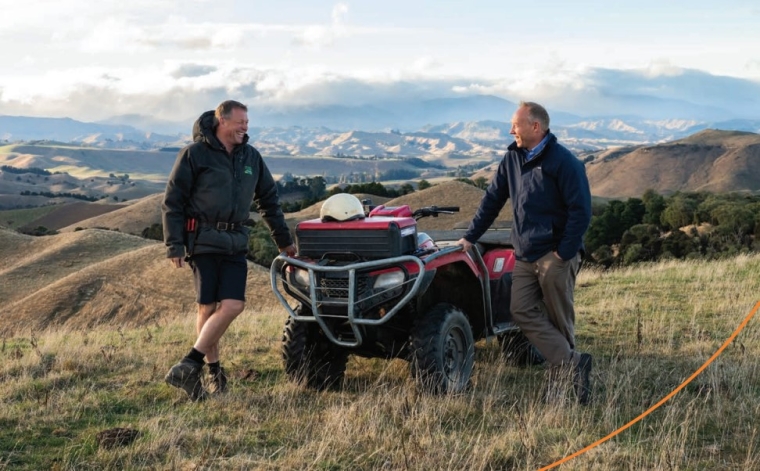
two farmers

Debt appears to be back in vogue down on the farm, with a strong turnaround in rural lending so far this year.

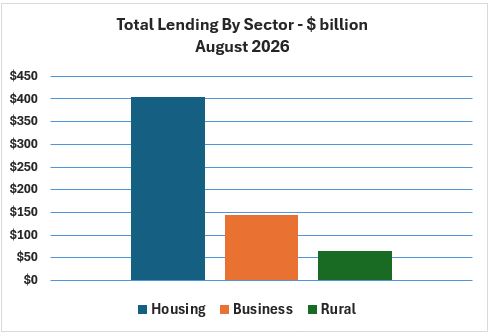
According to Reserve Bank (RBNZ) figures for August, the rural sector remains a relative minnow when it comes to debt, owing banks and other financial institutions $65.7 billion. This is a relatively modest amount compared to the $143.8b owed by businesses and the massive $403.3b owed on housing.

However, farmers get a big tick from the banks for being the most improved on the lending front this year.

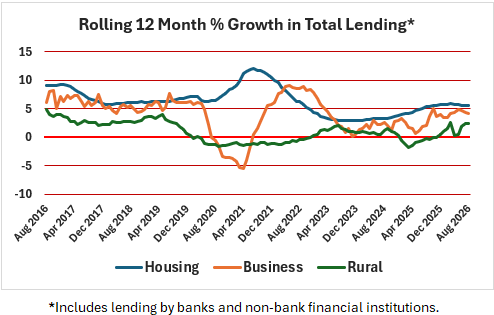
In the 12 months to August 2026, the total rural sector debt increased by 2.4%, compared to negative growth of -0.2% in the 12 months to August last year.

Total rural debt was declining for most of last year, with the annual growth rate fluctuating between -0.2% and -1.8% over the period from January to September, as many farmers preferred to pay down existing debt rather than take on more.

But annual growth in rural debt has remained in positive territory since December last year and this year appears set to have the highest overall annual growth in rural debt since 2019.

Lending to businesses has also been on the up, growing by 4.1% over the 12 months to August this year, almost double the 2.1% annual growth over the 12 months to August last year.

Since March this year, annual growth in business lending has been at its highest level since 2023, although there are tentative signs that the latest growth figures may be starting to get a bit wobbly, with annual growth levels declining for three consecutive months, from 4.9% in May to 4.1% in August.

Residential mortgage lending has also shown some growth, but there are signs that it is also slowing.

Over the 12 months to August this year, total lending on housing grew by 5.5%, up from 5.2% in the 12 months to August last year.

The annual growth in residential lending to August this year was also the highest it has been for that period since 2022.

But residential lending is also having a few wobbles, with annual growth declining steadily from 5.9% in March this year to 5.5% in August.

The Reserve Bank's monthly figures also suggest a decline in new mortgage lending is already underway.

So a banker looking for the sweet spot in the lending market at the moment should probably pull on the gumboots and head for the back blocks.


Rural debt

Select chart tabs

Source: RBNZ
Source: RBNZ

Business debt

Select chart tabs

Source: RBNZ
Source: RBNZ


We welcome your comments below. If you are not already registered, please register to comment

Remember we welcome robust, respectful and insightful debate. We don't welcome abusive or defamatory comments and will de-register those repeatedly making such comments. Our current comment policy is here.

13 Comments

Rural sector is the powerhouse of the NZ economy, particularly the South Island, producing real goods/services not buying and selling houses to each other. If only lending was more evenly weighted NZ Inc would be humming but sadly the Banks exist on the margins made from selling housing mortgages. 

Up
1

Most ag lending is much the same as for houses. Borrowing to buy land.

Both produce consumer goods ultimately, somewhere to lay your head at night, something to eat.

Up
2

"If only lending was more evenly weighted NZ Inc would be humming but sadly the Banks exist on the margins made from selling housing mortgages. "

I don't think that is correct. Interest rates for rural and business lending are higher than for residential lending (a reflection on risk). Lending to farmers and businesses is not based on availablility of money supply but rather the individual risk involved. 

Seemingly more an emotional statement rather than facutal. 

Up
0

Vast majority of that agriculture lending is for dairy - a sign that prices are high and returns are possible.

It is also important to note that new agriculture lending (drawdowns) in August 2026 was basically unchanged from August 2025 (at $1bn for the month) . Total lending is going up because of the interest that banks add to loan balances every month. If the world ended tomorrow and bank systems carried on running, outstanding agriculture loans would go up by around 6% per year!

The correct way to interpret the data is to say that loan repayments remain higher than new loan drawdowns, with interest added to balances driving the net increase in total loans outstanding. 

Up
2

My understanding is along those lines.

Biggest changes in dairy has been the ability with the mainland money coming in to do quite a bit of succession planning. The banks have been supportive but not enthusiastic with debt repayment.

Considering the profitability relative to past years you'd think there'd be a huge rush to debt.

Up
0

But how does that explain the years when annual growth in rural debt has been in negative territory, as can be seen in the second graph below the article?

Up
0

When repayments > (interest added + new drawdowns), overall loan balances reduce. Typically during times of low interest rates and investment. 

You see the same dynamic in housing loans too but rbnz publish the actual data in C35. In the UK, the bank of England publishes the net lending (drawdowns minus repayments) for all lending, which gives a better indicator of the economic oucture IMHO.


Up
1

Which is what was stated in the article: "Total rural debt was declining for most of last year, with the annual growth rate fluctuating between -0.2% and -1.8% over the period from January to September, as many farmers preferred to pay down existing debt rather than take on more."

Up
0

Sure, don't disagree, I am just saying that comparing overall loan growth across time needs to be done with caution as growth rates are a function of interest rates, drawdowns, and repayments. You can't conclude that demand for loans is up because outstanding loans are up or vice versa. Here's a decent estimate of drawdowns net of repayments. 

Up
0

I visited a farmer friend in the Manawatu-Whanganui region last weekend, he made no secret that he's currently doing very well.  I didn't know what a "station" was, lol, that was an eye opener for a city person like me.

Up
1

Sounds like there's plenty of NZ for you to explore if you weren't aware of that Yvil. I'd recommend the Rainbow road when it's open in the summer (Nelson Lakes National Park through to Hanmer Springs) which goes through some beautiful back country, however I'm not sure if your EV would have the juice to make it through, let alone the river crossings. Either way, a lovely adventure if you ever get to it.

Up
1

Thanks Interesting, I'm actually going to be in Nelson for a wedding in February, but' I'll fly there.  I know the South Island better then the NI because I lived there for longer, until I lost my house in the Chch EQ, then moved up to Auckland.  We used to go camping at McDonald's Farm just past Kaiteriteri, a beautiful part of NZ.

Up
1

take a fishing rod


Up
0
