
By Alex Tarrant
Overall farm profits before tax are forecast to rise 53.7% to NZ$6.916 billion by 2014/15 as revenues rise faster than interest payments, according to the Ministry of Agriculture and Forestry (MAF).
Interest payments made by the agriculture sector are forecast to rise 27% between 2011 and 2015 as interest rates rise, MAF said in its annual Situation and Outlook for New Zealand Agriculture and Forestry (SONZAF) report for 2011, released today.
Total gross revenue for the sector is expected to rise 32.2% from 2010/11 to NZ$32.149 billion by the year to March 2015, while final income for the sector once costs and interest payments are taken away, is expected to rise 53.7%. However forecast revenue increases from March 2012 are largely relying on a depreciating New Zealand dollar from the middle of that year, MAF said, pointing to Treasury forecasts. The NZ dollar hit a post-float record high of 83 US cents in the past week.
Treasury is forecasting the Trade Weighted Index will drop to 56 by the March quarter of 2015 from 71 now.
The global financial crisis in 2008 and 2009 had seen growth in credit to the agriculture sector fall away, while farm sales and prices declined, MAF said in the report. Falling land values had increased the sector's leverage, which left farmers reluctant to take on more debt.
In its latest Monetary Policy Statement for the June quarter, the Reserve Bank of New Zealand said farmers were using current high prices mainly to pay down debt, although the RBNZ expected to see the sector begin investing and spending again when debt was back at managable levels over the next year.
The numbers
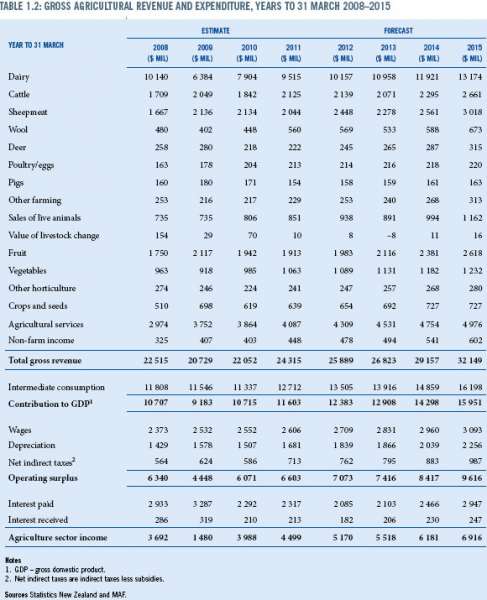
Interest payments made by the agriculture sector are estimated to have fallen 30% from NZ$3.287 billion in the year to March 2009 to NZ$2.292 billion in 2010 before rising again slightly to NZ$2.317 billion in the year to March 2011. MAF forecasts interest payments to climb another 27.2% to NZ$2.947 billion by 2015.
Total gross revenue produced by the agriculture sector is expected to rise 32.2% between now and March 2015 from NZ$24.315 billion to NZ$32.149 billion.
The sector is expected to produce an operating surplus, before interest payments, of NZ$9.616 billion in the year to March 2015, an increase of 45.6% from 2011. Taking off interest payments, total agriculture sector income is expected to rise 53.7% from NZ$4.499 billion in the year to March 2011 to NZ$6.916 billion in the year to March 2015.
See the full table from the MAF report below.
The crisis hurt
"Over the decade, to 31 March 2010, aggregate credit extended to agriculture by both banks and non-bank lending institutions grew at an average growth rate of 14% a year," MAF said in the SONZAF report.
"With the global financial crisis in late 2008 and 2009, when international credit availability became more restricted and the outlook for agricultural commodities worsened, agricultural borrowing, farm prices, and farm sales all declined significantly. Aggregate credit extended to agriculture by both banks and non-bank lending institutions was constant in the year ended 31 March 2011," MAF said.
"The decline in farm sales has reduced the equity withdrawal from the agriculture sector. This occurs with farm sales as older farmers with relatively high levels of equity are more likely to be selling and younger farmers with lower levels of equity are more likely to be buying," it said.
"Also, falling land values have, on aggregate, increased the leverage for the sector, which leaves farmers reluctant to take on new debt and increases the perceived riskiness of the sector to lenders. The fall in land values has been significant, with Quotable Value New Zealand’s total rural land price index at June 2010 18% below the peak achieved in June 2008."
Gross agricultural revenue was estimated to have increased by 10% in the year to 31 March 2011, driven by significant increases in dairy, cattle, and wool revenue.
"As a result of a later lamb slaughter in summer and autumn 2011, improving lamb schedule prices do not flow through to revenues until the year to 31 March 2012. Beyond 2012, increases in revenue are mainly driven by the assumption of a depreciating New Zealand dollar," MAF said.
"Aggregate interest paid by the agriculture sector has declined significantly since the year to 31 March 2009, primarily because of lower interest rates but also because the aggregate stock of agricultural debt has stopped growing. Interest payments are forecast to increase with assumed rises in interest rates and the relatively slow growth in the stock of debt," it said.
"Agriculture sector income, an aggregate measure equivalent to the overall agricultural sector’s farm-gate profitability, is estimated to have risen by 13% in the year to 31 March 2011. Further growth in income is expected as revenue rises faster than interest payments, in particular."
High NZ$ taketh away but also giveth
The SONZAF report said New Zealand agriculture exporters were receiving high prices for their wares as a rebounding global economy drove demand for commodities. However, it noted commodity prices had been driven upward partly due to suply disruptions in other parts of the world.
"Short-term supply disruptions such as droughts and floods in various parts of the world are a significant factor supporting recent agricultural price increases. At the same time, the strength of demand coming through from emerging markets, the recovery in many developed economies, and continuing demand for agricultural resources for biofuel production has led the Ministry of Agriculture and Forestry to revise upwards its view of medium-term international agricultural prices," MAF said in the report.
"The relative strength in the New Zealand dollar has seen only a portion of these foreign currency price gains passed through to New Zealand farmers and foresters. The strong New Zealand dollar has, however, also reduced the impact of price rises in imports, especially fuel and fertiliser," MAF said.
"Beyond 2012, steady production growth in dairy, forestry, wine and kiwifruit, together with an assumed depreciation in the New Zealand dollar, leads to strong forecast growth in export revenues."
Dairy outlook positive
Meanwhile, the outlook for New Zealand's dairy sector, which accounts for between a third and half of all agriculture revenue, was positive over the next four years, MAF said.
"MAF estimates that milk solid production will increase by 2.4% for the year ending 30 May 2011, 5.7% for the 2011/12 season and 2.9 and 1.2% for the following years," it said in the report.
"Dairy export revenue for the year ending 30 June 2011 is estimated to be NZ$13.0 billion. Increased milk solid production, along with high dairy prices, is forecast to increase export revenue for the year ending 30 June 2012 to NZ$14.6 billion, or 12%. Further out, export revenue is forecast to increase by another 6.9% for the year ending 30 June 2013, with more gradual increases thereafter," MAF said.
Dairy prices
International dairy prices had been increasing since the middle of 2009 but had not yet reached the highs of 2008, with butter being the exception. Since mid-2010, butter prices had increased faster than all other dairy product prices. Most other commodity prices had also increased rapidly in recent months, fuelled by strong demand.
"The outlook for dairy demand in 2011 is robust, based on both rising incomes and population growth in developing countries," MAF said in the report.
"Dairy products, especially milk powders, are in strong demand in developing countries like China, underpinning high international dairy prices. Increasing world oil prices should also support strong demand, and thus high international prices, for dairy products from oil-exporting countries, like Venezuela, United Arab Emirates and Saudi Arabia. These countries are already important dairy export markets for New Zealand," MAF said.
"An assumed return to average weather and high international prices is expected to encourage higher milk production in the major producing and exporting economies, such as the EU, US and Australia, lifting world dairy production beyond 2011. Producers in the US are already responding to high dairy prices by increasing exports and production, despite high corn prices," it said.
High corn prices were expected to moderate production growth in countries that mainly used feed-based systems but the additional product available should ease some of the pressure on international prices over the medium term.
"The milk price for the 2010/11 season is estimated at NZ$7.50 per kilogram of milk solids, 9 cents short of the historic high of three seasons ago. International dairy prices improved as the season progressed, lifting the milk solid price," MAF said.
"MAF forecasts the milk price for the year ending 31 May 2012 at NZ$6.87 per kilogram of milk solids. This price reflects the assumption of softening international dairy prices as world supply starts to respond to increasing world demand," it said.
"Beyond 2012, the assumption of a depreciating New Zealand dollar drives most of the lift in the milk price, which is projected to be NZ$8.64 per kilogram of milk solids by the year ending 31 May 2015."
(Updates with link to full report)
We welcome your comments below. If you are not already registered, please register to comment
Remember we welcome robust, respectful and insightful debate. We don't welcome abusive or defamatory comments and will de-register those repeatedly making such comments. Our current comment policy is here.