
By Alex Tarrant
Dairy export revenue will fall by almost ten percent next year as prices weaken, production stays static and as the New Zealand dollar remains strong, the Ministry for Primary Industries (MPI) says.
In its latest annual Situation and Outlook for Primary Industries, MPI said New Zealand’s dairy sector currently faced weakening international prices as a result of the European debt crisis and expanding global milk production. Prices were expected to ease further in the 2012/13 season, although the longer-term outlook for the sector was positive.
Steady growth in domestic production and increasing prices as a result of good demand from emerging markets, and an economic recovery in developed countries would support returns out to 2017.
"Dairy export revenue is expected to reach NZ$13.9 billion for the year ending 30 June 2012, 5.6% higher than the same period last year, buoyed by strong production," MPI said.
"As a result of the high exchange rate, low prices and static production, export revenue is forecast to decrease by 9.2%, to NZ$12.6 billion, for the year ending 30 June 2013. Export revenue is then predicted to reach NZ$17.0 billion for the year ending 30 June 2016 with an expected rise in domestic production, recovering international dairy prices and a depreciating New Zealand dollar," it said.
The European debt crisis and expanding milk supply across all major dairy exporters had seen international dairy prices fall since June 2011, MPI said.
The world's four largest dairy exporters – New Zealand, the US, the EU, and Australia – all increased milk production in 2011/12. In addition, Argentina, Uruguay and Chile, which dominated the South American market, each had double-digit growth rates in milk production.
"Weak domestic demand and low exchange rates in both the EU and US will increase supply of dairy products from these countries. This could exacerbate the expected weakening in dairy prices throughout the year," MPI said.
Butter prices had declined more than the price for milk powders, reflecting the different economic conditions in the markets that demand butter.
"Developed countries, which have been worst hit by the debt crisis, predominantly demand fat-based products such as butter and cheese. Emerging markets typically demand milk powders, which has helped prevent a collapse in milk powder prices," MPI said.
Dairy prices were expected to recover during the latter years of the outlook period (to 2017) as increased demand from emerging markets caught up with the increased supply, and a global economic recovery supported demand in developed countries.
"Southeast Asian countries, OPEC members and Russia are the dominant importers of butter and milk powder. Their positive economic outlook, driven by high GDP growth rates or high oil prices, is expected to support increased demand in the medium and long term, contributing to the recovery of dairy prices," MPI said.
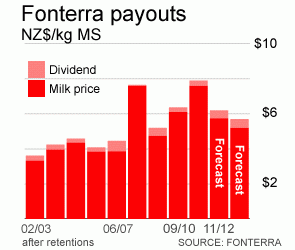
"The domestic farm gate milk price is expected to be NZ$6.08 per kilogram of milk solids in the 2011/12 season, 20 percent lower than the previous season. This is attributed to the strength of the New Zealand dollar against the US dollar, as well as the weakening international dairy prices. As the high exchange rate and low dairy prices are expected to persist into the 2012/13 season, the outlook for the farm gate milk price is NZ$5.73, a further decrease," it said.
"Beyond 2013, the assumption of a depreciating New Zealand dollar and recovering international dairy prices lift the farm gate milk price, which is projected to be NZ$7.83 per kilogram of milk solids by the year ending 31 May 2016."
More soon.
We welcome your comments below. If you are not already registered, please register to comment
Remember we welcome robust, respectful and insightful debate. We don't welcome abusive or defamatory comments and will de-register those repeatedly making such comments. Our current comment policy is here.