
Electricity prices for residential customers will rise for the next five years, after the Commerce Commission's draft decision to allow the national grid owner Transpower to increase its maximum allowable revenues by 43%.
The increase is smoothed by the Commission over five years. It is going up by 15% per annum for the first two years, and then by 5% for the remaining three years of the five-year timeframe, for a total of $5.8 billion.
For residential customers this will result in roughly an additional $15 a month on their bill, or $180 a year. That's for the first year, starting April 1, 2025. Over the four years after that, the Commission says monthly bills will increase on average by $5 annually.
The Commission adds the increases to household electricity bills will differ depending on location. Some areas will see increases of $10 a month on average, whereas in others bills will go up by an average of $20 a month.
While rising power bills is unwelcome news for consumers, the Commission says without the slower revenue recovery, price increases would be around $25 a month or $300 a year.
It's not just Transpower that'll be allowed to increase its allowable revenues: the Commission is proposing local lines companies can increase their earnings by 50% compared to the preceding five years, for a total of $12 billion.
Again, the Commission wants the increase to be smoothed, with a 24% hike in the first year, and then gradually increasing over time. How much exactly will be allowed depends on how regional growth unfolds.
“Some companies have forecast that they require an increase in investment that is as much as three times higher than their historical spend. The regulatory regime has a bespoke process to consider these large step changes in investment. This customised process is designed to give greater confidence through more detailed information, greater scrutiny, and an independent expert review," Commissioner Vhari McWha says.
Several factors are driving the revenue and ultimately, price increases. Transpower and local lines companies face higher costs and more expensive borrowing and materials, as well as inflationary pressures since the last revenue review that took place in 2019.
Older electricity distribution assets built in the 60s and 70s need to be maintained and replaced, and there is population growth and the electrification of transport and industrial process heat to factor in.
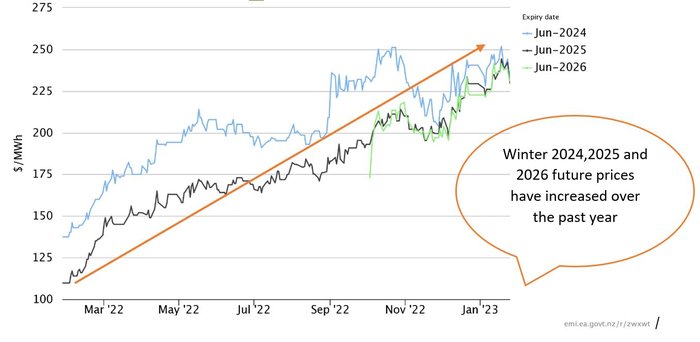
The Electricity Authority noted in 2023 that despite some 2600 giga-Watt hours annually of renewable energy generation is forecast to be online over the next few years, it comes from intermittent sources. For that reason, electricity spot prices over the winter period in particular are projected to remain high due to tight supply and the need to start up fossil-fuel generation to meet peak demand.
Energy Minister Simeon Brown said in December demand is forecast to increase by two-thirds by 2050, and added that the Government will make it easier to consent wind, solar and geothermal renewable energy projects to drive investment in new generation.
Commissioner McWha says maintenance and improvements to the electricity network now "will help keep the lights on in the future".
“As an essential service for all Kiwis, the affordability of electricity is important. We’re conscious that for consumers to get the electricity network they need, more investment is required. That’s why we’re proposing to increase the amount of revenue Transpower and local lines companies can earn," McWha says.
“However, we haven’t allowed for all of the expenditure that they forecast. We’ve taken the additional step of spreading the recovery of revenue by Transpower and local lines companies over a longer period to soften the impact of initial price increases on consumers,” she adds.
The Commission's draft decisions for Transpower and the local lines companies will now go into consultation over June and July, before a final decision is made in November.
We welcome your comments below. If you are not already registered, please register to comment
Remember we welcome robust, respectful and insightful debate. We don't welcome abusive or defamatory comments and will de-register those repeatedly making such comments. Our current comment policy is here.