By Mark Laurence*
Artificial intelligence (AI) is here, and it isn't going away. The choice in front of us is whether New Zealand and New Zealanders will be equipped for it, or surprised and steamrolled by it.
Why this exists
AI is already at work in New Zealand. It's in the software reconciling a builder's invoices, it's helping a GP write up notes, and it's in the homework our kids are handing in. Over the next few years it will reach deeper into almost every job and every organisation in the country, and the pace is not going to slow down while we catch our breath.
A lot of what's coming is genuinely good. Work that swallows whole days getting done in minutes. Small businesses with capability that only big companies could afford last year. Some of what's coming will be hard, too. Jobs will change shape faster than the people in them are being helped to keep up, and the gains won't spread themselves fairly on their own. That's the whole reason we wrote this.
None of it asks New Zealand to do something it has never done. About 25 years ago, in response to the "knowledge economy" it could see coming, this country gathered its public, private and academic leaders in conference for several days, brought in some of the best international thinkers, and asked how New Zealand should evolve around what was arriving. It moved things. There is a proposal at the end of this document for doing it again.
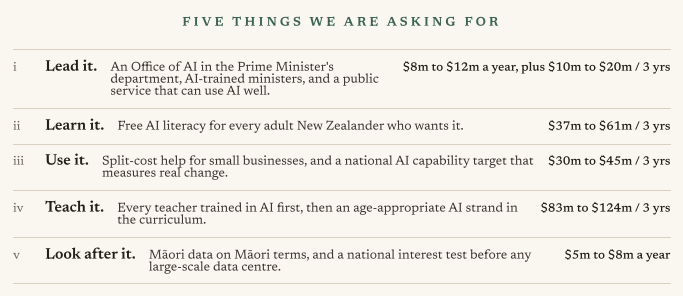
Together these five pillars come to roughly $200 million to $310 million over three years.
Which money, rather than whether there is any
The government's own AI strategy leans on a Microsoft estimate that AI could add $76 billion to our GDP by 2038. So we are asking for well under half a per cent of the opportunity our own national AI strategy has already put a number on. In Budget 2025 the government reprioritised $613.5 million from within the education vote alone. At the lower end, what we are asking for comes to $66 million a year. Less than half of what the government already moved inside the education budget alone, without anybody calling it "new spending."
Lead it · an Office of AI, and a government that goes first.
Someone has to own AI in our country. Right now nobody does cleanly. An Office of AI inside DPMC, the way Australia did in July, with an independent review point five years in. Twenty hours of hands-on AI training for every minister and chief executive, and an AI capability programme for the public service itself: about 65,000 people, $10m to $20m over three years. Nobody can lead a change of this scale that they have only been briefed on.
Learn it · free AI literacy for every adult New Zealander.
The market reaches the companies big enough to have someone whose job AI is. It isn't reaching the sole trader, the high school teacher, the ward supervisor, or the 58-year-old who's just been told their role is changing. We have done the alternative before: Digital Boost, about $57 million across its life, independently evaluated, and it worked. The costing assumes a million adults take it up over three years, providers funded on results, and a published number every year for how many are using AI at work afterwards.
Use it · back small businesses to actually use AI properly.
Split-cost vouchers so a small business can get proper help getting started with AI. 97 per cent of New Zealand businesses have fewer than 20 employees, and they are who this is for. Then a national AI capability target that means something: a business can name a meaningful process AI has changed, show you before and after, and say whether it built efficiency, productivity or innovation. Three questions you can answer in a minute, that can't be confused with buying a subscription.
Teach it · teachers first, and properly.
Fund every teacher to learn AI properly, with release time so it happens in work hours: $400 to $600 per teacher a year, against the $138 million of professional learning New Zealand funded in 2024/25. ERO's own recommendations ask for a national framework, teacher capability building and centrally provided tools. Then an age-appropriate AI strand: AI covered only lightly up to Year 6, safe AI tutor access from Year 7, and assistive technology protected at every age. Schools and workplaces also need to go both ways, repeatedly, so students see how the work they are walking into is changing.
Look after it · our languages, knowledge, data, water and power, on our terms
Adopt the Māori Data Governance Model and the Māori AI Governance Framework as the standard for public sector AI, rather than commissioning something similar three years later. And a national interest test before any data centre at the Makarewa scale is consented, with the criteria published, iwi and the local community at the table, and conditions on operators along the lines Australia has set. To be transparent, we do want data centres built here. Done right they bring investment and benefit New Zealanders.
What should happen next · one conference, a short clock.
This document exists to start the conversation before the election. The conference should happen after it. Whoever forms the next government should stand up a national AI conference inside its first hundred days, convened out of the Prime Minister's office and co-chaired so government and the private sector share the leadership. The room should be representative of the country: employers, Māori leadership, educators, worker representation and the public service. And it should run the way a wānanga runs, with Māori leadership co-designing the process, not just attending it.
Ninety days after it happens, an interim set of priorities and first actions, published. Six months after, a full costed national plan with named owners. A year is the traditional timeline, and it is too slow. Nobody involved in writing this document should be running it or sitting on it.
*This document was written by Mark Laurence in his own time. He runs an AI training business, so he has a commercial interest in some of what it asks for, and he isn't going to pretend otherwise. If any of what it proposes gets funded, it should go to open, contestable process, and his company can compete on the same terms as everyone else, or not at all.
The full version of the document is here.
Who helped? Specialists in each of the five pillar themes were asked to pull the thinking apart, and they all changed what had been written. Reviewed with input from Professor Frank Scrimgeour (Economics, University of Waikato), Brett O'Riley (former CEO, the EMA), David Irving (former CEO, Wattie's NZ) and Dr Tim Gander (Director, FutureLearning).
We welcome your comments below. If you are not already registered, please register to comment
Remember we welcome robust, respectful and insightful debate. We don't welcome abusive or defamatory comments and will de-register those repeatedly making such comments. Our current comment policy is here.