

The strong profits of New Zealand's banks puts them in a good position to earn their social licence by supporting customers through taking a long-term perspective in times of stress in their lending books, the Reserve Bank (RBNZ) says.
In the RBNZ’s May Financial Stability report, Governor Adrian Orr said the financial system was well placed to handle higher interest rates and global economic disruption.
The banking system’s capital and liquidity positions were strong, with profitability and asset quality remaining high. This will allow financial institutions to take a long-term perspective and support customers through economic challenges, Orr said.
The RBNZ said the benefits of profitable banks were apparent in the current environment, where banks will be able to manage increased stress on their loans as economic conditions deteriorate.
The central bank signaled that retail banks should use their profitability to support customers through the difficult times, as high interest rates start to result in mortgage defaults.
“Therefore, profitability puts banks in a position to earn their social licence by contributing to a sound, efficient, inclusive, and dynamic financial system”.
A social licence to operate refers to the ongoing acceptance of a company or industry's standard business practices and operating procedures.
Strong profitability questioned
Bank profits in the pandemic-era have been controversial. The National Party and the Green Party have both called for a select committee inquiry, while the RBNZ’s chief economist has said a Commerce Commission market study might be appropriate.
The financial stability report, however, said bank profitability was only high in nominal terms, and was about average once adjusted for inflation and economic growth.
Nominal profits grew in 2021 and 2022 as the economy boomed, it said, this was aided by few loan defaults and higher net interest margins.
During the pandemic years, large monetary and fiscal stimulus allowed New Zealanders to park large sums of money in bank deposits which offered very low interest rates.
Deposits are a high quality source of funding for banks and having high levels of cash allowed them to fund lending without relying on more expensive wholesale funding.
Rates on short-duration deposits, such as transaction and on-call savings accounts, have not increased as quickly as the Official Cash Rate and the interest income banks earn on their assets.
“Consequently, these deposits have become increasingly profitable sources of funding relative to term deposits or issuing debt in wholesale markets,” the central bank said.
Customers have been slowly transitioning back into term deposits as interest rates have risen, but competition for deposits has been mild as banks already have lots of cash and demand for loans has softened.
Really profitable
However, measuring profitability in nominal terms hides the impact of inflation and the growing size of a business. Return on assets and return on equity are more useful measures, the Reserve Bank says.
Bank balance sheets have grown since 2020 due to economic growth and lower dividend payouts to shareholders.
“As a result, the return on assets and return on equity are at similar levels to those in the decade prior to the pandemic,” the RBNZ said.
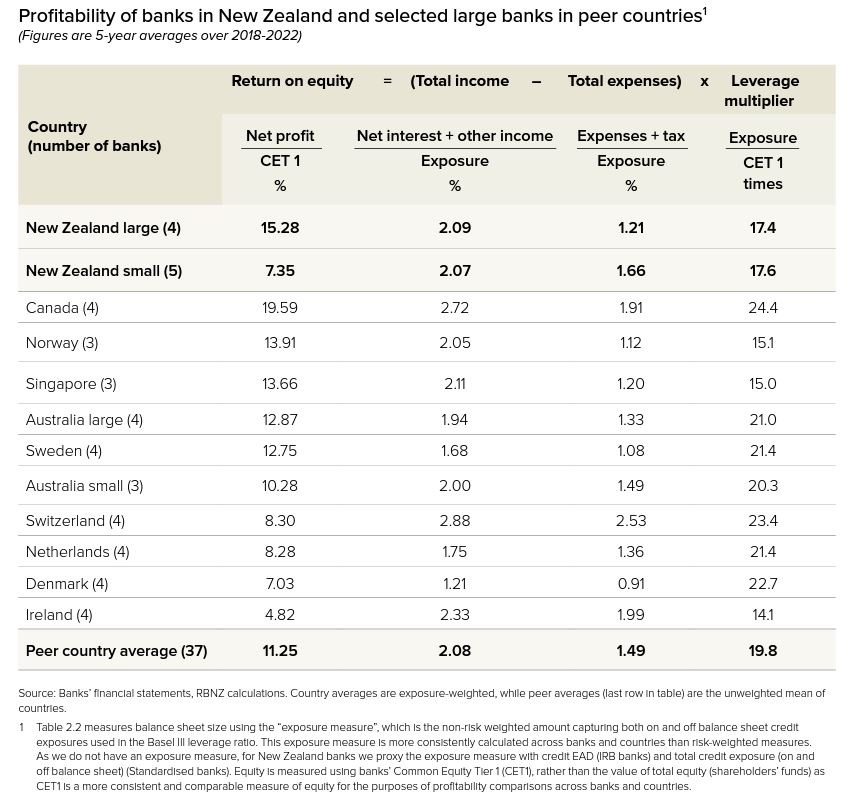
While large NZ banks are not “materially more profitable in 2023” than in the past 30 years, they have long been more profitable than most in comparable economies.
The RBNZ outlined a number of possible reasons for the higher profitability of NZ banks including: higher levels of risk, a lack of competition, economies of scale, and Australian shareholders requiring higher returns to cover tax costs.
Whatever the reason, large New Zealand banks earn a 15.3% return on equity, compared with an 11.3% average in peer countries. Australia’s average was 12.9%, Canada was 19.6%, and Ireland was 4.8%.
We welcome your comments below. If you are not already registered, please register to comment
Remember we welcome robust, respectful and insightful debate. We don't welcome abusive or defamatory comments and will de-register those repeatedly making such comments. Our current comment policy is here.