
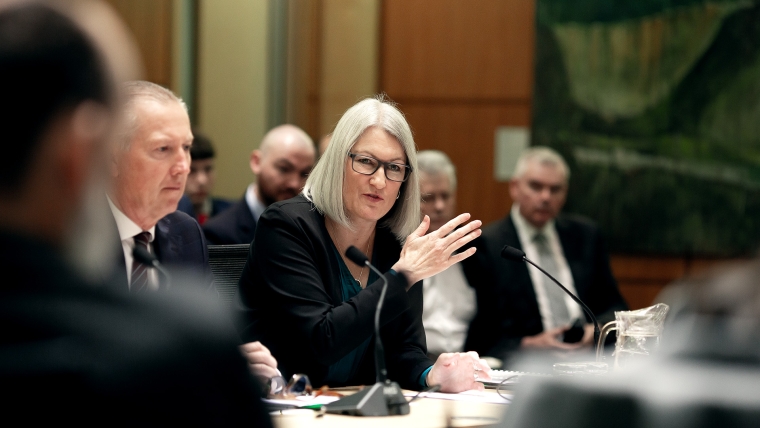
Chief executive of ANZ New Zealand, Antonia Watson says profitable banks are enablers of a successful economy and its return on capital is the minimum required to attract investment.
The leader of the country’s largest bank faced questions from a joint session of Parliament’s Finance & Expenditure and Primary Production committees on Wednesday morning.
It was the first hearing in a banking inquiry which will run for the next month and scrutinize the sector’s profitability and treatment of rural customers.
National Party MP Catherine Wedd asked Watson how she could justify pulling in a $2 billion profit when customers, farmers, and homeowners were doing it “really, really tough”.
She held up a chart from the Commerce Commission’s banking study which showed New Zealand banks were more profitable than other comparable ones overseas.
Watson said the banks which were not in the top quarter of profitability were often ones that had experienced deep economic crises and weren’t covering their cost of capital.
“Do we want to compare ourselves to their rung of countries in the middle who have experienced banking crises, whose banks are trading at below their book value?” She asked.
“We are a big importer of capital into NZ, which we need to grow the economy, we need to provide our shareholders a fair return on that capital … to be worth investing here”.
Another National Party MP, Ryan Hamilton, asked whether ANZ had made any concessions to share the burden of high interest rates that were being experienced by households.
Watson pointed to support offered to communities after recent natural disasters, but said the bank wasn’t able to insulate households from higher interest rates.
“I think you're asking if we should not have raised interest rates over the time the interest rates have been raised by the Reserve Bank. If we had done that [inflation would not have fallen],” she said.
It is also true that the bank would have been able to operate if it didn’t lift its rate in sync with the central bank and wholesale markets. However, it could have slimmed its margins slightly.
Milking farmers
Members of the Primary Production Committee also questioned Watson, and ANZ’s board chairman Scott St John, about the perception farmers were being poorly treated by big banks.
Labour MP Damien O’Connor asked St John—who recently finished a long stint at Fonterra—whether he was now “milking farmers” instead of cows.
“Because with such a high level of debt, the interest rates you are charging, and the inflexibility that we hear from farmers; do you think you have perhaps set this up?”
Suze Redmayne, a National Party MP from Rangitīkei, said one in five farmers claimed banks weren’t allowing them to structure their debt in the most efficient way.
Watson said staff were highly trained to correctly structure debt and did not encourage farmers to use overdraft facilities, which charge higher interest rates, for capital expenditure
Excess profit tax
Chlöe Swarbrick, the Green Party co-leader, asked about a Commerce Commission allegation banks were quick to increase interest rates for borrowers and slow to lower them.
Rates go “up like a rocket and down like a feather”, she said, which was also an allegation leveled against petrol retailers during a market study in 2019.
Watson disagreed with this finding in the Commission's report. She said ANZ had been “very quick to respond” to the last two cuts to the Official Cash Rate, and would never hold off adjusting rates just to make more profit.
The last question came from FEC chairman Stuart Smith who brought up Watson’s recent public support for a possible extension of capital gains tax, and suggested a tax on banks instead.
“I noticed you've had some comments on alternative revenue streams for the Government … did you consider a corporation tax surcharge on large bank profits, as is the case in the UK?”
Watson said “excess profit” taxes around the world had only been implemented when there was an event which had caused unusually high returns.
“I think our submission and what we've talked about today has made it clear that we don't make excess profits. We are roundabout at our cost of capital — which is the minimum an investor would choose to earn to keep their money in New Zealand,” she said.
After the hearing, Interest.co.nz asked Watson whether this question was intended to be a threat but she did not think so.
We welcome your comments below. If you are not already registered, please register to comment
Remember we welcome robust, respectful and insightful debate. We don't welcome abusive or defamatory comments and will de-register those repeatedly making such comments. Our current comment policy is here.