

As global financial stability risks continue to increase, the Reserve Bank (RBNZ) is warning cyber incidents are becoming an increasingly common feature of the financial sector’s operating environment.
According to the RBNZ’s latest Financial Stability Report, conflict in the Middle East and geopolitical tensions pose risks to global growth, while government bond yields and “still-stretched valuations”, particularly among AI-related firms, are leaving financial markets vulnerable to a correction.
These global risks could adversely affect NZ through weaker export demand or higher import costs, and more expensive or less accessible offshore funding, the RBNZ said.
“So far, resilient trading partner growth, in part supported by AI-related investment and relatively favourable conditions in funding markets, have helped contain these risks. However, global economic growth remains uneven and fragile.”
Despite these risks, the central bank believes NZ’s domestic financial system remains “resilient and well placed” to support the economy.
“While the global economic environment is uncertain, our financial institutions remain well placed to withstand financial market turbulence and support the economy,” RBNZ Governor Anna Breman said.
AI is ‘rapidly changing’ cyber threats
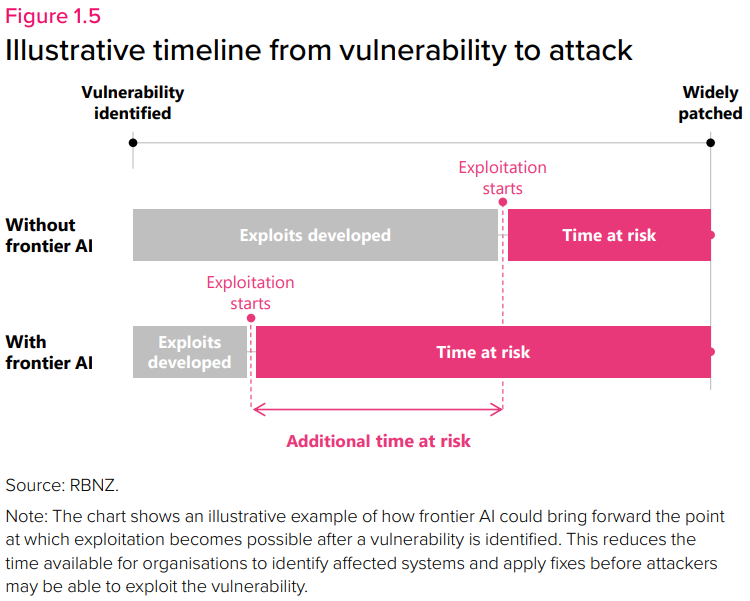
Cyber incidents are becoming an increasingly common feature of the operating environment, the RBNZ said, with frontier AI models “rapidly changing” the cyber threat landscape, according to the report, as AI is making information theft, scams and malware development faster, cheaper and easier to scale. These models are accelerating attacks and reducing the time available to address software vulnerabilities.
The RBNZ said as cyber threats evolve, “strong operational resilience and coordination” across the financial sector and with public agencies will be critical.
This is because a significant cyber incident could disrupt critical financial services, undermine public confidence and have widespread effects, particularly where institutions rely on common technology providers.
The RBNZ found more capable AI models are reducing the time and expertise required to exploit vulnerabilities once they are identified, which in turn is leaving financial institutions with less time to detect threats, apply fixes and contain attacks.
However, at the same time, the RBNZ thinks AI could help strengthen cyber defences by improving threat detection, monitoring and incident response.
“Financial institutions need to keep strengthening cyber defences and their ability to maintain critical services and recover quickly when disruptions occur. Cooperation across industry and with public agencies is increasingly important,” Breman said.
The RBNZ said it is working with the Financial Markets Authority, New Zealand’s National Cyber Security Centre (NCSC), the Department of the Prime Minister and Cabinet and industry to strengthen sector-wide cyber incident resilience.
Five Eyes cyber security agencies, including the NCSC, have called for organisations to strengthen their preparedness for cyber risks associated with frontier AI.
“Preparedness is important for financial stability because not every cyber incident can be prevented. Financial institutions need to be able to continue providing critical services and recover quickly when disruptions occur. This requires strong operational resilience, including by managing third-party risks,” the Reserve Bank said.
The RBNZ’s Operational Resilience Standard, which is being rolled out as part of the Deposit Takers Act that’s coming into effect in December 2028, supports these objectives by requiring deposit takers to identify critical operations, set impact tolerances and strengthen their ability to withstand and recover from disruptions.
We welcome your comments below. If you are not already registered, please register to comment
Remember we welcome robust, respectful and insightful debate. We don't welcome abusive or defamatory comments and will de-register those repeatedly making such comments. Our current comment policy is here.