

Net core Crown debt will keep rising until it peaks at 43.9% of GDP in 2027/28, the latest fiscal and economic update before the election forecasts, down from a predicted 46%.
With Treasury releasing its economic update on the country's fiscal position on Tuesday, Treasury Secretary Iain Rennie revealed net core Crown debt as a share of GDP is forecast to begin to fall during the Pre-election Economic and Fiscal Update (PREFU) forecast period.
Net core Crown debt is now expected to increase from 41.0% of GDP in 2025/26, to 43.7% of GDP in 2026/27. Then it is forecast to peak at 43.9% of GDP in 2027/28, before slowly slipping below the 40% mark in 2030/31 to 39.5%.
The 43.9% figure is lower than May's Budget forecast, where Treasury predicted debt to rise to 46.1%.
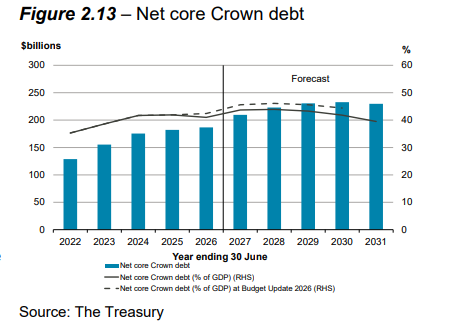
With one-off factors such as the Reserve Bank's Funding for Lending Programme (FLP) repayments, the timing of tax receipts and increase in circulating currency contributed to minimising the growth in debt for this year, there was still a “pronounced increase in net core Crown debt expected in 2026/27," the Treasury document stated.
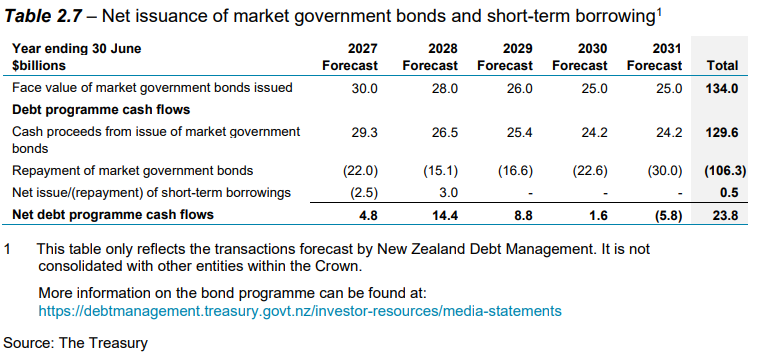
An accumulated residual cash deficit remained, Treasury said, with the overall cash shortfall mainly funded by issuing government bonds. Overall, the programme was forecast to provide net funds of $23.8b to cover the residual cash deficits and maintain the Crown liquidity buffer.
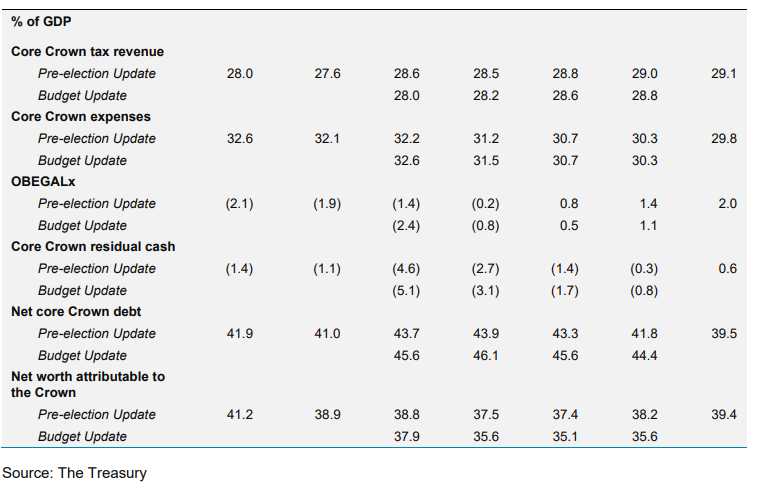
Rennie described the country's fiscal position as "largely a tax story," due to tax outturns being higher for 2025/26, compared to what was forecast.
"In addition, the lower debt starting point from 2025/26 means that lower debt levels offset the impact of higher interest rates on finance costs and lifted interest rates in these projections, given trends that we see in global bond markets."
Government borrowing
Finance Minister Nicola Willis said from next year, new government borrowing "will be for capital investment only, including for hospitals, schools, roads, the justice sector, defence and social housing."
"The government's operating cash balance will be positive next year," she said. "The government's accounts are prepared on an accrual basis, but we borrow to meet cash needs. This may be too much accounting to throw into the mix, but what it effectively means is that in the current financial year, this is the last year that the government will be borrowing to pay for groceries."
This is contingent on the forecast panning out, dependent on a range of factors such as the policies in place and the government of the day, and different risks such as weather events and global influences having potential impacts.
Bonds
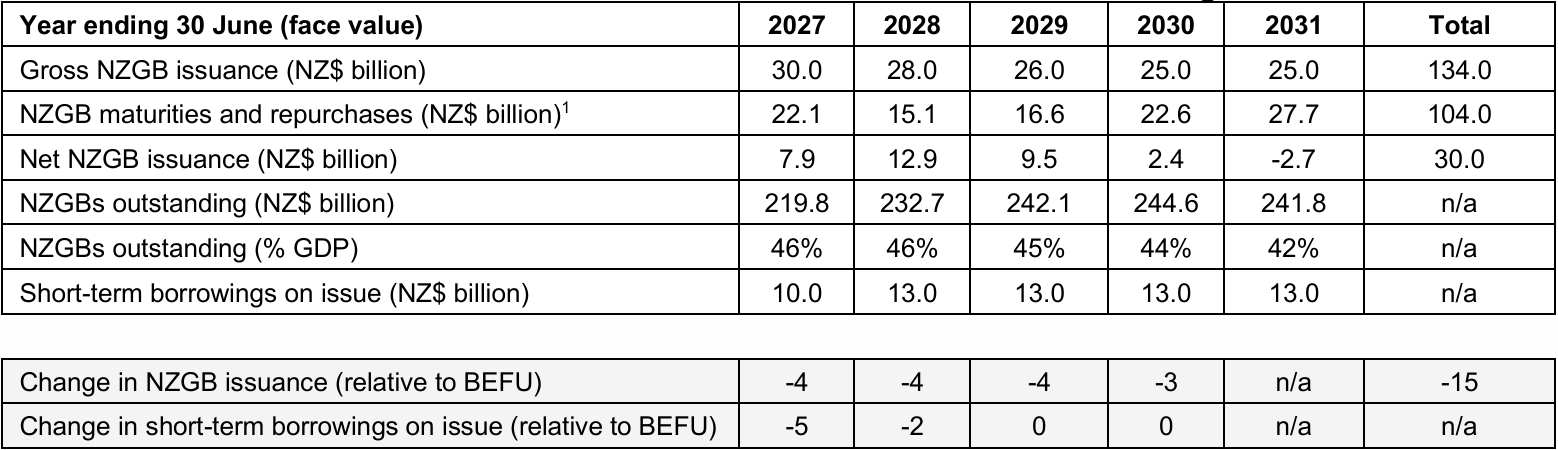
The government bond programme was reduced by $15b over the forecast period out to 2031 versus the Budget 2026 forecast, including by $4b in 2026/27 to $30 billion. Treasury said net issuance in 2026/27 would be below the level of residual cash deficits, "reflecting the planned transition to a lower liquidity buffer and smoothing of the government bond programme across years."
'Utterly exposed to the global bond market'
Rennie said Treasury was still trying to work through the implications of the significant rise in interest rates globally.
"It is clear that we are moving from a very low interest rate environment that we saw between the global financial crisis and COVID, and that is an implication for fiscal projections going forward," he said.
Willis said the situation in the global bond market underscored "why it's so important that at this time New Zealand takes significant steps to reduce our debt."
"It is worth noting that the interest rate forecasts in the PREFU were updated on the 21st of August, but relative to that date, New Zealand yields are now roughly 30 to 40 basis points higher across the [yield] curve."
"It's also worth noting that while offshore bond yields, such as US Treasury's, are currently at their highest level since 2007, New Zealand government bond yields have not risen as far," Willis said.
"In fact, our 10-year bond yields are currently lower than a few years ago. New Zealand 10-year rates are currently 5.12% and as recently as October 2023, they were 5.55%."
Tax take
Tax revenue, particularly from businesses, was been higher than expected.
“It’s not because of new or larger taxes, but because New Zealand businesses have been doing better than anticipated. This is what we all want to see,” Willis said.
“Many of these positive effects, including higher business tax and boosted revenue, are expected to flow into future years as well.”
She said the update showed the operating balance deficit shrinking from the $11.4b forecast at the Budget to $6.8b this financial year, and to less than $1b next year.
We welcome your comments below. If you are not already registered, please register to comment
Remember we welcome robust, respectful and insightful debate. We don't welcome abusive or defamatory comments and will de-register those repeatedly making such comments. Our current comment policy is here.