By Morgan Edwards*
The 2026 Election Campaign is in full swing. We’ve been bombarded with fiscal plans and policy proposals and claims from all parties, 1300 of them, by some estimates. These have been met with those inescapable election time questions: how will you pay for it and where is the money coming from?
While we can’t expect a full explanation of the mechanics of government finance every time a question like ‘where will you find the money’ comes up, unless you ask me or can read my mind, it is something we should work towards understanding.
Let’s start with this: these questions asked of politicians do not reflect the reality of how government spending works. The government is not like a household which means that how it spends is quite different to how you or I spend.
While this is a simple proposition, it might be difficult to grasp.
One way we can grasp this is by observing the behaviour of the government’s bank account, the Crown Settlement Account.
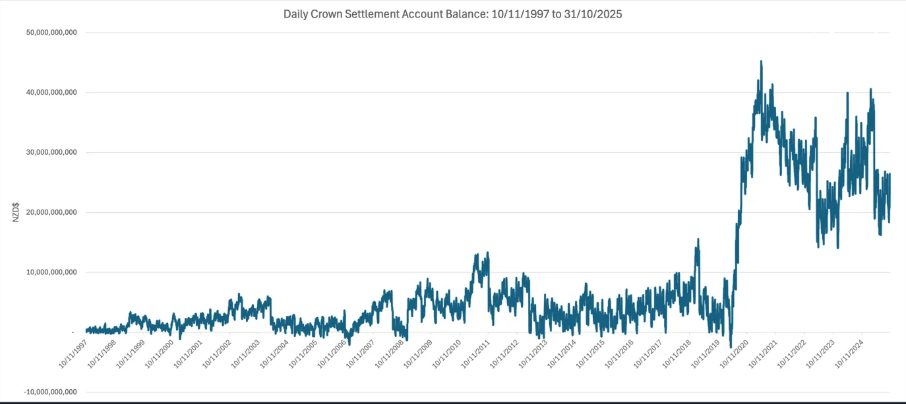
As part of my PhD research into understanding the mechanics of government finance, I’ve made a few Official Information Act requests (OIAs). One of those requests was for daily Crown Settlement Account balances. After waiting patiently for a few months, New Zealand Debt Management (NZDM) sent me daily Crown Settlement Account balances from 10 November 1997 to 31 October 2025. This is 7949 days of data.1 You can look for yourself here.
Numbers can hide a lot of extremely important background information and processes. This data is no different. For example, it doesn’t tell you the underlying processes of how the New Zealand Government spends money.
The data does, however, tell you that the New Zealand government’s bank account has been negative (or ‘overdrawn’) 272 times since November 1997.
Put simply, the New Zealand Government’s bank account has ‘run out of money’ (gone below zero) 272 times before, and you never even realised.
Cat’s out of the bag now!
Inside the Black Hole of Public Finance
Generally, an overdraft is considered a form of short-term lending. If my bank account goes negative after I do some online shopping, then I have to repay that money to Westpac.2
The same is said for the government. When the government spends too much and their account goes negative, then they ‘borrow money from the Reserve Bank’. This is considered the ‘classical way in which governments can ‘print money’ to finance their activities’. However, this leads to inflation – so it is a big no-no.
Obviously, the reality is quite different.
The Crown Settlement Account (CSA) is an account of all the Crown’s settlements (transactions). Former Reserve Bank Assistant Governor Christian Hawkesby explained the Crown Settlement Account like this:
When the Government receives taxes, or sells a bond or bill, it produces an inflow into its bank account. Conversely, payments of welfare benefits, interest on Government bonds or repaying the principal of a bond as it matures, produces outflows from the CSA.
So, the balance of the Crown Settlement Account is made up of all the government’s (Core Crown!) revenue - which includes all taxes and bond issues - minus expenditures.
However, the balance of the Crown Settlement Account has no impact on the New Zealand Government’s ability to make a payment.
Why?
Because the Government’s transactions have happened before any funds have been moved to or from the Crown Settlement Account.3 I’ll go into these processes another day.
So, right off the bat, the Crown Settlement Account overdraft obviously isn’t an overdraft in the traditional sense. The Crown Settlement Account ‘overdraft’ just means that the account has become negative. The only difference is that there’s a minus sign in front of the number.4
This leads us to the daily Crown Settlement Account data.
The Crown Settlement Account has been negative 272 times since November 1997.
That doesn’t sound like that much as 272 out of 7949 days is only about 3%, However, it is in an international context. No other advanced economy shows these kinds of negative balances. This is because most other countries legislate against any type of ‘central bank lending’. In 1992, the Reserve Bank said that ‘legislating against Reserve Bank funding of Government was unnecessary given the rest of the statutory framework for the Bank’. Remember, central bank ‘lending’ to the government is instantly inflationary.
Of course, this legislation is all for show to maintain ‘credibility’ and enforce ‘responsibility’.
While the New Zealand government’s account has become ‘overdrawn’ 272 times, there was no inflation as a result. The sky didn’t fall in either. The best thing to do is just not talk about it.
There are sizable numbers in this data too. The Crown Settlement Account has been below zero in excess of $500 million 77 times, in excess of $1 billion 31 times, and in excess of $2 billion nine times. Here’s a breakdown of negative balances in excess of $50 million from fiscal year (FY) 1997.
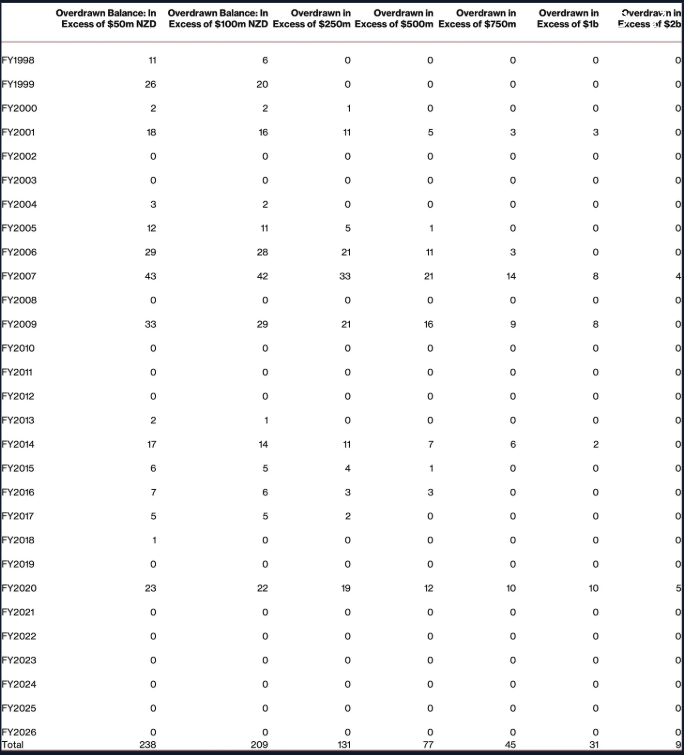
Most of these 272 negative balances have never been reported in any Treasury or Reserve Bank (RBNZ) annual reports. The exceptions make the story weirder.
First, Treasury reported on page 52 of their 2018 Annual Report that ‘sufficient cash was available at all times to meet the Government’s outlays such that there was no requirement during the year to use the RBNZ overdraft facility’.
This is incorrect.
The data shows that the CSA was negative on Thursday the 11th of January 2018 by -$83,646,580.
In 2020, the Reserve Bank and Treasury reported that the overdraft was used briefly in mid-April following the 15 April 2020 bond maturity.
This is only partially correct.
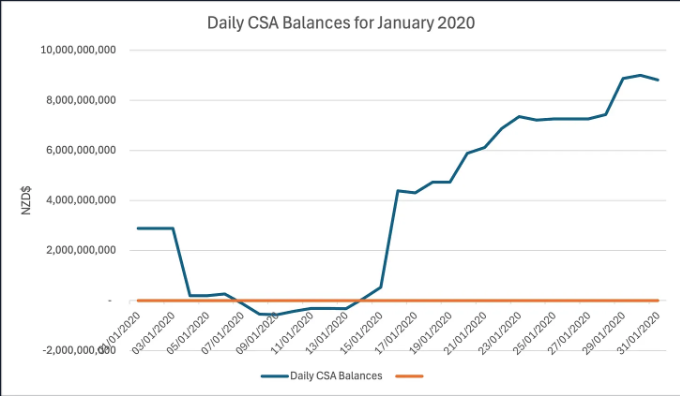
While it was used briefly in mid-April following the April 2020 bond maturity, it was also used frequently before. Specifically, it was negative for seven days in January (from the 7th to the 13th) and for five days from April 10 to April 14.
Here’s a graph for January 2020.
And here’s a graph for April 2020.
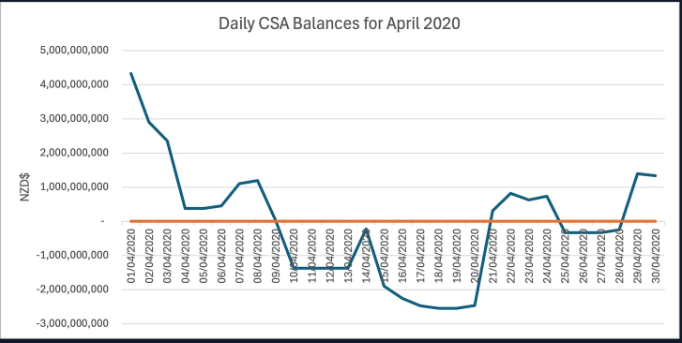
Here’s something that really blew me away. Seven out of 17 New Zealand bond maturities have been met through the Crown Settlement Account going negative.5 This one gold nugget of information single handedly dispels the notion that government debt will leave a burden for the grandchildren. Repaying government debt has never been a burden and it never will be. It is just business as usual.6
Finally, 49% of negative Crown Settlement Account balances were during the Fifth Labour Government. What was this period most known for? Oh yeah, the Cullen Surpluses. Michael Cullen noted in his Ministerial Statement in the 2007 Financial Statements of the Government of New Zealand that:
The Government’s fiscal position is strong [and] is the result of the Government’s commitment over the last three terms to reduce debt and more recently build up financial assets’.
Relatedly, my favourite example of the Crown Settlement Account going negative is between November 2006 and January 2007. There were 62 business days between 1 November 2006 and 31 January 2007. The Crown Settlement Account was negative for 37 of them.
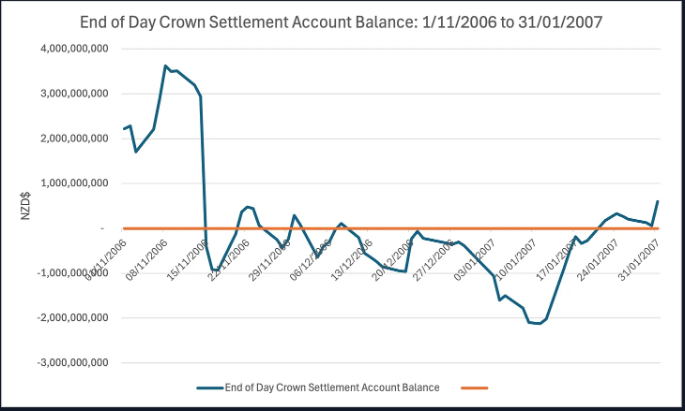
It was negative initially after a $2.775 billion New Zealand Government Bond Maturity on November 15 2006, dropping from a balance of $2,941,773,697 ($2.9 billion) on the 14th of November to -$406,259,954 on the 15th of November. It bounced around a bit after, largely staying below zero.
It became really negative in January 2007, dropping below minus $1 billion for eight days between January 3 and January 12. It was negative by $2 billion between the 9th and the 12th of January. Treasury and the Reserve Bank had ‘quite a detailed discussion […] about the use of the overdraft in December 06/January 07’. The contents of that discussion have been redacted under the OIA to ‘avoid prejudice to the substantial economic interests of New Zealand’. You can read about the bits that aren’t redacted in this OIA release.
Just to remind you - all of this happened in the context of ‘a strong fiscal position.’
I think that this data reflects a fairly brutal reality. The mechanics of government finance in New Zealand are so obscured that, even if these 272 negative Crown Settlement Account balances were reported, no one would know what the hell the Crown Settlement Account was anyway. Perhaps more damningly, no one would ever question it being negative.
It may be perplexing, confusing and mind-melting, but the data shows one very simple fact: A negative Crown Settlement Account doesn’t show that the Reserve Bank is lending to the government or that the government has run out of money.
What it does show is that there is no situation where government will run out of money to pay for things.
I Fought the Law and the Law Won
All government expenditure is a creature of law. In other words, once Parliament has authorised expenditure, that expenditure is legislatively bound to occur, unless that legislation is revoked of course. The law will always win.
An even simpler way of putting this is that there is one source of government expenditure, and that’s Parliament.
The entirety of the mechanics of government finance cannot be unpacked in a single Substack post. Needless to say, there is a high degree of nuance here. For instance, it is perfectly legitimate to say that the government should be smaller and leave the provision of services to private providers (i.e., the market). This is, however, an ideological position.
It is not legitimate to say that the government will run out of money or that debt incurred today will be a burden on the grandchildren.
The data shows us that this isn’t true.
The Crown Settlement Account data shows that yesterday’s tax income doesn’t equal tomorrow’s expenditure. Austerity is a political choice - plain and simple.
If you want to set yourself a fiscal target, or have the other side set it for you, then that’s great. Well done you. When it comes to the government making a payment, that target means absolutely nothing. It does, however, have implications for the future delivery of services. It seems like the election has turned into a contest of who can underfund public services with a nicer smile.
This data shows us that we shouldn’t be asking ‘how will you pay for it’. The questions we should be asking are ‘how will you find the resources to enact your policies’, and ‘can we afford to continue with this current policy prescription’.
- Treasury have provided me with 7949 different days in total. These 7949 days are comprised of business days only up until late 2016. After this, they’ve given me every day (including weekends and public holidays).
2) I bank with Westpac. The Government does too. I get certain services from Westpac. The Government gets its own specialised services too. We’ll talk about those another day - they aren’t so relevant here.
3) Just to avoid any doubt, understanding the mechanics of government finance (and in this case, the overdraft) doesn’t simply mean or show that the government can create money to meet its expenditure requirements. It does show that government’s do create money to meet their expenditure requirements. All government expenditure is, in fact, money creation. Government expenditure occurs entirely independently of income from taxation and bond issuance.
4) It is worth pointing out here that, when its positive, the Crown Settlement Account is a liability of the Reserve Bank and an asset of the Treasury. This is because the Reserve Bank pays interest on positive Crown Settlement Account balances. When its negative, it becomes an asset for the Reserve Bank and a liability for the Treasury. This is because the Treasury pays interest on overdrawn (i.e., negative) Crown Settlement Account balances. My friend coined the term SHort-term Intermittent Transfer (SHIT) to describe this. It is also worth taking the time here to understand that, ‘for the consolidation of the Government financial statements the CSA is eliminated’. This is from page 103 of the latest Financial Statements. It is eliminated because it is a corresponding asset/liability between components of the Core Crown segment, which includes the Treasury and Reserve Bank. In other words, through the magic of accountancy, the balance of the government’s bank account is always precisely zero.
5) These include a $2.450 billion NZGB maturity on 15 July 1998 after which the CSA was negative for 10 days, a $3.050 billion NZGB maturity on 15 February 2000 after which the CSA was negative for two days, a $2.675 billion NZGB maturity on 15 February 2001 after which the CSA was negative for nine days, a $2.825 billion NZGB maturity on 15 February 2005 after which the CSA was negative for four days, a $2.600 billion NZGB maturity on 15 February 2006, a $2.775 billion NZGB maturity on 15 November 2006 after which the CSA was negative for four days, and a $5.290 billion NZGB maturity on 15 April 2020 after which the CSA was negative for six days. You can have a look through government bond data here.
6) Remember that under sections 65ZH(1)(c) and 65ZH(1)(d) of the Public Finance Act 1989, the issuing and repayment (redemption) of government securities is authorised under permanent legislative authority. Parliament has already approved every single dollar that will be used to ‘pay back debt’.
*Morgan Edwards is a PhD Candidate at the University of Otago. This article was first published in his Substack here, and is used with permission.
We welcome your comments below. If you are not already registered, please register to comment
Remember we welcome robust, respectful and insightful debate. We don't welcome abusive or defamatory comments and will de-register those repeatedly making such comments. Our current comment policy is here.