

The industry body for chartered accountants says the Government's Covid support measures such as the wage subsidies have had unintended consequences of propping up businesses that might have failed in "normal times".
And the accountants say there's now a "national insolvency cliff looming" with the end of various support measures coming.
Chartered Accountants Australia and New Zealand (CA ANZ) business reform leader Karen McWilliams said the wage subsidies, various tax relief measures and a ‘safe harbour’ from insolvent trading for directors had achieved their overall aim of keeping Covid-hit businesses "at least ticking over".
"But they have had the unintended consequence of also propping up some businesses which would have failed in the natural course of events."
Insolvency figures for July and August show that the number of liquidations in those two months were in fact far lower than in the same months in each of the two previous years. And this at a time when the country has plunged into a deep recession.
The figures, from RITANZ (The Restructuring Insolvency and Turnaround Association New Zealand) showed there were 122 new liquidation appointments in August, down 14% on the same month in 2019. In July 2020 there were 117 new liquidation appointments, down 28% on a year earlier.
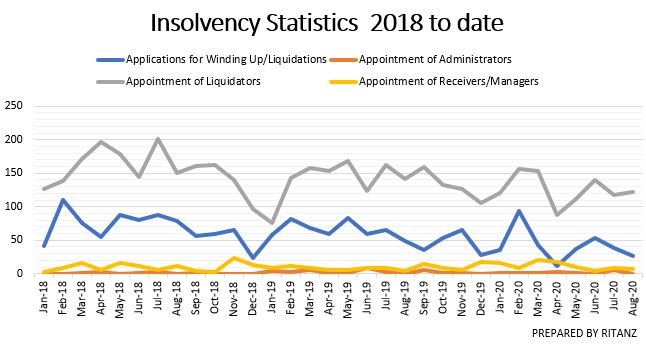
McWilliams said the liquidation statistics, "backed up by reports of looming large-scale closures in certain sectors such as hospitality", represented a significant problem not only for those immediately involved in these businesses, "but for the economy as a whole".
“A reality check will be coming for some once the various forms of Government business support are turned off,” she said.
She's urging Kiwi businesses surviving on Government Covid-19 support – and that may otherwise have fallen into liquidation or receivership in normal times – to get professional advice immediately "with a national insolvency cliff looming".
Applications for the two-week resurgence wage subsidy remain open until September 10 while final applications for the wage subsidy extension closed on September 1.
"Struggling businesses should take a hard look at their situation now, and not just the financial one. Small business owners should also consider the impact on the mental health not only of themselves, but also of their families,” McWilliams said.
“Many businesses, even though they may be in hibernation mode, will still be accumulating debt, which may have been deferred but not waived – and is likely to be compounding interest. They may also be progressively eating into the value of assets provided as security, which for small businesses could include the family home.
“Therefore, it is important for businesses to seek help early as, the longer they wait, the bigger their problems may become. Such problems are unlikely to go away quickly in this Covid-constrained economy which, sadly, is likely to be with us for some time to come,” McWilliams said.
“The risk is that by not acting early, when these businesses fail, they will do so more spectacularly, possibly bringing other businesses down with them.
“These are incredibly tough decisions as very personal hopes and pride are at stake, something insolvency practitioners know and feel all too well.”
We welcome your comments below. If you are not already registered, please register to comment
Remember we welcome robust, respectful and insightful debate. We don't welcome abusive or defamatory comments and will de-register those repeatedly making such comments. Our current comment policy is here.