By Susan Harris*
Carbon tariffs on international goods being imported into the European Union (EU) may have been first mooted by European Commission (EC) officials 18 years ago at the 2005 International Sustainability Conference in Basel, Switzerland. The EC officials discussed a four-point plan to reduce carbon emissions - voluntary standards - industry standards - regulation - carbon tariffs. They commented that if the first step didn't work then they would move on to the next.
The EU Carbon Border Adjustment Mechanism (CBAM) regulation entered into force on 16 May this year. There will be a transitional pilot phase from 1 October where it applies to certain carbon intensive goods with the most risk of carbon leakage (production could shift to other nations with weaker climate rules): cement, iron and steel, aluminium, fertilisers, electricity and hydrogen.
Importers will be asked to collect embedded greenhouse gas emission (GHG) data for their products beginning as of 1 October 2023 (fourth quarter), but their first report won't be required until the end of January 2024.
Source: European Commission 2023.
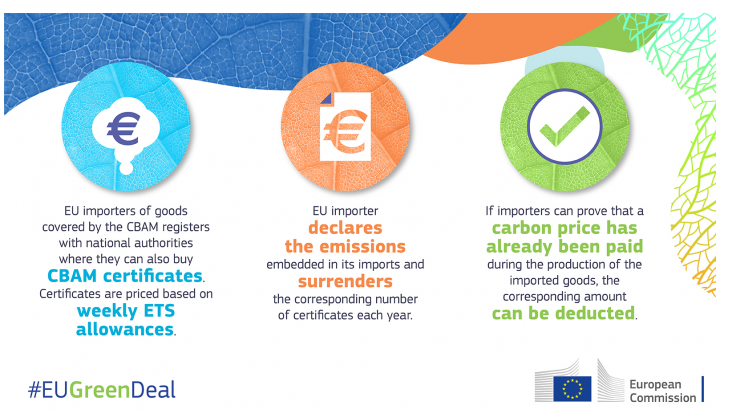
The permanent system will apply from 1 January 2026. Importers will need register with national authorities (eg. France, Germany), declare each year the quantity of goods imported during the preceding year, and its embedded GHG (which include transportation emissions), and buy CBAM Certificates to cover the embedded GHG.
They will then need to surrender the corresponding number of CBAM certificates. The price of the certificates will be based on the weekly average auction price of EU ETS (Emissions Trading Scheme) allowances in €/tonne of carbon emitted.
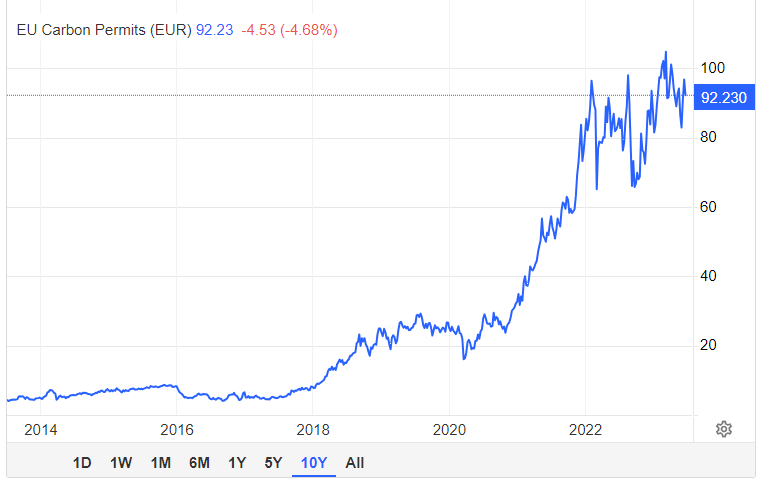
If importers can prove the carbon price has already been paid during production, the corresponding EU carbon debt can be waived. Notice the CBAM are like voluntary carbon credits - they cannot be traded between importers and can only be surrendered once. From 1 January 2026, EU importers will have to start paying the difference between New Zealand carbon credits (NZU) and EU carbon credits (EUR).
Source: Trading Economics 260623.
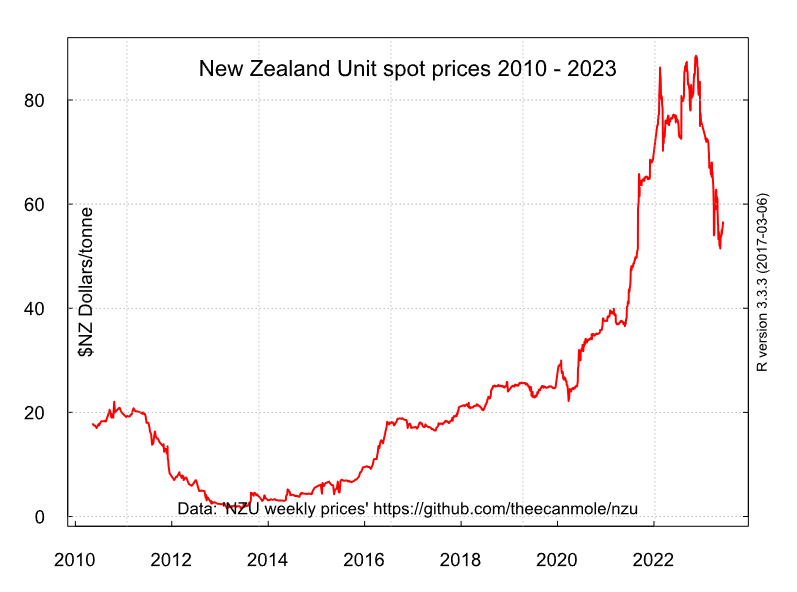
Historically the New Zealand carbon price (NZU) has always tracked significantly below the EUR price. Over the past five years the value of NZUs has been running about half the value of the EU. Recent policy settings have seen that gap broaden to $NZD100 to $NZD120, with NZUs currently worth less than a third of the EURs.
There have been several attempts in the USA to bring in carbon pricing and carbon tariffs at the border. The latest bipartisan proposal has senators from both parties signed on to legislation that would calculate the emissions intensity of industrial materials produced in the United States.
This is a step toward a USA-version of a CBAM, with tariffs on carbon-intensive imports like aluminium, iron, steel, plastic, crude oil, lithium-ion batteries, solar panels and wind turbines - notice a wider scope than the EU version.
The US Department of Energy has two years to work out the carbon intensity of these products made in the USA, and other work is proceeding to facilitate the development of the USA-CBAM.
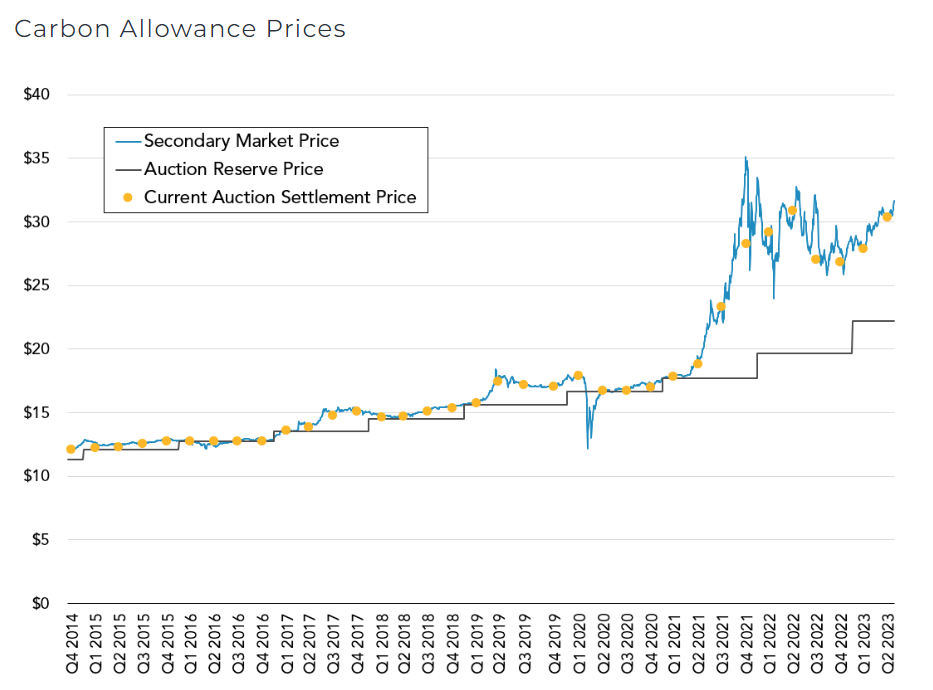
Source: California Air Resources Board 2023.
At present there are five ETS operative in the USA and three under consideration. Each covers different industry sectors, and credit values range from $USD0 (free allowance) to $USD107 in Oregon.
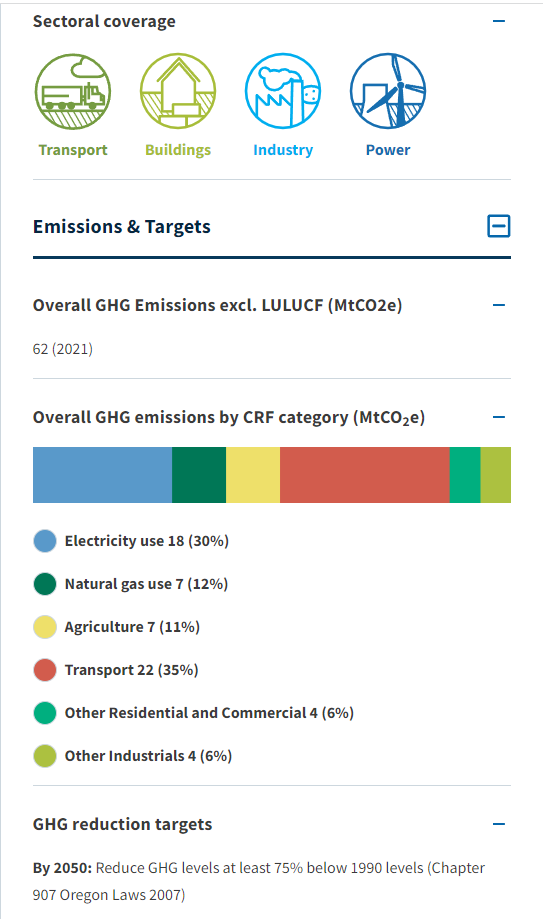
A USA carbon tariff price of US$55 has been suggested, as has linkage with the EU CBAM by large multi-nationals. New Zealand's carbon price, especially recently, lags significantly behind the suggested USA carbon tariff at only about half its value.
The major conclusions from this brief analysis of developing international carbon tariff systems are that:
1) Carbon tariffs are being developed by two of our most important premium export destinations - the EU and USA - that is, countries rich enough to pay premium prices for New Zealand exports;
2) Exporters need to know their product's embedded GHG tonnage;
3) New Zealand's ETS needs price strengthening to minimise carbon tariff costs on exporters;
4) New Zealand has very little, if any, control on the scope and cost of carbon tariffs even with our fair-trade agreements;
5) Industries not sheltered by the NZETS are the most exposed to carbon tariff risk in future; and,
6) As an export nation and as individual exporters, we need to develop smart strategies now to take advantage of the changes coming in the next five to 10 years and minimise financial exposure.
*Susan Harris is Principal Scientist at GreenXperts Limited, a New Zealand-based sustainability consultancy involved in numerous carbon and land management projects. Susan was on the science team that helped the New Zealand Government create the New Zealand Emissions Trading Scheme. Susan worked on emission factors with other colleagues at that time.
We welcome your comments below. If you are not already registered, please register to comment
Remember we welcome robust, respectful and insightful debate. We don't welcome abusive or defamatory comments and will de-register those repeatedly making such comments. Our current comment policy is here.