

Interest.co.nz is unpacking how AI will change your everyday life - the risks, the opportunities, and what to actually expect. Our new series brings you the policymakers, experts and industry leaders from New Zealand and overseas, with a new story every workday over the coming weeks.
By Anna Whyte - This story was made with help from funding from the Asia New Zealand Foundation
Artificial Intelligence (AI) is not a new concept at Beca, the engineering and design firm, and it's a topic that comes up on almost every front around the world for CEO Amelia Linzey.
In May, Linzey addressed the 2026 New Zealand-Singapore leadership forum held in Singapore in May, where AI was a dominant theme across the agenda, where leaders tackled questions on AI such as how to bring the capability in Singapore to New Zealand.
Linzey's message was, the two countries can both seize AI's opportunities and manage its risks.
"New Zealand and Singapore are well placed to respond together," she said. "Singapore is a hub for capital connectivity and regional reach. New Zealand brings strengths in areas like innovation, infrastructure, food systems and practical problem solving."
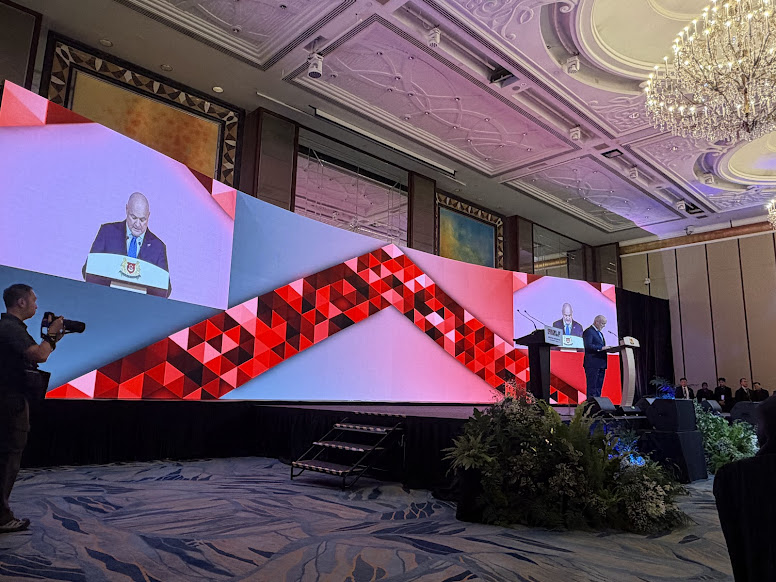
"While we were more specifically interested in the wider topic of innovation, of course it was very hard to have any topic of innovation that wasn't very deeply AI-infused," Linzey told Interest.co.nz.
It's a prominent topic that comes up "on every front" for Beca, and certainly in Singapore, it was data requirements and the infrastructure needed for AI advancement, she says.
"Some of the really interesting conversations we were having in Singapore was about the role that we could have together between Singapore and New Zealand to support each other - us with our good access to good and clean energy, our better access to water...and things in Singapore, in what AI technology looks like and what it needs."
The opportunity AI holds for Beca is huge, Linzey says. And Beca is known for being ahead in New Zealand's AI space, implementing the new technology for more than a decade. One example is the upgrade of New Zealand's Geotechnical Database, cutting search time for engineers, using Microsoft's Azure cloud and OpenAI's GPT-5.1.
Linzey says AI tools and automation accelerates the process of deciding where and what infrastructure is needed, how to design it, how to work through the evaluation and investment decision making, "which is bigger than just the financials of it".
Linzey said Beca has been applying applied machine learning for 15 years, "and we've been testing our own large language model AI tool for over seven years".
(For AI terminology 101, click here).
"I like to think we are great, but I don't think we're unique. There's a lot of people in New Zealand that are doing those kind of things, that quiet experimentation, testing, exploring, and learning, and we are certainly more modest about it than some parts of the international market."
Linzey said there are some economies around the world; "that are hugely advanced and have some quite sophisticated thinking about what the role of AI is playing and what the risks are, and how we manage them."
But, she does not think anyone has worked their way through all facets of AI to a finished position.
"Singapore has a very strong singular governance arrangement, and that gives it some advantages in terms of being able to look long-term into infrastructure delivery... and know how it can pop some of that change programme out, that's more dynamic in a place like New Zealand," Linzey said.
"Different countries are at different stages, but also every sector within those countries is at different stages as well, and in many cases for very good reasons, and I think there's probably more variability between those sectors than there is between countries."
Linzey doesn't think New Zealand is "miles and miles behind."
"I do think the quicker you get onto it, the better, and I do think that there is a huge amount of investment going on internationally on these tools, and so that's a challenge for a small country in a small economy."
On what AI can do for Beca, Linzey says they are specifically interested in how it can translate into the physical and built world.
"What AI is allowing us to do and the things that I'm finding really exciting are the innovation and prototyping of ideas, to test them outside [the] theoretical and transition into practical much more quickly."
Linzey gives the example of: "Here's a concept as an idea - we can run so many more scenarios and models and evaluations of how something might work, so that we can then move to prototyping a physical thing more quickly, and we can understand how that might then impact the wider ecosystem, the value chain of production."
"You can think about the consequences - intended and unintended - of some of those changes, because the sheer amount of data that you can test against is so different."
Linzey said AI for places like New Zealand, it can help improve where seniors and data collection intersect; "so that we can address challenges and problems we've got, like maintenance and renewal of infrastructure, which we know is a huge deficit in this country, and with things like climate change and more extreme climatic events, is going to become more of a problem."
With AI, the state of assets can be understood in more real time.
"Then we can work out what maintenance work is required, what remediation work is required, what renewal work is required."
But how does Linzey see AI when it comes to the workforce?
"It's really difficult because … everybody is understandably nervous, and this is not something to blindly enter into," she said.
"But at the same time, the thing that I find reassuring is the scale of... how much infrastructure spend is needed [in New Zealand]... You could be overwhelmed by the capacity of people to actually do that, and then there's the opportunity for these tools to help us do that more smartly, more quickly, more efficiently."
"There are ways for us to find the positive outcome... rather than the replacement of people, but the augmentation of that capacity to actually to meet that scale of demand."
On how to upskill the workforce on AI, Linzey says it is an ongoing journey.
"I would say we've got about 75% of our people actively using the AI tools that we have in our business. We've got 10%, maybe 15% who are expert users well beyond my capability, and I consider myself a pretty good user of our tools," she said.
"There's a couple of things we do, one is the 'why' case, focusing on the opportunities [AI] creates to solve problems beyond what we have been able to do traditionally."
"[That] is much more exciting for our people than the, 'being more efficient and therefore the risk of what does that mean for my job'."
Linzey focuses on that opportunity side of AI for the workforce as much as the efficiency side.
"We try and think of that trifecta of, how can you be more efficient and save yourself time, and then what can you do with that time that you've now created that will help you solve problems that we just haven't been able to solve, and then how can we use it to amplify and scale what we're doing in a way that we haven't been able to do before."
Since Singapore, Linzey has travelled to San Francisco and Silicon Valley. Reflecting on that trip, she says New Zealand has no shortage of opportunities to test AI and speed things up - the challenge is the sheer number of them.
'It's multifaceted, and there's so many of them that it can be quite overwhelming."
"It's about setting that strategy up clearly, and I think Singapore has done some very good work in thinking some of that through, in terms of who they want to be - high-end manufacturing, for example."
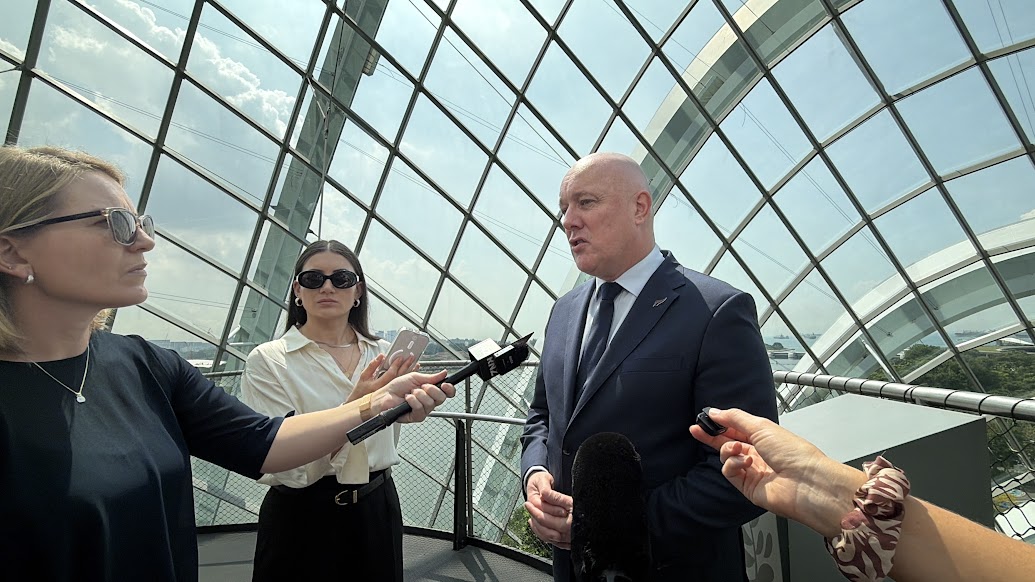
Singapore Prime Minister Lawrence Wong, speaking after Linzey at the forum, outlined the opportunities that New Zealand and Singapore could pursue in the digital economy.
"We are unlikely, as two small, open economies, to be able to build the largest foundation models, but we can be leaders in AI deployment in use cases," he said.
"... We hope to advance AI use cases, not just small pilots, but in real scale... and again, there will be opportunities for collaboration with New Zealand firms."
Prime Minister Christopher Luxon said at the time one of the big topics during the forum was the potential of AI, "and how that can help us improve the productivity and lift our living standards at home. And we know there's a lot of work for us to do there".
We welcome your comments below. If you are not already registered, please register to comment
Remember we welcome robust, respectful and insightful debate. We don't welcome abusive or defamatory comments and will de-register those repeatedly making such comments. Our current comment policy is here.