

Interest.co.nz is unpacking how AI will change your everyday life - the risks, the opportunities, and what to actually expect. Our new series brings you the policymakers, experts and industry leaders from New Zealand and overseas, with a new story every workday over the next couple of weeks.
Political correspondent Anna Whyte reflects on her attitude to AI.
I’ve spent the last two months reporting on AI in New Zealand, and travelling to Malaysia and Singapore with support from the Asia New Zealand Foundation.
Starting out, I was only just above an AI novice level, and thought AI was a bubble that I had my fingers crossed would hopefully pop soon.
My view of AI was mainly limited to frequently getting conned by what I thought were real videos on Instagram, sifting through AI slop posts on LinkedIn and once ending up in a fight with Chat GPT over whether it copied a headline from another outlet. (I did at some point realise I was arguing with a robot and decided to let it go).
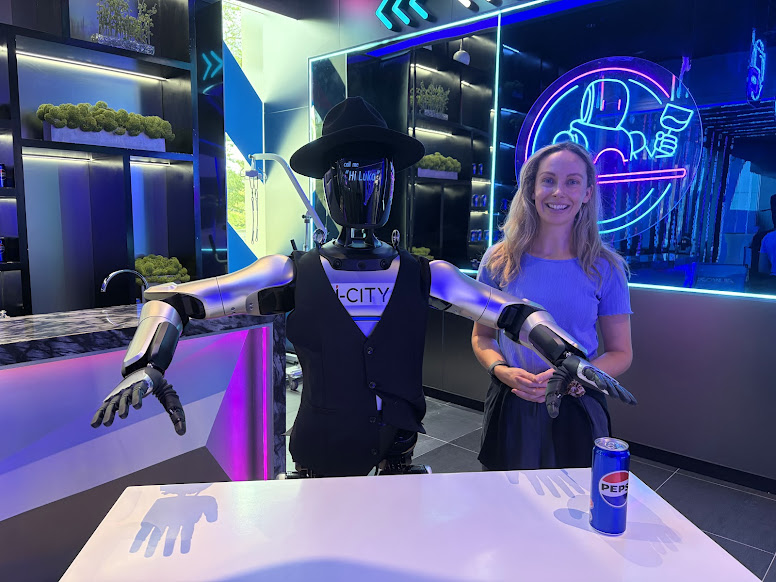
I have since largely changed my perspective (with a caveat I just spent way too much of my time attempting to instruct a paid-AI video editor to create a piece that was so bad and so clunky, and would have taken a person a fraction of the time).
Pushing aside this morning's incident, I see it now not as a money-saving, job-taking entity, but as a tool to enhance workflow, speed up tasks and open up my time for better use. Talking to those at the AI coalface has made me want to upskill, both because of the opportunity it holds and from seeing how far ahead others are.
But the gaps are evident. Countries playing catch up on regulations, the cybersecurity risks and the question mark of how extensive the environmental toll will be.
Our series, Unpacking AI, will go into all of that, to help understand what the future of AI can mean for workers, for businesses and for the wider country, starting with Prime Minister Christopher Luxon's vision for New Zealand.
Because I was getting baffled by the jargon, I asked Claude for some help when it came to AI terminology, and have added the AI dictionary below:
The basics
AI (Artificial Intelligence) — Software that can do things we normally think of as requiring a human brain, like understanding a sentence, recognising a face, or answering a question. It's not actually intelligent in the way humans are — it's pattern-matching on a massive scale.
Prompt — Whatever you type to an AI. Your question, your instruction, your request. That's it.
System prompt — Hidden instructions baked in before you even start chatting. When a company builds a product using Claude, they use a system prompt to tell it how to behave — what to focus on, what to avoid, what tone to use. You never see it, but it shapes every response.
API — A way for one piece of software to plug into another. When a business builds an app powered by Claude, they connect to Claude through Anthropic's API. Think of it like a power socket — the app plugs in and draws on the AI's capability.
Models and how they work
LLM (Large Language Model) — The type of AI behind Claude, ChatGPT, Gemini and others. It was trained on enormous amounts of text and learned to predict what word should come next. Do that billions of times and you get something that sounds remarkably human.
Model — The actual AI system doing the thinking. Claude Sonnet, GPT-4o, Gemini — these are all different models, like different car engines. Same general idea, very different under the hood.
Token — The tiny units an AI reads and writes in. Roughly a word, sometimes part of a word. AI costs and limits are measured in tokens. "Wellington" might be one or two tokens; "a" is one.
Context window — How much text the AI can hold in its head at once, including your whole conversation. Once you hit the limit, older parts of the conversation start dropping off. Like a desk — once it's covered in paper, something has to go to make room for more.
Temperature — A dial that controls how predictable or creative the AI is. Low temperature means focused, consistent answers. High temperature means more creative, more surprising, more likely to go off-script.
Training data — Everything the AI learned from. Most big models trained on huge amounts of internet text, books, and other written material. What was in that pile shapes what the AI knows, how it thinks, and what blind spots it has.
Fine-tuning — Taking an existing AI and giving it extra training on a specific topic so it gets better at that thing. Like sending a generalist journalist on a specialist economics course.
Multimodal — An AI that can handle more than just text — images, audio, video too. Most of the leading models now work this way.
Inference — The moment an AI actually generates a response. Training is when it learned everything; inference is when it puts that learning to use. Studying vs sitting the exam.
Foundation model — A big, broadly trained AI that can be pointed at many different tasks. Claude, GPT-4, Gemini are all foundation models. Generalists that can be directed.
Open source model — An AI where the code is made publicly available so anyone can download, run or modify it. Meta's Llama models work this way. The opposite of proprietary models like Claude, where the internals are kept private.
Agents and automation
Agent — An AI that doesn't just answer questions — it takes actions. It can search the web, read files, write and run code, and string multiple steps together to complete a task on your behalf. The difference between asking a colleague a question and delegating them a whole project.
Tool use — When an AI is given access to specific capabilities beyond text generation, like web search, a calculator, or your calendar. It can reach for those tools mid-conversation when it needs them. Like giving someone a Swiss Army knife instead of just their memory.
Agentic workflow — A multi-step task where an AI works through the whole thing largely on its own, making decisions as it goes, rather than waiting for you to approve each step.
Data and search
Embeddings — A way of converting words and documents into numbers so a computer can compare them by meaning, not just by exact wording. The reason an AI search can understand that "Welly housing crisis" and "Wellington property shortage" are about the same thing.
Vector database — A database that stores those meaning-based numbers and lets you search by concept rather than keyword. You don't need to use the exact word — it finds things that mean the same thing. Normal databases find what you literally typed; this finds what you meant.
RAG (Retrieval-Augmented Generation) — A technique where the AI searches a specific set of documents before answering, so its response is grounded in your actual content rather than its general training. Instead of relying on memory, it looks things up in your filing cabinet first.
Safety and risks
Hallucination — When an AI states something confidently that is completely wrong or made up. It's not lying — it genuinely can't tell when it doesn't know something. Like that person at a party who gives a very assured answer rather than admit they have no idea.
Guardrails — Rules built into an AI to stop it producing harmful content or helping with dangerous requests. Like editorial standards at a news outlet — certain things don't get published regardless of what someone asks for.
Alignment — The deeper challenge of making AI do what humans actually intend, not just what they literally said. A huge area of AI safety research. Like briefing a very literal contractor: if you say "fix the leak," you want it properly fixed — not just a bucket placed underneath.
We welcome your comments below. If you are not already registered, please register to comment
Remember we welcome robust, respectful and insightful debate. We don't welcome abusive or defamatory comments and will de-register those repeatedly making such comments. Our current comment policy is here.