
By Bernard Hickey
The Reserve Bank of New Zealand (RBNZ) has held the Official Cash Rate (OCR) at 2.5%, as expected, but it has again lowered its forecast track for short term interest rates.
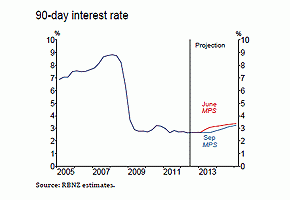
The Reserve Bank forecast in its September quarter Monetary Policy Statement (MPS) the 90 day bill rate would start rising from its current 2.7% in the December quarter of 2013 and hit a peak of 3.3% by the March quarter of 2015.
This represents a reduction in its interest rate outlook of around 30-40 basis points through late 2013 and early 2014. Over the last 9 months the Reserve Bank has lowered its forecast for the 90 day bill rate for late 2013 by a combined 130 basis points from around 4% to around 2.7%.
The Reserve Bank doesn’t formally forecast the OCR, but instead forecasts the 90 day bill rate, which is typically around 20-30 basis points higher than the OCR. The 90 day bill rate is the basis for floating mortgage rates.
This outlook for a flat 90 day bill rate suggests floating mortgage rates are likely to be flat well into late 2013, before rising around 60 basis points through the end of 2013 and into 2014.
Reserve Bank Governor Alan Bollard, speaking in his last MPS before his retirement on September 25, said the outlook for growth in New Zealand’s trading partners remained weak.
“Several euro-area economies are in recession and Chinese growth has slowed. The risk of significant deterioration in the euro area persists,” Bollard said.
“Domestically, the Bank continues to expect economic activity to grow modestly over the next few years,” he said.
“Housing market activity continues to increase as forecast, and repairs and reconstruction in Canterbury are expected to further boost the construction sector,” he said.
“Offsetting this, fiscal consolidation is constraining demand growth, and the high New Zealand dollar continues to undermine export earnings and encourage substitution toward imported goods and services,” he said.
“Underlying annual inflation, which recently moved below 2 percent, is expected to settle near the mid-point of the (1-3%) target range over the medium term. It remains appropriate for the OCR to be held at 2.5 percent.”
House prices
Elsewhere, the Reserve Bank noted a divergence in house price inflation across New Zealand, with prices in Auckland and Canterbury rising faster than the rest of the country.
But it said “these divergences are currently not significant relative to history.”
The Reserve Bank sees house price inflation rising to around 5% per annum by early 2013, before easing back to nil by 2015.
We welcome your comments below. If you are not already registered, please register to comment
Remember we welcome robust, respectful and insightful debate. We don't welcome abusive or defamatory comments and will de-register those repeatedly making such comments. Our current comment policy is here.