
By Bernard Hickey
Sometimes it's useful to pick out a few key moments and learnings from a set piece announcement and the following news conference. So here's my 10 'takeaways' from the Reserve Bank's December Quarter Monetary Policy Statement (MPS) and a 45 minute news conference with new RBNZ Governor Graeme Wheeler and his key officials. I've also updated with the key things from Wheeler's appearance in front of the Finance and Expenditure Select Committee.
1. No worries about LVR action...yet
We quizzed Wheeler and his deputy Grant Spencer in depth on this. The summary is the Reserve Bank is working with Treasury and the Finance Minister on a Memorandum of Understanding about how to use macro-prudential tools including Loan to Value Ratio limits, Counter-Cyclical Capital buffers and capital risk weightings. Wheeler said he had met Finance Minister Bill English and talked about them yesterday.
However, he said he wouldn't be using them with the current national house price growth of 5% and lending growth of 2-3%. "At present we don't see we would need to use macro-prudential instruments," he said, adding however that could change if the housing market doesn't moderate as expected. Deputy Governor Grant Spencer ruled out using regional LVRs, saying they would be too easy to fiddle.
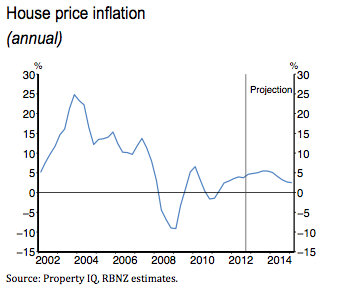
2. No worries with housing...yet.
The Reserve Bank has noticed the pickup in the housing market in Auckland, but expects house price inflation to moderate as the 'supply response' of more house building added to stocks. It also said the current pickup in house price inflation was not likely (corrects from would in earlier version) flow on into household spending as it did during the mid 2000s, and it didn't expect it to create generalised inflationary pressures.
Wheeler later said New Zealand house prices appeared expensive relative to the rest of the world, but when prodded also told us he had just bought a house in Wellinton after returning from overseas.
3. No worries about unemployment
The Reserve Bank is forecasting economic growth will rebound to 2.5-3% over the next couple of years and that a current output gap of minus 1.4% (ie surplus capacity in the economy) will be eaten away over the next couple of years and drive the unemployment rate down to 4.9% by 2015 from 7.1% in 2013. The RBNZ expects the growth to come from the Christchurch rebuild and a recovery in residential construction elsewhere.
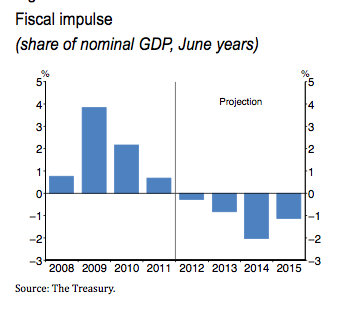
4. New Zealand's own fiscal cliff
The Reserve Bank estimates the 'cumulative negative fiscal impulse' from the government's fiscal tightening to get to a surplus in 2014/15 will be around 4% of GDP. That's the same 'negative fiscal impulse', albeit over a longer period, as the US 'Fiscal Cliff' tightening that would be triggered without a deal between the Democrats and Republicans by January 1.
Essentially, the Reserve Bank is expecting the construction sector to pick up the pace as the government steps back. There's little mention of a pickup in the export sector. The Reserve Bank actually increased its forecast for the Trade Weighted Index.
5. Retail interest rates are forecast to fall
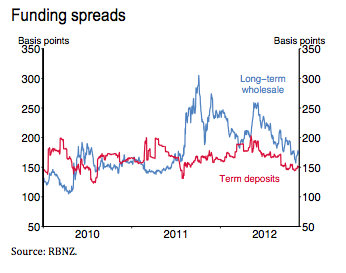
The Reserve Bank didn't make a song and dance about it, but it forecast retail mortgage rates would fall over the next year despite there being no implied cut in the Official Cash Rate. Then it expected them to rising slowly through 2014. This is because it's noted the more intense competition between the banks and because the weighted average marginal funding costs have fallen around 30 basis points over recent months.
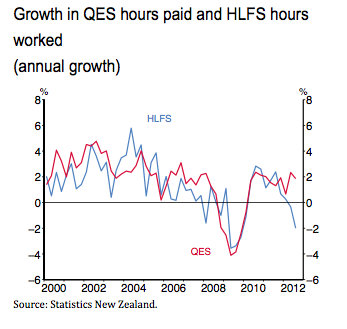
6. The Reserve Bank is sceptical about the jobless figures
The Reserve Bank spent a lot of time in the MPS pulling apart the sharp rise in the unemployment rate to 7.3% in the September quarter. It says the Household Labour Force survey overstates the degree of deterioration in the economy in the second half of this year.
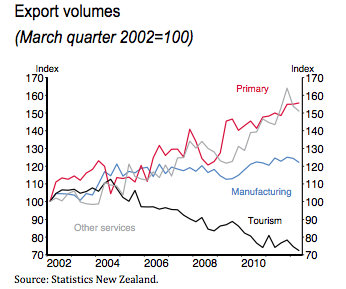
7. Tourism and manufacturing are tanking
The Reserve Bank included a useful discussion and chart showing just how much some parts of the internationally exposed parts of the economy are struggling. Manufacturing, both for export and for import substitution has been weak to flat for a decade, with the import substituting part taking the biggest hit.
"While prolonged weakness in the New Zealand construction sector substantially accounts for the decline in domestic sales, the fall and subsequent downtrend also coincide with a higher exchange rate," it said.
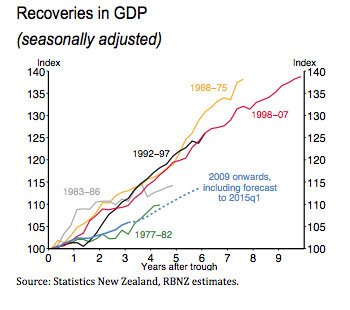
8. This is now the weakest recovery since at least the 1960s.
The Reserve Bank didn't make any comments around this, but I found the chart fascinating.
9. Wheeler would use macro-prudential tools before the OCR
The Reserve Bank included a discussion about asset bubbles, house prices and the risks of such bubbles spilling over into inflation and creating problems within the banking system. Box D on page 20 was non-committal about how the Reserve Bank might use macroprudential tools and whether it would use them as well as or instead of using the Official Cash Rate. Box D suggests it might simply hike the Official Cash Rate to cool down an economy inflated by a housing bubble.
But in the questions in the news conference afterwards, Wheeler said the bank would use macro-prudential tools 'in the first instance' to lean against an asset bubble that threatened prudential stability and inflation. See the video above for more detail on that. He did include some caveats that if an asset bubble was more dangerous for the banking sector then macro-prudential tools would be appropriate, while an asset bubble threatening higher inflation may cause the bank to use the OCR.
10. The RBNZ is quietly querying the banks about their high LVR lending
Wheeler said during the news conference the banks officials were regularly talking to bank executives and boards about their higher levels of high loan to value ratio lending.
But when pushed, Spencer said he was not concerned about the 80-90% plus LVR lending...yet.
Later in the Finance and Expenditure select committee Spencer said annualised credit growth in recent months had been running at around 5%, which was also not a concern yet. If the growth continued to accelerate in tandem with significant growth in high LVR lending, then the Reserve Bank would become concerned, he said.
(Updated with charts and detail from the FEC meeting)
We welcome your comments below. If you are not already registered, please register to comment
Remember we welcome robust, respectful and insightful debate. We don't welcome abusive or defamatory comments and will de-register those repeatedly making such comments. Our current comment policy is here.