
By Gareth Vaughan
As Auckland debates whether its future should be as a more compact, high rise city or as one that continues to sprawl outwards, how energy is sourced and consumed ought to be an important part of the discussion.
So says Nirmal Nair, a senior lecturer at the University of Auckland's Department of Electrical and Computer Engineering. Nair, along with colleagues from the university's architecture department, Hugh Byrd and Anna Ho, and another from the business school, Basil Sharp, is the author of a report entitled Measuring the solar potential of a city and its implications on energy policy. They used Auckland as their case study.
In a Double Shot interview Nair told interest.co.nz a key question for him was whether Auckland could develop some level of energy self sufficiency. Looking out 30-50 years, Auckland needs an energy plan.
"If you look at Auckland as a city, and look at what its energy consumption is, be it electricity, be it gas, be it the petroleum products to run our cars, we are importing all of them," said Nair.
"That is the reality so there in lies the question; Can we be a little bit of a producer? And solar sprang out neatly and clearly."
From both a resilience aspect, and from a growth perspective, energy should definitely be part of the equation, Nair says.
The Auckland Council has been consulting on its Unitary Plan that sets out the aim of absorbing the majority of Auckland's population growth in a more compact, high density manner over the next 30 years. However, the Government has indicated a desire to see more greenfields land opened up for development around Auckland's fringes. See all our stories related to the Unitary Plan here.
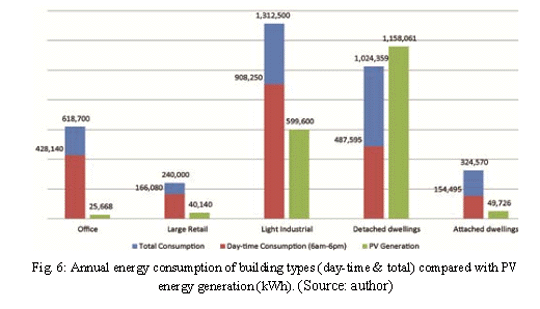
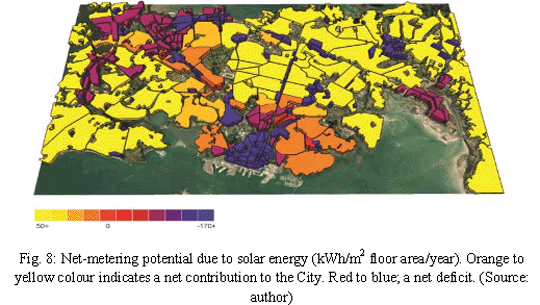
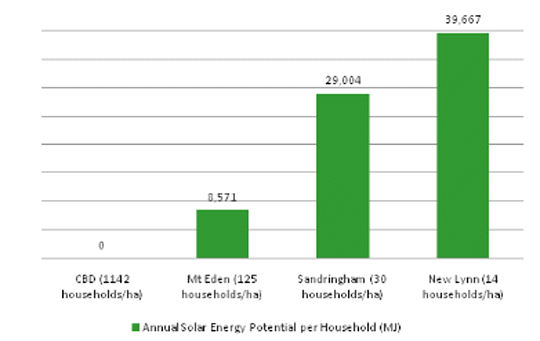
Byrd, Sharp and Nair's study concludes that; "Low dense suburbia is not only the most efficient collector of solar energy but that enough excess electricity can be generated to power daily transport needs of suburbia and also contribute to peak daytime electrical loads in the city centre."
"This challenges conventional thinking that suburbia is energy inefficient. While a compact city may be more efficient for the internal combustion engine vehicles, a dispersed city is more efficient when distributed generation solar power is the main energy source and electric vehicles are the means of transport."
Nair makes it clear , however, that he's not necessarily advocating for greenfields development over higher density living. Rather, he wants to see energy as part of the debate.
In terms of solar power potential, Auckland stacks up well compared with cities overseas.
"We were doing international benchmarks," said Nair. "We were looking at Madrid where there were a lot of investments into clean technologies like solar, cities in Germany, LA where there were incentives like (subsidised) feed-in tariffs to encourage solar. In all these places we found Auckland had one of the best weather patterns from the point of solar potential. So it stacks up pretty well compared internationally."
Their study looked at a cross section of Auckland from the Central Business District out about 10 kilometres through Mt Eden and Sandringham to New Lynn.
They also looked at the possibility of using solar energy generated on rooftops to power electric cars. Although acknowledging the development of electric cars to a point where they're feasible for mass, mainstream use, was a "big unknown," Nair said over the medium to long-term, he and his fellow authors are optimistic.
"When we're talking about the 10-year timeframe, or the 20-year timeframe, or even a generational timeframe - the electric vehicle - definitely we should be looking at this from that aspirational aspect as well," Nair said.
*The charts and graphic below come from Nair, Byrd, Ho and Sharp's study.
We welcome your comments below. If you are not already registered, please register to comment
Remember we welcome robust, respectful and insightful debate. We don't welcome abusive or defamatory comments and will de-register those repeatedly making such comments. Our current comment policy is here.