
By Bernard Hickey
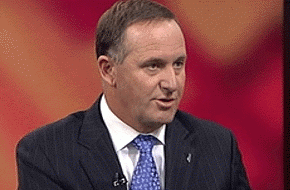
Prime Minister John Key has rubbished proposals from Labour's leadership contenders for the government to pay workers a 'Living Wage' of NZ$18.40 an hour.
Key told his weekly post-cabinet news conference that implementing a 'Living Wage' could cost between NZ$2.5 billion to NZ$4 billion and as many as 26,000 jobs.
"They clearly have no understanding of economics," Key said of the proposals from Labour contenders Grant Robertson and David Cunliffe.
"It sounds great in principle until you put 26,000 people on the dole queue and cost the economy around NZ$2.5 billion," Key said.
Cunliffe proposed lifting the minimum wage for all government workers to NZ$18.40/hr at a cost of NZ$25 million.
Key said he was sceptical of Cunliffe's costings, pointing to government estimates that an increase in the minimum wage to NZ$15/hr from the current NZ$13.50/hour would cost NZ$68 million for Ministry of Health, Ministry of Social Development and ACC workers. He suggested Labour would have to apply the Living Wage across all low-paid workers.
"If it was as simple as legislating for higher wages, why wouldn't we legislate for NZ$30/hour? Why wouldn't we double the wages of every single New Zealander? There is no country I can think of in the world that has legislated its way to prosperity. We have to earn our way to prosperity and none of these candidates are talking about that. They are talking about a move to the far left.," Key said.
"They certainly are talking about writing policies they can't afford to fund and being fast and loose with what these things would cost," he said.
"When they go out and say the cost is NZ$20-30 million and the bill is NZ$2.5 billion, it screams why we in the National Government believe that Labour can't be trusted with the chequebook."
Key was then asked if trickle down economics worked for all New Zealanders, he pointed to the government's deficit returning to surplus, falling unemployment, rising house prices and overall economic statistics 'doing OK'.
"Is it perfect? No. But we have a redistribution system through Working for Families that's heavily oriented towards low to middle income workers. Yes New Zealand needs to lift its wages, but if New Zealand is going to do that in a way that isn't inflationary and doesn't put people on the dole queue we need to make our economy far more competitive."
'The Easter bunny'
Key said Labour had opposed many of the government's proposals to make the economy more competitive, including abolishing the 90 day limit and putting pressure on the wage bills of smaller businesses. He also said Labour and the Greens were opposed to more mining and roading and fast broadband.
Key said he accepted that wages needed to rise and that many people struggled on low wages. He said the government had played its part by supporting Working For Families taking some tough steps to keep interest rates low.
"But if anybody thinks that we can just through the click of our hands double or substantially increase wages with no impact then we would do that tomorrow because it's a really popular thing to do. It's not real and the people who believe that we can do that with no implications for the economy also believe the Easter bunny is going to turn up next year and he won't."
I then asked Key for his views on companies such as The Warehouse, which announced in May increases to its wages to at least NZ$18.50/hour as part of moves to reduce staff turnover and improve skills.
"They are free to to go and do that if they want to and that's absolutely supported. We don't encourage people to pay the minimum wage."
Key said the government supported those on low wages with Working For Families and the Accommodation Supplement. He gave an example of a cleaner working in Parliament on the minimum wage of NZ$13.75/hour earning NZ$29,000 per year. If that worker had 3 children, they would lose NZ$4,000 in tax and get back NZ$23,000 through the Accommodation Supplement and Working For Families.
Low wage subsidy?
I asked Key if this meant the government was effectively subsidising companies paying low wages.
"Yes they are a government funded subsidy for lower wages. I accept that fully. But if we don't do that, then essentially what would happen, some of those jobs would disappear and some of those companies would disappear and would force outsourcing to certain areas."
Robertson responds
Robertson described Key's comments as an "hysterical reaction" to his proposal for the government to pay its workers and contractors a living way.
"John Key is deliberately misleading New Zealanders with grossly inflated figures that have no relationship to what I am committing to, and are based on the usual flawed arguments against wage rises for workers. The bottom line is that if John Key can find NZ$30 million to subsidise his share float, he can find the money to give a boost to low paid workers that he directly or indirectly employs," Robertson said.
"I find it odd that John Key is promoting Working for Families as the alternative to a Living Wage. I thought he was all about reducing dependence. In actual fact paying workers a living wage will reduce dependence on programmes like Working for Families."
(Updated with extra details, quotes on The Warehouse's living wage move and subsidies for low wages, Robertson response)
We welcome your comments below. If you are not already registered, please register to comment
Remember we welcome robust, respectful and insightful debate. We don't welcome abusive or defamatory comments and will de-register those repeatedly making such comments. Our current comment policy is here.