
Lending to businesses is dominated in New Zealand by banks.
Borrowing by small businesses is similarly dominated, but this is unique in that most banks basically require real estate security for their lending, often the owner's house.
On the other hand, most small businesses require funding for working capital.
This mismatch generates a distortion and can induce financial stress.
It is easy to see why banks insist on this structure. Houses are more 'liquid' than SME debtors and stock and their value is more certain.
It also means that banks don't really need to make much effort to understand the business they are lending to. In fact, they can much more easily push lending decisions down to quite junior staff using well-understood mortgage lending criteria.
But for the business owner, this completely distorts how they fund their business, turning good practice on its head.
All businesses require funding in three areas:
1. Start up funding
This is the risk capital of the business - also known as 'equity'. Ideally, this will be unencumbered cash resources invested by the owner. But often owners don't have such liquid funds available and they may use their house as the ATM, increasing their mortgage to provide the funds needed. Borrowing money to make an equity investment is not ideal, certainly not recommended. But it happens, by increasing a mortgage or from friends or relatives. Hopefully not by using a credit card, but even that does happen.
Another source is to use funds from a third party investor. In that case however, they will want a generous shareholding and share of the profits. They will want it to be 'generous' because you will be in control of the business and therefore their risk is much higher. Third party shareholders are probably best brought in when the business has a provable track record.
2. Fixed asset finance
This is for specific items of plant and machinery (or land and buildings), things that will have multi-year productive lives for the business.
Asset vendors and suppliers often can supply this, and there are also specialist asset funders and finance companies (like UDC, Kiwi Asset Finance, and GE Capital). Some trading banks may also offer this asset-specific finance. The key here is to have the lending solely secured by the asset itself. It is not actually asset funding if a 'general security' is also taken over all the assets of the business and/or the owner.
Asset funding usually works best when the business is able to purchase the asset with a substantial deposit (of at least 25% or more).
Both start up capital and fixed asset funding address the long term needs of the business. But they don't help with the day-to-day operating requirements, which in many businesses can be quite mismatched with cash receipts. For this you need ...
3. Working capital funding
This is the lubricant that keeps most businesses running smoothly. Many businesses that have been running for a long time have built sufficient cash reserves to fund their working capital needs internally.
But many others can't do that, or they are expanding faster than their internal cash generation can support.
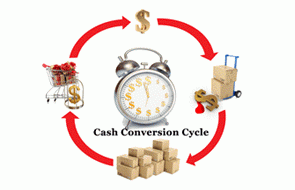
This is the funding that bridges the gap between buying the inputs and generating the cash from the regular business activity.
The cycle is usually between 30 and 90 days.
As such, the best funding for this is significantly different to equity or asset finance.
Working capital funding should be secured by working capital assets - that is, debtors and stocks.
It is the most often funded by an overdraft, which is appropriate. The other common credit used is 'creditors' (accounts payable).
It may also be funded by other options such as invoice financing, factoring, or single invoice discounting.
But there are problems with each of these and the main one is the cost. These are all high-cost options.
A bank overdraft also has 'security' issues in that the bank will usually want belts-and-braces protection that almost always requires the owner's house. Signing their 'debenture' or 'general security' documents also usually means they have a veto over you using any other form of finance. Asset financing is out unless you use them. Bank loan agreements are a straight-jacket. They may be your 'partner' but they are a very fair-weather friend.
As Terry Haydon of Auckland-based Cashflow Funding says, "The approach taken by banks is totally at odds with the definition of working capital and ignores the fundamental reasons for working capital".
A working capital finance plan
Assuming your business has been financially set up with a sensible (and unencumbered) base of equity (something like 30-40% of the total asset value of the business), then the best approach is to get your working capital funding plan sorted first.
Objective 1. Working capital funding should be strictly related to your working capital needs and 'secured' only by those assets if possible. Don't try and make this funding cover fixed asset requirements and certainly not covering for a shortfall in the core capital requirements of the company.
Objective 2. Plan exactly what you will require over the working capital cycle of your business. Know the 'highs' of when your cash will flow in, and the 'lows' of when it flows out. You should have a continuous method to monitor this in advance in weekly blocks up to 3 months ahead. No surprises is the goal.
Objective 3. Prepare to give security on your working capital assets to your funder.
Objective 4. Work hard to keep costs for working capital funding under control. It is easy to get working capital funding that is high cost, but sensible research can make it quite manageable.
In fact, you might be surprised at how much a bank overdraft actually costs you. Overdraft costs are not transparent. There is the overdraft base rate which a bank will happily tell you. There is the margin, which will be on a document you sign somewhere which the bank will hope you will forget. And there is the facility fee, which you may not have realised at all. All up, they represent the cost to you of a business overdraft.
What can surprise is that these total costs can look more like credit card interest rates. Banks love business lending because it can be very profitable given all the 'extras' they can participate in. They and other non-bank lenders have more than $83 bln loaned out to businesses (plus another $54 bln loaned out to rural businesses).
About half of that is for working capital.
Some banks do offer working capital funding secured on current assets - banks like BNZ Partners and Heartland Bank - but they tend to charge interest rates on a cost scale as though they are unsecured, often touching the 20% pa level.
Your job is to minimise these finance costs.
You can do that best by understanding them. A good place to start is our business overdraft calculator.
If you are set up with best practice, working capital finance should cost you about 10% or 11% pa. (when most owners seem to be paying 14-20% pa for overdrafts). There is no point subsidising those who aren't at that level, or are embellishing bank margins.
Best practice does not use the owners house as an ATM for their business. Mortgage interest rates are seductively lower but it is usually a trap. 11% on a weekly or monthly up-and-down proper working capital funding arrangement may well be less than 5% on a omnibus, maximum-draw permanent home loan used for business purposes.
Besides, working capital funding is active, positive management of a real business issue. A background house loan is not and it can so easily mask corrosive issues that should be addressed when they arise.
A proper working capital funding arrangement:
- does not require security of your house,
- does require specific security of current assets,
- will require you to manage your stock and debtors to a plan agreed with your funder,
- works with your operating business cycle over a rolling 90 days period,
- can accommodate growing working capital requirements,
- should not cost more than an interest rate of about 10-12% pa when secured on current assets and you are organised with best practice.
- does not inhibit alternative funding requirements for fixed assets, nor separate equity raising,
- does not require you sign an all-obligations security document.
Knowing best practice should help you set up your working capital funding systems sustainably and as an integral element of your overall business.
We welcome your comments below. If you are not already registered, please register to comment
Remember we welcome robust, respectful and insightful debate. We don't welcome abusive or defamatory comments and will de-register those repeatedly making such comments. Our current comment policy is here.