In this Newsletter, we discuss the economic and financial market consequences of a Donald Trump victory in next month’s US presidential election. We outline Mr Trump’s policy agenda and simulate two possible outcomes, Trump Lite and Donald Dark, based on the extent to which he delivers his planned agenda.
The prospect of Mr Trump becoming the next US President has alarmed many economists and investors. Indeed, in the extreme, Mr Trump poses a significant risk to not only the US economy, but the global economy too. However, it is doubtful whether Mr Trump intends to fully deliver the programme that he has set out – which politician ever does? And even if he wanted to, we doubt that he could.
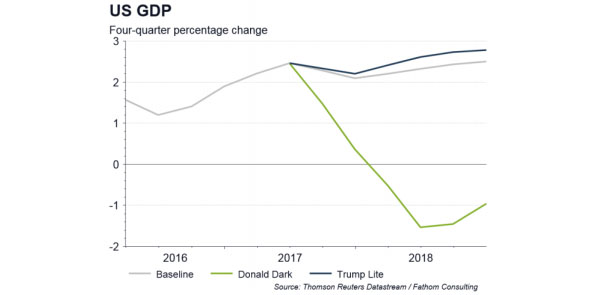
As illustrated in the chart below, in our Trump Lite scenario, the most likely of our two simulations, US GDP growth is slightly higher than the consensus-implied baseline. However, in our Donald Dark scenario, which assumes a massive fall in global trade, growing isolationism and much lower US population growth, US GDP growth slows rapidly next year and the economy enters recession in 2018.
Plenty of sound and fury
A number of checks and balances exist to prevent the US President from having free reign: new US laws need to be approved by Congress (both the Senate and House of Representatives), not just the US President. The Supreme Court has the power to overrule these laws if they are deemed unconstitutional.
Assuming Mr Trump wins next month’s election, the Republicans would probably keep control of both the Senate and House. But even then, there s no guarantee that they will pass the laws necessary for Mr Trump to push through his agenda. The
US President cannot remove Supreme Court judges, or heads of independent agencies such as the Federal Reserve. However, the President can nominate candidates for vacant positions, which must then be approved by the Senate.
Donald Trump’s agenda in brief
Mr Trump has campaigned to improve the fortunes of US workers by reducing the US trade deficit and increasing US manufacturing employment. To do so, he has pledged to tear up or renegotiate existing trade agreements such as the North American Free Trade Agreement (NAFTA) and walk away from trade deals in the pipeline such as the Trans-Pacific Partnership (TPP). He has also threatened to slap tariffs on imports from China and Mexico to the tune of 45% and 35% respectively, after branding the former a currency manipulator.
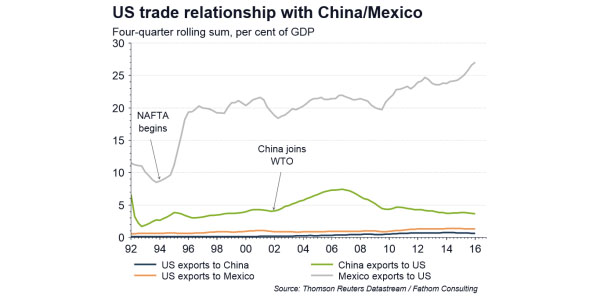
Mr Trump has said he would deport an estimated 11 million illegal immigrants, increase border patrols and build a wall between the US and Mexico. These policies would reduce US population growth and US GDP growth. But Mr Trump has proposed a number of progrowth policies too. These include lowering energy costs (albeit at the expense of the environment), boosting labour participation by subsidising childcare, cutting regulation, increasing government spending and cutting taxes. For these reasons, it seems, many US small business owners prefer Donald Trump to Hillary Clinton.
Mr Trump’s fiscal plans would cause US government debt to rise significantly; independent estimates range from US$2.6 trillion to US$9.5 trillion over ten years.
Trump Lite
In our central Trump scenario, which we call Trump Lite, nothing much changes. In this world, either Mr Trump backs down on his more controversial proposals, or he is unable to pass the laws he needs to enact them. Accordingly, we assume only a small number of deportations and minor trade disputes with China and Mexico. Broadly speaking, business carries on as usual.
Less immigration and less trade would be bad for US GDP growth, but we think that Mr Trump’s probusiness policies and fiscal package would offset this. Overall, we expect a small net positive boost to real US GDP in this scenario. Moreover, to the extent that Mr Trump’s fiscal policies are inflationary, his victory may enable faster normalisation of US interest rates. As we have highlighted in the past, we think that this would be good for the US economy.
Donald Dark
There is a risk that this all goes horribly wrong. The US President has relatively free reign to start a trade war by using existing US laws, thereby avoiding approval from Congress.
A US President could, for example, slap tariffs and quotas on imports by invoking the International Emergency Economic Powers Act (1977) or sections of the Trade Act of 1974.
The legalities of these tariffs would be challenged in the courts by US firms and other countries, who are likely to retaliate. In short, things could get messy, with Trump’s presidency feeding the mood of isolationism and populist politics. It could also contribute to events such as a ‘hard Brexit’ and Marie le Pen doing well in the French presidential elections, both of which would fuel concerns about the future of the European Union.
In this world, we forecast a sharp fall in global trade, as well as a sharp slowdown in the annual rate of US population growth (from 0.8% to 0.2%) due to the mass deportation of illegal immigrants. US GDP falls sharply from baseline (see chart on first page) and the global economy enters a 2008-style recession.1
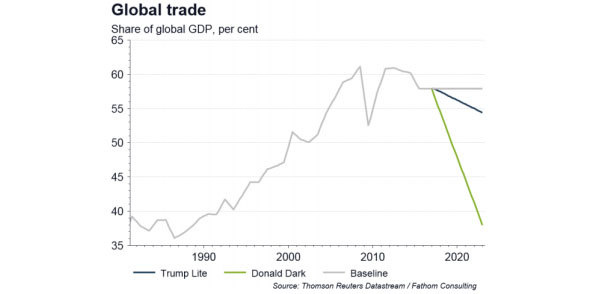
For all of Mr Trump’s inflammatory rhetoric, we think that the most likely outcome of a Trump presidency would be something closer to Trump Lite. That said, investors should brace themselves for the risk of Donald Dark and hedge themselves against that outcome, where possible.
How to trade it?
In either world, the stand out trade would be to buy the US dollar. Assuming an initial risk-off reaction to a Trump victory, we think that the US dollar would rise due to safe haven demand.
It may seem curious that the US dollar would benefit from safe haven demand, even though the US is the source of these concerns, but that is exactly what happened during the 2008 global financial crisis.
In the Donald Dark world, safe haven demand is likely to keep the dollar supported in the nearand medium-term. In our Trump Lite scenario, the initial appreciation of the dollar post-election may well be reversed, but as soon as it became clear that the US economy would continue to grow (indeed, grow faster than in our base case) the dollar would be likely to appreciate once again. Higher US interest rates as a result of better-than-expected economic outcomes and higher inflation would also drive the dollar higher in the medium-term.
We also think that the US dollar would appreciate if Hillary Clinton wins, since US interest rates would climb faster than investors currently anticipate. Either way, in our view, now is a good time to buy the US dollar.
US Treasuries would also benefit from safe haven flows after a Trump victory. Under our Trump Lite scenario, we think that this would be short-lived. Whereas in the Donald Dark world, Treasuries would continue to benefit from safe haven flows.
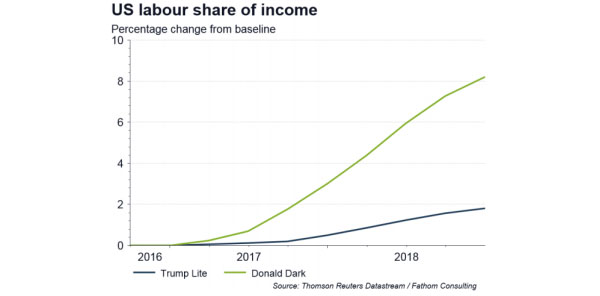
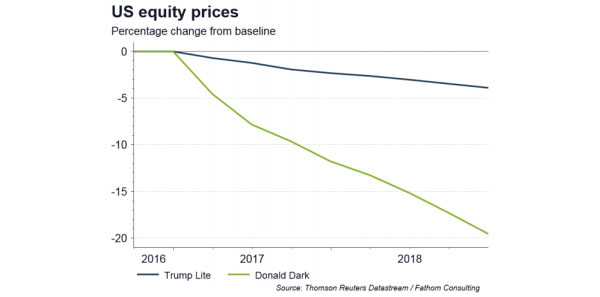
Equities fare very poorly under our Donald Dark scenario due to a significantly weaker growth outlook. Diminished trade results in a smaller economic pie, with labour’s share of that pie rising significantly due to greater bargaining power for workers as the available pool of labour shrinks. This is a double-whammy for equity holders who suffer from both a smaller pie and reduced share of that smaller pie.
In Trump Lite, the economy is a little bigger than it otherwise would be, although since labour’s share of income also rises in this world, equity holders are worse off than they would be in the consensus implied baseline (at least, before considering any changes to the US tax code).
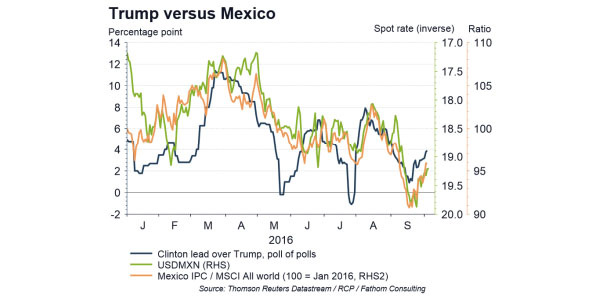
Another way to benefit from a Trump victory is to hold a short position in either the Mexican peso or Mexican stock market going into the election. As our chart highlights, the Mexican peso falls and the Mexican stock market underperforms when Mr Trump does well in the polls.
How did we get here and what now?
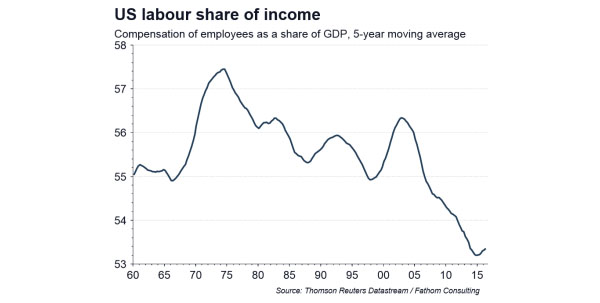
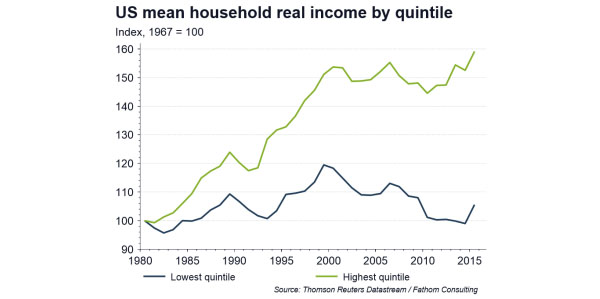
The emergence of Mr Trump as a political force reflects a mood of growing discontent (in the developed world at least) about immigration, globalisation, inequality and the benefits of free trade. Low earners in rich countries feel that globalisation has not worked for them. Judging by the fall of labour’s share of income and the widening gap between the real income growth of the richest and poorest households, that concern may be valid.
Indeed, as Edward Luce from the Financial Times noted in a recent article, “if Mr Trump loses it will be due to character – not because of his message”. The forces that have brought Donald Trump this close to the Presidency are akin to those unleashed by the Brexit referendum in the UK, and to those behind the rise of extremist parties across the developed world. Those forces are likely to remain in place whether or not Mr Trump prevails.
1. The baseline in our simulation is the consensus implied path
Fathom Consulting is a London-based research house supplying macro research and advice on the macro economy and financial markets to a number of the world’s leading corporate and financial institutions, governments and policy groups. This article is a re-post of an item emailed to subscribers. It is here with permission.
We welcome your comments below. If you are not already registered, please register to comment
Remember we welcome robust, respectful and insightful debate. We don't welcome abusive or defamatory comments and will de-register those repeatedly making such comments. Our current comment policy is here.