
By Linda Meade and Stephen Smith*


The New Zealand economy has experienced solid economic growth of late and is now in its seventh consecutive year of expansion. But low productivity and an ageing population, along with increasing protectionist rhetoric coming from some of our traditional trading partners, has the potential to stall New Zealand’s economic progress.
So where can New Zealand look to maximise its future economic prosperity? This report identifies the industries that are expected to experience above average global growth in the next twenty years. It also assesses the comparative advantage of industries here. We believe New Zealand’s industries of opportunity lie at the intersection of global growth and national economic advantage.
These industries of opportunity are:
• Tourism
• Agribusiness
• Food processing
• International education
• Advanced manufacturing.
Each of the industries of opportunity listed above are expected to achieve above average global growth, in large part due to the rise of the middle class in emerging economies, an ageing population and the expected pace of global growth in each particular industry. Consumers around the world want many things New Zealand can offer – excellent agricultural and food products, high quality education, the latest health technologies and unique tourism experiences.
This report is a call to action. There are competitors waiting in the wings if we are complacent.
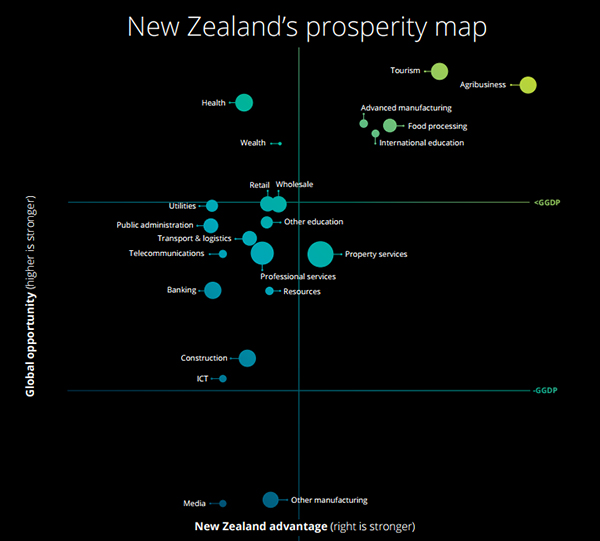
New Zealand’s prosperity map
The five industries we have identified are at the heart of our prosperity map. They provide New Zealand with the best chances to successfully turn local advantages into global opportunities. We project these industries to grow globally at annual rates between 3.66% (international education) and 3.88% (tourism) from 2017 to 2037. This compares to a projected annual growth of global gross domestic product (GGDP) of 3.4% over the same period.
The comparative advantage an industry enjoys is crucial to identifying its growth opportunities. We provide an advantage score for each industry, where a higher score indicates a higher level of advantage, based on data that evaluates performance in key areas relative to competitors. These five industries have advantage scores between 8.7 (advanced manufacturing) and 16.4 (agribusiness), compared to the collective advantage score for the New Zealand economy of 5.6.
Tourism
Tourism is New Zealand’s largest export industry and a major contributor to economic prosperity. We have given it the second highest industry advantage score and it is projected to be one of the world’s fastest growing industries.
Opportunities to take full advantage of future growth include better understanding of how the sharing economy is changing the industry, preparing for increasing demand for tourism from Asia and ensuring New Zealand continues to offer a unique visitor experience and more affordable direct air access. Challenges include renewing the infrastructure that supports tourism and maintaining the international visibility of New Zealand as a tourist destination.
Agribusiness
We have given agribusiness the highest industry advantage score for New Zealand and the industry will be among the fastest growing worldwide over the next twenty years. New Zealand can be a long-term winner in agribusiness by focussing its strategy more on growing value than growing volume, and we identify practical solutions to contribute to this shift.
However, there are a number of disruptors with the potential to transform the industry and affect any value-driven strategy. Global megatrends including demographic shifts, climate change and greater value chain integration will intensify disruption in the industry, while new customer preferences and the development of agricultural technologies are accelerating the speed of disruption.
Food processing
New Zealand is in a good position to take full advantage of opportunities in the food processing industry. Consumers are increasingly looking beyond the traditional preferences of price, taste and convenience, to include health and wellness, safety, social impact and experience. This shift in what lies behind food purchasing decisions presents a meaningful opportunity for the food processing industry. New Zealand offers a diverse range of products that address these evolving drivers.
However, future success will require both adapting to changing demographics and consumer preferences, as well as managing in an increasingly global and complex business environment. New Zealand food processors will need to collaborate across the value chain more effectively, while adapting to a marketing environment influenced by the reach of new media and social networks.
International education
New Zealand has been able to achieve success in the international education industry. This industry is currently the fourth largest export earner, and there are over 130,000 international students participating at all levels of education.
But students are more mobile and flexible about the location and timing of their study than ever before. And technology is changing the way education is purchased, experienced and consumed, extending international education markets beyond their established geographic and service boundaries.
The changing nature of the international education landscape means New Zealand’s opportunity is evolving. Focussing on targeted strategies for international collaboration and being in front of the innovation curve for online studies could help deliver significant benefits for New Zealand’s international education industry.
Advanced manufacturing
New Zealand is in a good position to take advantage of the opportunities within this industry. The advanced manufacturing industry is a revelation in New Zealand, having experienced significant growth in export earnings, as well as a material increase in foreign direct investment (FDI), in recent years. Health technology is the industry’s largest export sector, followed by generic pharmaceuticals and scientific technology.
But there are big challenges to address. To take full advantage of the global opportunities in the industry, New Zealand needs to be internationally connected through trade and investment, and the flow of people and ideas. Business and government will need to take bold steps to realise the full opportunity that exists in the industry. This can help advanced manufacturing support greater diversification of exports and become one of the biggest drivers of prosperity.
Next steps
Shaping our slice of heaven: Industries of opportunity analyses where global opportunities and New Zealand’s advantages will coincide to create growth opportunities for the economy. Recognising that New Zealand’s prospects are as bright as they were a decade ago is not in itself enough. How can New Zealand businesses and government apply these insights to their specific situations? How can New Zealand take a longer-term view and what does that mean in practice?
The answers lie in understanding where companies are positioned today, and identifying the best ways to move towards areas of higher growth and greater advantage. Government can play a role here, but it is worth underscoring that although government policies can help, success or failure lies more in the actions of the business community.
It is important to consider how businesses and government might take full advantage of the opportunities identified in this report “within New Zealand”. We believe it is just as important to articulate a “within New Zealand story” as it is to have an outward focussed “New Zealand story”. Business and government need to develop strategies to consider how New Zealand’s regions can work both separately and together to be more productive, and collectively, more competitive. It is not enough to develop regional economic development plans in silos; rather, they need to exist within an overarching framework.
Our core message is that while global or domestic opportunity and structural advantages are necessary, they are not sufficient. To ensure success, we need to build on New Zealand’s areas of advantage to maintain and improve performance relative to global competitors.
Linda Meade is a partner, and Stephen Smith is a lead partner at Deloitte Access Economics. This article is the executive summary of their report Shaping our Slice of Heaven - Industries of Opportunity. It is re-posted with permission. You can download the full report here.
We welcome your comments below. If you are not already registered, please register to comment
Remember we welcome robust, respectful and insightful debate. We don't welcome abusive or defamatory comments and will de-register those repeatedly making such comments. Our current comment policy is here.