

This is the first part of Deloitte Access Economic's "Regions of Growth" series. It is here with permission.
----
Over-reliance on a handful of urban economies, such as Auckland, Wellington and Canterbury, to provide growth for the entire nation leaves New Zealand vulnerable to economic shocks. For instance, an asymmetric shock to urban centers in the form of a downward property price adjustment would likely soften consumer demand due to declining wealth and reduced consumer confidence. Supporting growth more broadly within regional economies would spread economic risk over a greater number of geographical markets and improve overall economic resilience. This begs the question of what role regions across New Zealand should play in supporting overall economic success and to what degree there should be centralised coordination of these efforts. Deloitte refers to this as the ‘within New Zealand’ story.
A refreshed focus on regional economic development
There have been efforts to develop the ‘within New Zealand’ story, including a refreshed government focus on regional economic development, which includes:


Exports shaping our regional futures
There is, however, a lack of consideration of how regional exports could benefit regional economic development. There is a focus on exports nationally, through targets set by industry and strategies for how exports could be diversified. In 2014 the Productivity Commission conducted a study to understand inter-regional trade and the extent to which goods and services are traded across distances within New Zealand.1 But there is as yet little evidence on the link between exports and regional economic development.
Export-driven growth is highly important for New Zealand. We are trade-dependent, with exports directly accounting for a third of the country’s economic output. In addition, exports such as tourism, agribusiness, food processing and advanced manufacturing provide strong anchors for New Zealand’s economy. New Zealand is exposed to risks associated with being trade-dependent, such as exchange rate fluctuations and being a price-taker in the world economy, but can also reap significant benefits from trade, such as enhanced efficiency and increased innovation. Through this, if risks are managed, trade can lead to increased economic growth, higher employment and improvements in living standards.
In this second edition of our Shaping our slice of heaven series, Deloitte further develops the ‘within New Zealand’ story by determining the economic impact of increasing exports – both international and interregional – and how our regions can prosper from this.
Deloitte recognises prosperity is more than just economic growth and increased employment. Regions are more than that – their people, social cohesion, institutions, environment, history, culture, infrastructure, and proximity to other regions (to name a few) all have a bearing on the future prosperity of our cities and regions. However, this report is predominately focused on the economic and employment outcomes of our regions, rather than the broader wellbeing outcomes.
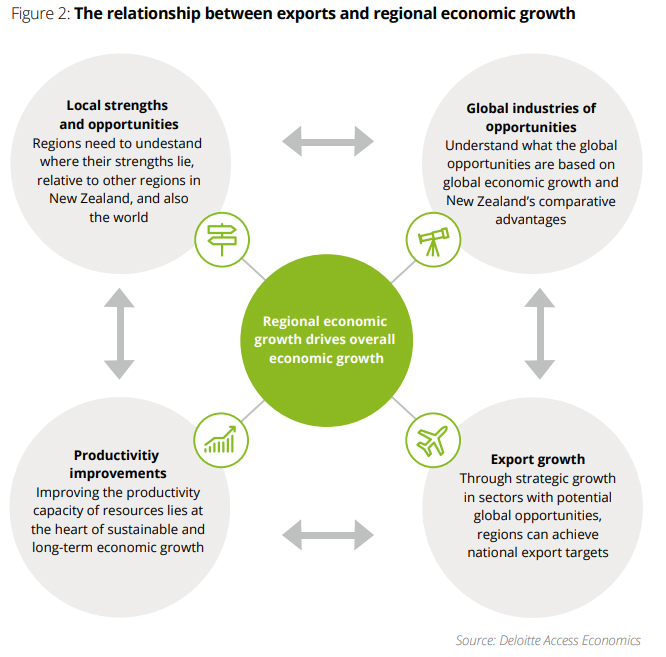
Relationship between exports and economic growth
As a small, open economy, New Zealand is highly exposed to global trends and events, which can have significant influence on our macroeconomic and social environment. New Zealand borrows money from overseas, so international monetary policy changes can flow through to our interest rates. This has economic impacts on things like mortgage repayment amounts and savings rates. Changes in the exchange rate, for instance, makes our products more or less desirable in relation to products from another country, directly affecting the profits of New Zealand exporters.
From a ‘within New Zealand’ perspective, exports facilitate economic growth at a regional level in terms of increasing output, employment and overall living standards for those based within the region.
A primary way businesses interact with the world is through trade inflows and outflows. For instance, New Zealand businesses sell milk and meat products to overseas consumers, we provide technical expertise to international businesses and welcome tourists into our country. It is not just cities that benefit – strong export demand is a central contributing factor to buoyant growth seen throughout the provinces.
One mechanism underpinning economic growth is based on extracting more out of the same inputs (improved productivity). Improving the productive capacity of resources involves identifying and understanding our industries of opportunity and building upon regional competitive advantages through investment and innovation.
With an increase in exports and productivity, businesses will benefit from being able to produce more goods and services with the same level of inputs. At the same time, the increase in demand for products and services may help attract new capital into a regional economy, by helping existing businesses increase their output and by inducing new businesses to locate in the region to access the benefits of increased exports. This in turn attracts more investment capital and local consumers.
The increase in activity will generate demand for labour.2 At the same time, households will benefit from being able to consume more goods and services as availability increases, individuals’ wages rise and if producers pass on production cost savings to consumers.
We do, however, recognise that the benefit to households may not be evenly distributed if growing wealth causes increased inequality.
Each region has its own strengths and competitive advantages. Some regions feature specific niche industries, while others benefit from a wide range of industries supported by infrastructure investment over many decades, or in some cases have natural advantages, such as climate. They begin their journey to prosperity at different paces. By understanding where each region starts, the opportunities available, and future challenges, we can gain a better understanding of how to improve the productive capacity of their resources and build a pathway to prosperity.
Notes:
1. New Zealand Productivity Commission (2014). Trade over distance for New Zealand firms: measurement and implications, retrieved from https://www.productivity.govt. nz/sites/default/files/nzpc-working-paper2014-05-trade-over-distance-rev2.pdf
2. It should be noted that not all of this additional demand for workers will be in the form of paid labour, it may be in the form of robotic or cognitive workers.
This is the first section of Deloitte's report: "Shaping our slice of heaven: Regions of opportunity". The full report is here. This article is reproduced with permission.
We welcome your comments below. If you are not already registered, please register to comment
Remember we welcome robust, respectful and insightful debate. We don't welcome abusive or defamatory comments and will de-register those repeatedly making such comments. Our current comment policy is here.