
Immigration is back in the headlines in Australia. And not in a good way.
Record levels of immigration coming out of the Covid-19 pandemic are being criticised in many quarters for suppressing wages, putting pressure on infrastructure, and pushing up house prices and rents.
According to two recent polls in the Sydney Morning Herald and the Australian Financial Review, more than 60% of respondents say that immigration is too high.
The federal government is alert to the issue and last week released its new Migration Strategy – Getting migration working for the nation. This document presents the government’s vision for a reformed migration system and is the result of extensive consultation with business and union groups.
Unsurprisingly, the government describes the current migration system as ‘broken’ and blames the previous government.
What do the figures say?
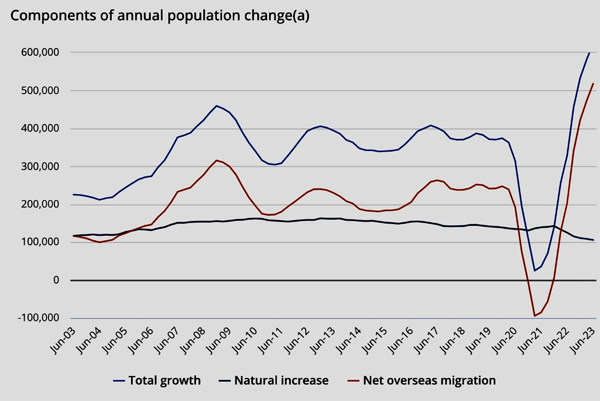
Last week the Australian Bureau of Statistics (ABS) published the data for the year to 30 June. Net overseas migration (NOM) was 518,000, the highest number ever by a considerable margin. That equates to approximately 1.94% of the total Australian population. A remarkable figure.
(Interestingly, provisional estimates from Statistics NZ suggest that for the year ended 31 October, New Zealand experienced a NOM of 129,000. That equates to about 2.45% of the total kiwi population.)
Of course, the latest figures need to be viewed in a wider context. In Australia the leap in the June 2023 year partly represents a recovery from the major dip in immigration triggered by the Covid border closure. After having NOM of more than 100,000 for two decades, Australia dived to negative NOM in the June 2021 year. From that perspective, 2023 just looks like a short term catch up.
Source: ABS
Indeed, the Mid-Year Economic and Fiscal Outlook 2023-24, released last week, forecasts that Australia’s NOM will fall back to 375,000 in the June 2024 year and 250,000 in the June 2025 year, broadly in line with pre-pandemic levels.
The latter figure, at about 1% of the total population, is still relatively high and reflects Australia’s status as an ‘immigration nation’. More than 30% of Australian residents were born overseas (including approximately 600,000 kiwis), and more than half were either born overseas or have a parent born overseas.
As the government said on releasing its Migration Strategy document, ‘migrants continue to be an essential part of Australia’s economic and social fabric’. It views migration as crucial to meeting the challenges of growing productivity, building a skilled workforce, and managing the pressures of an ageing population.
The government identifies several key problems with the current immigration system – the exploitation of migrant workers, the existence of ‘too many back doors and side doors into the system’, and a level of complexity that turns off many of the skilled people Australia wants.
A significant proportion of the jump in immigration over the last eighteen months has been attributable to an influx of international students. There’s been concern that the student visa system has been abused to bring low-skilled workers into the country or to allow students to prolong their stay. The government has announced a series of ‘integrity measures’, including higher English language standards, to ensure that the system is properly targeted.
Australia needs to be careful here. Education is a huge money spinner and there is significant international competition for foreign students. Australia is currently very well placed and wouldn’t want to jeopardise its position.
In the recent QS Best Student Cities 2024 survey, Melbourne was ranked the 4th best city in the world for university students. According to the Victorian Premier, ‘international education is Victoria’s biggest service export, generating $8.4 billion in revenue last year and supporting more than 40,000 jobs across the state’.
Sydney ranked 7th in that survey and there were three other Australian cities in the top 30. (Auckland was ranked 29th.)
The government needs its new strategy to prevent foreigners using the student visa system just to access jobs in Australia or to prolong their stay here, but without deterring genuine international students.
Another key feature of the new Migration Strategy is targeting skilled workers, both temporary and permanent. It recognises that ‘the global race for talent is ramping up’. Winning that race requires ‘simplifying the migration system to improve the experience for migrants and employers’.
One proposal is a new ‘Skills in Demand visa’ to be obtained via one of three ‘pathways’, including the ‘Specialist Skills Pathway’. To qualify under this pathway a migrant would have to be nominated by an approved employer, satisfy ‘the health and character requirements’, and earn at least $135,000, However, trade workers, labourers, and machinery operators and drivers would be specifically excluded from this pathway.
Entitlement based on occupation exclusions and an income threshold is designed to restrict the visa to skilled workers needed in the economy.
Significantly, the government has committed to processing approvals for visas under the Specialist Skills Pathway in just seven days, a major plus for employers.
The reaction to the government’s new Migration Strategy has been reasonably positive. Both business and union groups have welcomed various aspects of it. No doubt that’s attributable in part to the level of consultation involved in its preparation.
As with all government reform, most of the public will know little of the detail. The reality is that if economic conditions improve, Australians will focus less on immigration. And vice versa.
There are two potential problems for New Zealand in Australia’s new Migration Strategy. The first is that it will give Australia an advantage in attracting skilled foreign workers. For example, if an Australian employer can get a foreign worker a visa in seven days but a kiwi employer has a longer or less certain timeframe, the Australian option becomes more attractive.
The second problem is that the new Migration Strategy will make it more difficult for some unskilled foreign workers, and for some skilled foreign workers who don’t meet the new qualification requirements, to get Australian visas. This will make kiwi workers, who don’t require visas, more attractive to Australian employers.
Given the recent rise in the number of kiwis crossing the Tasman, the last thing New Zealand needs is increased recruiting by Australian employers.
Only time, and the trajectory of the Australian economy, will tell.
*Ross Stitt is a freelance writer with a PhD in political science. He is a New Zealander based in Sydney. His articles are part of our 'Understanding Australia' series.
We welcome your comments below. If you are not already registered, please register to comment
Remember we welcome robust, respectful and insightful debate. We don't welcome abusive or defamatory comments and will de-register those repeatedly making such comments. Our current comment policy is here.