
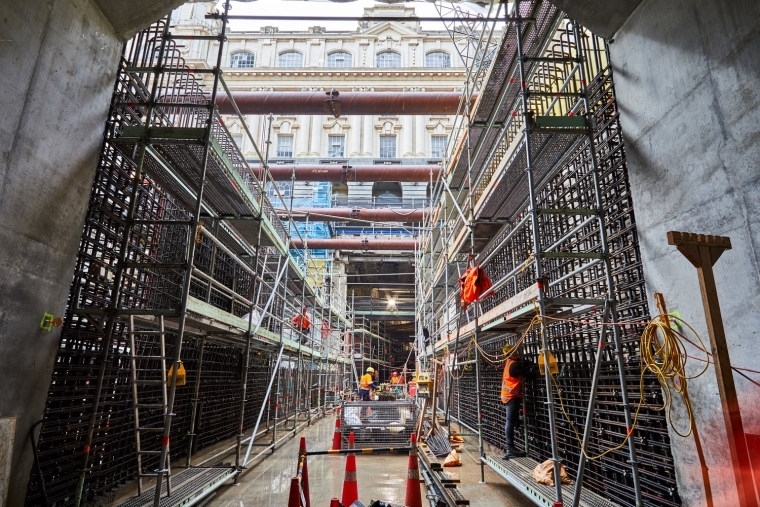
A new report from the New Zealand Infrastructure Commission says the country would need to spend around 60% of its infrastructure investment just to keep on top of NZ’s current infrastructure – rather than invest in building more.
The report, released on Friday, says it’s the first “comprehensive and consistent” view of the value of NZ’s infrastructure assets. It focuses on the supply of NZ’s infrastructure including how much the country has and how much NZ is investing in it.
Using data from Statistics NZ, the Commission’s report found the country’s infrastructure assets, excluding land, were valued at $287 billion in 2022 and the value of New Zealand’s infrastructure assets is rising over time.
Peter Nunns, the New Zealand Infrastructure Commission’s Director of Economics, says nearly three-quarters of NZ’s infrastructure assets are publicly owned through central and local government, with over one-quarter are commercially or privately owned.
Breaking it down further, $129 billion or 45% of this infrastructure is owned by central government, $76 billion or 26% is owned by local government, and $82 billion or 29% is commercially or privately owned.
The report says infrastructure assets comprise just over a quarter of all fixed capital assets in the New Zealand economy as the value of NZ’s total net capital stock – which isn’t just infrastructure – was $1.11 trillion in 2022.
“Infrastructure assets can have huge benefits for society, but they must be maintained, renewed, and repaired to ensure that they continue to provide those benefits - and that costs money,” Nunns says.
The report found between 2013 and 2022, depreciation costs for infrastructure were equal to 58% of new capital investment.
“For every $10 we spent on new infrastructure, almost $6 of existing infrastructure wore out,” the report says.
This leaves only $4 out of every $10 of investment available for new or improved infrastructure.
On the other side of that coin, the inflation adjusted value of NZ infrastructure assets has also risen per person from $32,900 in 1990 to $55,800 in 2022. This is a 70% increase in per-capita infrastructure assets, the report says.
This consisted of an 88%, or $34,100, increase of horizontal infrastructure assets – transport, electricity/gas, water/waste, and telecommunications infrastructure – and a 47%, or $21,700, increase in vertical infrastructure assets – education, hospitals, public administration and safety, including defence, social housing, and other types of public capital.
The report says this suggests the quantity and quality of infrastructure is rising “significantly faster” than New Zealand’s population.
Enough investment?
Nunns says it’s a question of if NZ is currently investing “enough” on renewed infrastructure.
“In some areas, like electricity distribution, the data suggests that assets are being renewed at about the right rate. But in other areas, like state highways, local roads, and water infrastructure, renewal investment seems to be too low to ensure our assets are maintained for the long term. If this trend continues, the condition of our infrastructure will decline,” he says.
“What’s even more concerning is that in some sectors, like education, health, and justice infrastructure, we couldn’t find good data on maintenance and renewal spending. This is because central government, which owns most of these assets, does not compile and publicly report this data.”
The report found current investment rates signal likely future investment levels and pointed to infrastructure investment made between 2003 and 2022 averaging 5.8% of gross domestic product (GDP).
Of that 5.8% GDP figure, 3.4% was spent on ‘horizontal’ infrastructure – like transport, electricity, water and telecommunications networks while 2.4% was spent on vertical infrastructure – like education, hospitals, social housing, and defence infrastructure.
It’s noted in the report that because NZ is investing “a roughly constant share” of GDP in infrastructure, and because GDP is growing over time, “the dollar value of infrastructure investment is rising both in total and in per-capita terms”.
“Sustaining higher investment would require us to increase taxes, rates, or user charges, while lower investment would require us to accept less or lower-quality infrastructure,” the report notes.
“In this context, it may be possible to modestly increase the share of GDP we invest in infrastructure, but it is more likely that we look for ways to change the mix of investment to better meet our future needs.”
We welcome your comments below. If you are not already registered, please register to comment
Remember we welcome robust, respectful and insightful debate. We don't welcome abusive or defamatory comments and will de-register those repeatedly making such comments. Our current comment policy is here.