
The expectation was clear. After peaking at the end of 2022, inflation in Australia was rapidly declining to a level that would allow the Reserve Bank of Australia (RBA) to start dropping the cash rate before the end of 2024. Not a moment too soon for many businesses and homeowners.
However, economic expectations are notoriously unreliable. And last week’s inflation figures were no exception. Economists had been forecasting Australian inflation for the March quarter to come in at 0.8% but the actual number was 1%. That compares with 0.6% for the December quarter.
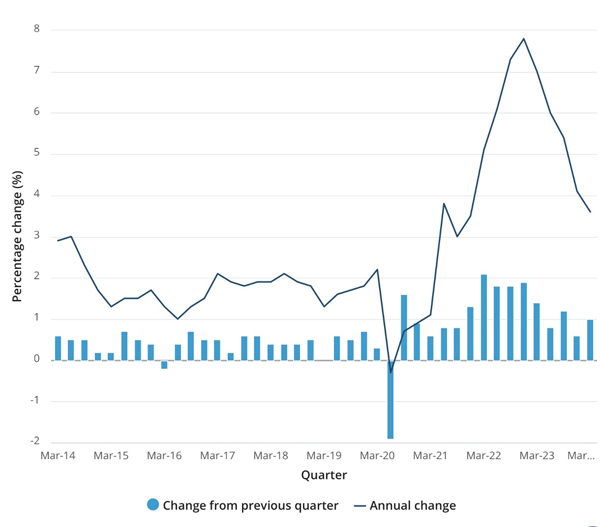
Source: Australian Bureau of Statistics
While the annual inflation rate continues to fall, the result for the March quarter is a sign that inflation remains sticky. Getting it down into the RBA’s desired range may take longer than originally forecast.
Significantly, some commentators now argue that not only are rate cuts off the table this year, but the RBA needs to raise rates again to slay the inflation dragon.
That possibility was quickly reflected by bond markets. The Australian dollar also rose at the prospect of interest rates remaining high for longer than previously predicted.
The current Australian cash rate is 4.35%, a figure that is materially lower than the rate in comparable countries like the US, the UK, Canada, and New Zealand. The RBA is endeavouring to quell inflation while limiting the economic damage caused by high interest rates. It remains to be seen whether this ‘softly-softly’ approach can work or whether it will prove more costly in the medium term.
Sticky inflation creates several problems for the Labor government. The first, and most acute, is the pain experienced by Australians in the current ‘cost-of-living crisis’. The key drivers of inflation in the latest period were rents (+2.1%), education (+5.9%), insurance (+3.7%), and health (+2.8%). Such rapid rises in the cost of services crucial to many voters spell trouble for a government facing an election next year.
The second problem for the government is that sticky inflation also means ongoing high interest rates for borrowers. Australian households (like kiwi households) are heavy borrowers, thanks in part to high house prices. They are also very exposed to current interest rates because so many mortgages carry floating rather than fixed rates.
The graph below from Shane Oliver, the economist for AMP Capital, shows the ratio of household debt payments to disposable income for a range of developed countries. It’s not a pretty picture for Australia.
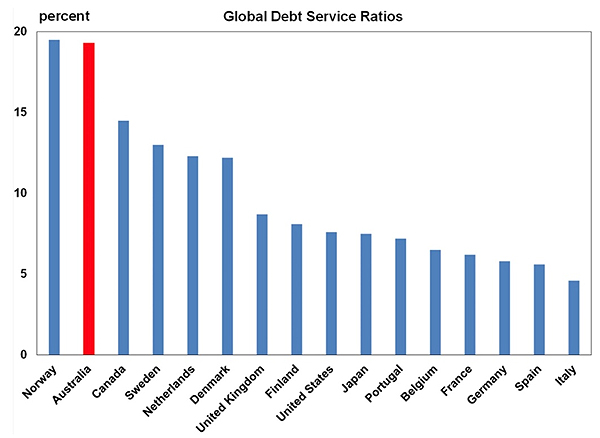
Source: AMP Capital
The contrast between Australia and major European countries like France, Germany, and Italy is remarkable.
Oliver highlights the difference between Australia and the US. Debt servicing takes up nearly 20% of household income in the former but just 7.5% in the latter. Much of this difference is attributable to the predominance of mortgages with floating rates in Australia but fixed rates in the US. That means Australians have suffered much more from the upward shift in interest rates post-Covid than Americans.
The third problem for the government is that it’s difficult to see how sticky inflation can be defeated without a material increase in unemployment. Hardly an appealing prospect for any government, let alone a centre-left Labor government hoping for re-election next year.
The good news, or the bad news depending how you look at it, is that the Australian economy is proving resilient, and the labour market remains reasonably tight. According to Judo Bank’s Chief Economic Advisor, Warren Hogan, ‘the Australian economy’s underlying fundamentals remain solid. … We are seeing an investment boom, led by a surge in infrastructure spending and solid building activity’.
Not an environment conducive to the RBA cutting the cash rate.
Sticky inflation also creates major fiscal restraints for the government. There is a budget due next month and the Treasurer, Jim Chalmers, is under enormous pressure to provide cost-of-living relief to struggling Australians. However, he knows that such relief, without compensating cuts elsewhere, would be inflationary.
To add to the pressure on the Treasurer, the Economic Inclusion Advisory Committee has just released its latest report. The Committee was established by the current government to advise on ‘boosting economic inclusion and tackling disadvantage’. Its report makes 22 recommendations to improve the lot of poorer Australians.
If implemented, the Committee’s recommendations would boost government spending by tens of billions of dollars. Not exactly a recipe for controlling inflation.
The challenge for the Treasurer is exacerbated by an already legislated new round of tax cuts worth $107 billion that will come into effect on 1 July.
Can the government cut taxes, stimulate economic growth, increase welfare spending, maintain low unemployment, and balance the budget, all while suppressing inflation? Not to forget two of its other goals that are part of the complex inflation equation – making housing more ‘affordable’ and getting the right ‘balance’ for immigration.
With an election rapidly approaching, the government is going to have to prioritise. Both fiscally and politically. Bringing inflation down will surely be a top priority. It would be absurd if the RBA was forced to raise the cash rate to dampen the economy because the government’s budget was too stimulatory.
Of course, absurdity is not unknown in politics.
*Ross Stitt is a freelance writer with a PhD in political science. He is a New Zealander based in Sydney. His articles are part of our 'Understanding Australia' series.
We welcome your comments below. If you are not already registered, please register to comment
Remember we welcome robust, respectful and insightful debate. We don't welcome abusive or defamatory comments and will de-register those repeatedly making such comments. Our current comment policy is here.