
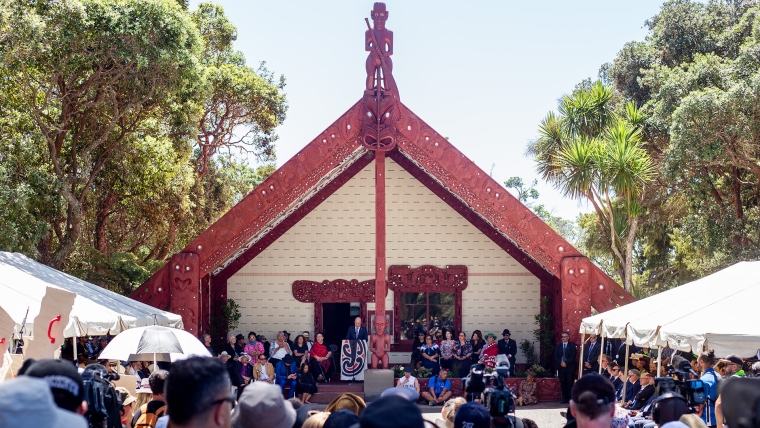
This year Prime Minister Christopher Luxon chose to steer clear of the Waitangi Day celebrations and confrontations at the Upper Treaty Grounds — he instead went to Ōnuku marae in Akaroa.
People have lots of opinions on this. Some said he was running scared, others that he wanted to distance himself from his pesky coalition partners.
The Prime Minister himself said he wanted to visit various different places where the Treaty was signed, as less than 50 of almost 500 rangatira did so at Waitangi.
Whatever the reason, Luxon got to hear an excellent speech from Ngāi Tahu chairman Justin Tipa.
The iwi leader was mainly talking about the Treaty but his message applies to economic policymaking, as well. He said New Zealand was "not a blank canvas" and that leaders had to combine the existing "strands of society into a workable whole."
“It’s a complex and messy task, but it’s important. Because when there’s an absence of this type of leadership, voices that represent comparatively simpler and shallower viewpoints, begin to shine through,” he said.
“Not because of the strength of their position or mandate, but because they’ve got a simple philosophy that provides simple answers to the complex questions we are inevitably confronted with”.
Minor parties were setting too much of the political agenda—not just on Treaty issues—because major parties lacked a clear vision, he said.
“So instead, we get an ACT Party neoliberal thought experiment, posing as a faux source of moral principle and national unity”.
Instead of retreating into political echo chambers, New Zealanders should focus on incremental gains over “radical revisions” and work to get the basics right.
“We won’t get anywhere if we keep debating which abstract, party-political philosophy to apply to a blank canvas instead of making reasonable refinements to a nation that actually exists”.
Seriously, read the full speech. It is fantastic and isn’t just relevant to Treaty politics.
Don't bother with boogeymen
For example, two economic debates—capital gains tax and asset sales—are brewing ahead of next year’s election, but neither is worth the fight. We don’t need to spend the next two years hyperfixating on these two policies, shouting simple and shallow viewpoints into our respective echo chambers.
First of all, there aren’t many assets to sell. David Seymour told Stuff that asset sales could raise $570 billion, but that’s only if he sold off every single asset on the Crown balance sheet.
That might mean listing the Beehive on Trade Me, finding a willing buyer for State Highway 1, and liquidating the Reserve Bank’s financial assets. It’s not serious.
What could be sold are state enterprises that are already run as commercial businesses such as property valuation firm Quotable Value. TVNZ has been offered as another example, although few investors are looking to buy into the television sector, right now.
Money raised from selling commercial assets could be reinvested in public assets which have a better rate of return at a macroeconomic level. For example, Auckland and Wellington have both sold minority stakes in their airports to invest more in transport and water infrastructure that will allow the cities to grow.
Another sensible asset sale would be allowing Kiwibank to raise capital through an initial public offer on the stock exchange. To its credit, Labour says it may support this.
However, there is a furious ideological opposition to most other asset sales. The Public Service Association has already launched a campaign to oppose the hypothetical sale of Quotable Value some time after 2026 — as if they don’t have bigger fish to fry.
If the left is irrationally allergic to asset sales, the right is bizarrely opposed to a capital gains tax. It is really not clear why, as it is a pretty moderate and sensible policy change.
Perhaps the strongest argument against the tax is that it won’t raise much revenue. A recent Official Information Act request dug up a 2018-era estimate that a capital gains tax would take eight years to build up annual revenue equal to half a percent of GDP.
The way I see it, New Zealand has three major economic issues: the cost of housing, insufficient infrastructure, and an imbalance between Government spending and revenue.
Both asset sales and a capital gains tax could help, but neither is a gamechanger. We shouldn’t sweat the small stuff just because they are ideological boogeymen.
To quote Justin Tipa again: “We won’t get anywhere if we keep debating which abstract, party-political philosophy to apply to a blank canvas instead of making reasonable refinements to a nation that actually exists”.
We welcome your comments below. If you are not already registered, please register to comment
Remember we welcome robust, respectful and insightful debate. We don't welcome abusive or defamatory comments and will de-register those repeatedly making such comments. Our current comment policy is here.