

We hear a lot these days about the number of New Zealanders leaving to live and work overseas and the effect this is having on our population growth.
But it may be that population patterns from migration are simply returning to their long-term norms after a period of significant disruption.
It is certainly true that the number of New Zealand citizens emigrating to foreign shores is close to a record high, with Statistics NZ estimating 69,231 left long-term over the 12 months to the end of January this year.
The effects of that loss were mitigated by the return of 24,997 NZ citizens after an extended stay overseas during the same 12 month period..
That gave an estimated net loss of 44,234 NZ citizens over the 12 months to the end of January this year.
Having a net loss of NZ citizens in a year is not unusual, in fact it is the norm.
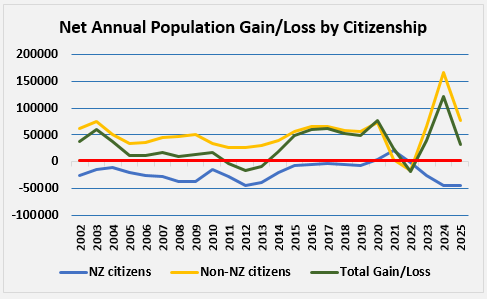
Over the last 24 years to January, there was a net loss of NZ citizens due to migration every year from 2002 to 2019 and then again from 2022 to 2025.
The only time in the last 24 years that more New Zealanders have returned than departed long-term was in 2020 and 2021 as the Covid pandemic gripped the planet, and NZ citizens rushed back to home and hearth.
The net losses then resumed in 2022, as shown in the graph below, (the blue line).
Although the net loss of 44,234 NZ citizens in the year to January 2025 was high, it wasn't a record.
That was set in the previous 12 months, (year to January 2024), when there was a net loss of 44,731 NZ citizens.
Neither was the net loss that unusual.
The net loss in 2012 came close at 43,519 and also in 2008/2009 when it was around 37,000 in both years.
So the current high net loss of NZ citizens may already have passed its peak and be beginning to stabilise.
One thing the high outflow of NZ citizens has done is to bring down the total population gain from migration to around its long-term average.
Over the 24 years from 2002 to 2025, 12 months to January, Statistics NZ figures suggest there was a cumulative net population gain of 763,281 people from migration, which gives a long-term average of 31,803 a year.
That in turn is near enough to bang-on the net gain of 32,471 in the 12 month to January this year.
So in spite of recent swings and roundabouts in the composition of NZ's migration figures, total net population growth from migration is currently running at its long-term average, which may not be a bad thing.
After all, it must be a lot easier to provide the necessities of modern life, such as employment and housing and services such as health, education and efficient transportation, to 32,000 extra people, than it was to provide those things to the almost 122,000 that swelled this country's population in the year to January 2023, or even the 77,000 in 2019/20.
The comment stream on this story is now closed.
We welcome your comments below. If you are not already registered, please register to comment
Remember we welcome robust, respectful and insightful debate. We don't welcome abusive or defamatory comments and will de-register those repeatedly making such comments. Our current comment policy is here.