
sign up log in
Want to go ad-free? Find out how, here.

The future of work — according to Generation Z — is purposeful, digital and flexible

Economy / analysis
The future of work — according to Generation Z — is purposeful, digital and flexible
z
Gen Z hold strong views around equity and sustainability, often expecting their employers to ‘walk the talk.’ (Unsplash).

By Eddy Ng*

As Generation Z — those born between 1997 and 2012 — enters the workforce in growing numbers, Canadian employers are encountering a cohort whose expectations and behaviours signal a fundamental shift from current norms.

Unlike previous generations, Gen Z brings pragmatic sensibilities shaped by the unique social, economic and technological landscapes of their upbringing.

Gen Z grew up amid economic uncertainty, technological upheaval and heightened social awareness. Unlike millennials, who entered the job market with “great expectations” for rapid promotions and pay raises, Gen Z is more pragmatic.

And so if Canadian organizations want to attract, engage with and retain this generation of talent, it’s essential to understand what makes them tick.

Purpose, values and why Gen Z stays

Recent research shows that this generation values job security, work-life balance and mental health above all else. These preferences are shaped by formative experiences, including observing their Gen X parents navigate dual-career households and witnessing economic disruptions and automation-driven restructuring.

For Gen Z, stability is seen as essential for their well-being at work.

This generation is ambitious, albeit in ways that diverge from traditional hierarchical advancement. Rather than prioritizing vertical mobility, they seek roles that provide flexibility, meaningful contribution and alignment with personal values.

Central to Gen Z’s workplace vision is a desire to work for organizations that prioritize diversity, inclusion and corporate social responsibility. This generation is the most racially diverse in Canadian history and has grown up in a more socially conscious environment. They tend to hold strong views around equal treatment and environmental sustainability, often expecting their employers to “walk the talk.”

One report suggests that Gen Z employees are significantly more likely to remain with organizations that offer purpose-driven work, with retention likelihood increasing by a factor of 3.6 when such alignment exists.

The rise of 'conscious unbossing'

One notable trend within Gen Z is the preference for collaboration over authority.

A recent survey reveals that nearly half of Gen Z professionals favour promotions that do not entail supervisory responsibilities. This reluctance stems from the perceived drawbacks of traditional leadership roles, including heightened stress, rigid scheduling and diminished autonomy.

Some Gen Z workers even indicate a willingness to accept reduced compensation to avoid managerial obligations. This phenomenon, described as “conscious unbossing,” presents a structural challenge for organizations anticipating leadership gaps as baby boomers retire and millennials ascend to senior positions. This means a reconceptualization of leadership, emphasizing project-based authority, mentorship opportunities and expertise-driven influence rather than hierarchical control.

This generation is also the first to grow up entirely within a digital ecosystem, resulting in expectations for seamless technological integration across work processes. Gen Z actively leverages AI tools for skill development, yet formal organizational training often lags behind these self-directed practices. If organizations don’t offer structured, technnology-based learning, digital gaps among employees will grow.

Employers will need to invest in continuous learning opportunities such as micro-credentialing, AI-driven platforms and intergenerational mentorship that can enhance skill acquisition while respecting Gen Z’s preference for autonomy.

Flexible work arrangements also constitute an important characteristic of Gen Z workers’ employment preferences. Having studied and entered the workforce during the COVID-19 pandemic, they view remote and hybrid work arrangements as normal rather than an exception.

Flexible scheduling and outcome-based performance metrics are perceived as baseline expectations rather than discretionary benefits. Employers that adhere rigidly to traditional work structures risk attrition among Gen Z employees. Instead, employers should prioritize policies that emphasize results over physical presence.

How employers must adapt or risk losing talent
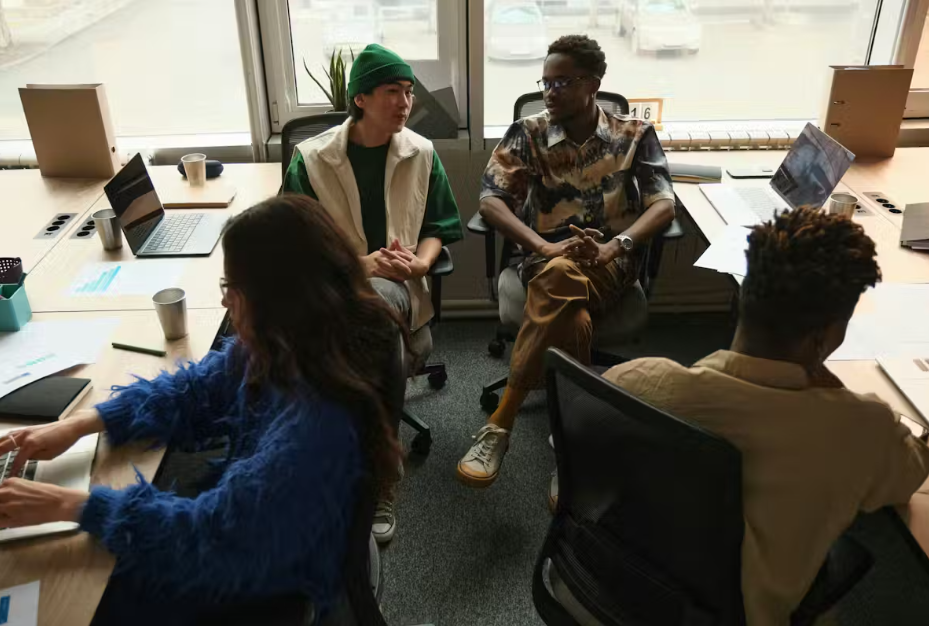
One of Gen Z’s preferences is collaboration over hierarchy, which has led to a phenomenon called ‘conscious unbossing.’ (Unsplash).

To attract and retain Gen Z talent, Canadian employers should adopt evidence-based strategies that include redefining career pathways by moving away from traditional linear models toward frameworks that emphasize lateral mobility, project leadership and skills-based advancement.

As AI and algorithmic HR systems become more prevalent, employers must consider how these tools align with Gen Z’s ways of working. They expect technology to enhance — but not replace — the human side of work.

While AI and automation can improve efficiency, Gen Z places a premium on trust and authentic relationships. Employers should ensure transparency in algorithmic decision-making and maintain opportunities for personal interaction, as these elements are critical to engagement and retention for this cohort that values connection as much as convenience.

Sustainability is another priority for Gen Z. For this generation, climate action is not a marketing slogan, but a moral imperative. Employers must move beyond superficial “greenwashing” and embed sustainability into employment practices, from eco-friendly benefits to green office policies.

These initiatives should be inclusive, ensuring that environmental efforts also advance equity and deliver tangible benefits for all employees. Gen Z expects organizations to demonstrate measurable progress on both ecological and social fronts. Likewise, diversity and inclusion will remain critical for Gen Z, even in politically polarized environments.

And because this generation values guidance but prefers collaborative, non-hierarchical relationships, mentorship must also evolve. Employers should expand mentoring programs to include underrepresented groups, creating pathways for career stability and growth.

Understanding Gen Z and taking the steps to meet these new professionals where they are will help employers create the necessary trust for meaningful growth.The Conversation


*Eddy Ng, Smith Professor of Equity and Inclusion in Business, Queen's University, Ontario.

This article is republished from The Conversation under a Creative Commons license. Read the original article.

We welcome your comments below. If you are not already registered, please register to comment

Remember we welcome robust, respectful and insightful debate. We don't welcome abusive or defamatory comments and will de-register those repeatedly making such comments. Our current comment policy is here.

13 Comments

This reluctance stems from the perceived drawbacks of traditional leadership roles, including heightened stress, rigid scheduling and diminished autonomy.

While understandable, it doesn't give much hope for those wishing to step up for their generation to lead. Sit in the background and get your paycheck it sounds more like, while never getting a hard word or being told no.

Gen Z actively leverages AI tools for skill development

Is it leveraging, or outsourcing any skills to AI to do for them? Granted the prevalence of AI being used to subvert real work in tertiary education, and seeping into high school work also, I wonder.

Employers should expand mentoring programs to include underrepresented groups, creating pathways for career stability and growth.

Is this inclusion, or going against a meritocracy for the sake of an organisations image as we have seen since 2020?

Up
4

Coming from an industry background, there has been a marked growth in aptitude testing and work trial to make sure new employees skills are real, rather than something out of AI-driven grade inflation.

Up
6

Great to hear. I've spoken to many teachers of polytechs, high schools and universities who all say AI is like drug smuggling, you are constantly trying to keep up with AI's methods to detect AI essays etc, but the best way is to ask the student about the content and if they can't articulate what is written and explain it, then they clearly haven't done the work.

Up
3

Coming from an industry background, there has been a marked growth in aptitude testing and work trial to make sure new employees skills are real, rather than something out of AI-driven grade inflation.

Good to hear. In terms of aptitude, willingness to learn is an important trait. Given the digital native lives of Gen Z, employers should be using digital tools to develop these people. My colleagues did such an exercise with Unilever and it worked extremely well. Mind you. the Unilever-style job is less desirable now and the associated career is somewhat going out of fashion.  

Up
1

Interesting the way this article is shaped. Remuneration is likely approached separately which would tend to indicate a lack of understanding of the total picture but the focus on work life balance and mental health requires reasonable remuneration packages to develop the lifestyles that enable them to deal constructively and unload the stresses from work and having to survive in general. This is something that most people don't seem to comprehend fully. Struggling to survive on low pay is detrimental to peoples work performance and mental health as well as physical health.

The "Unbossing" concept reads to me like a cry for real leadership and less "Management". Arrogant egos don't generally get the best from their workers.

Up
4

The desired stability, dislike for holding authority, and so on, make it sound like Gen Z want management to be a parenting relationship.

Not unreasonable to want mentoring, training and to be regarded as a valued worker rather than a human resource to be used up - but the corollary is that desire to be parented makes people very easily led and management positions will be ever-more filled by faux-collaborative egoists, rather than those best suited the job.

Up
3

A part of professional development includes the development of confidence in ones own abilities. Many, with some justification, are reluctant to truly exhibit what they can do for fear of pushback because others feel threatened. I know I've seen it. The ability to work collaboratively, bringing your own skills and abilities without being threatened by what others can do that you can't, or opinions that diverge from yours is a skill. Not everyone has it. Call it parenting if you want but it remains a part of the learning process.

Up
4

The common fear of other’s ability, particularly from bosses, says a lot about our national neurosis and adversarialism that sees everything in absolutist win/lose terms, and is the enemy of meritocracy while the lack of collaboration hinders our ability to function as a nation - but the divided nature of our society does make us easy to manage.

Karl Popper said he'd never seen a people as easily governed as New Zealanders. It wasn't a compliment.

Up
1

This is the antithesis of working in a government department, however years ago at DIA things were a bit better, and communications form bottom to top was smoother and less hierarchical. My experience otherwise with Govt employment was that through 2020 onwards, those that stayed the longest got better roles as so many were jumping from dept to dept, there was a large loss of collective experience leading to sub par workers due to lack of mentors to teach on the job skills, and promotion of some to roles they were not competent for due to hiring for diversity over competency. Interesting to see however that the youth think COVID times such as working from home and large pay increases are the norm. Reality currently must be biting as they can't command such large increases in salary and not always have the option for WFH in organisations. 

Up
1

Some leadership training wouldn't go astray, to motivate those suitable rather than the traditional wisdom of the Peter principle

Up
3

Servant Leadership is hard to find.

Corporate speak is also often two faced.  You spend years trying to convince bosses you have a succession issue, including loading key man risk, only to have staff reduced further during the next recession redundancy round making the situation even worse, the younger members got fired.

The boss won't hear that two people cannot possible do the work of the previous three, so you start putting work requests into a prioritization queue (prioritized by said middle manager) ,   obviously many pieces of work end in the "far queue" hint {can be spelt differently}, but has same effect.

So now two people can do the work of three, its just 1/3 of the work is never being prioritized high enough to actually get done.   But all is well, as we are prioritizing things effectively.

No one complains they have big mortgages, and it was the CEO's call to cut staff, you cannot fight it anyway!

Young idealists hate this BS game of word salad.

Risk keep asking what you plan to do about your succession risk that was loaded ......   


You smile and know you have only 5 years to retirement yourself, and suggest they raise it with ExCo at the next quarterly risk review meeting.   Its all a game, and while the music is playing you have to dance.


Up
4

There's also a trend that the psychos rise to close to the top. There's a few good ones as well. But it just takes a few psychos in the wrong positions to create an unpleasant atmosphere. 

Up
3

But all is well, as we are prioritizing things effectively.

Silly isn't it. Just keep fudging the numbers and priorities however you can to make it look like the organisation is coping to the outside world, while internally it is slowly rotting. That or companies have too many making new tools and 'frameworks' through dozens of meetings and fake laughter tryin go influence each other to their own personal agenda for the project, to have a big reveal of some supposedly wonderful new tool,.....that never gets used after the release, and the lemmings go back to another project to justify their jobs. 

Up
2