
International real estate consultancy Knight Frank has just released its latest, and twentieth, annual Wealth Report. It makes interesting reading for Antipodean investors.
Among a vast array of data, perhaps the most striking figures are the (negative) growth rates for prime residential property in Auckland and Wellington.
The Knight Frank Prime International Residential Index, known as the PIRI 100, ‘tracks movements in luxury prices across the world’s top residential markets’. It includes ‘major financial centres, gateway cities and second-home hotspots … as well as leading luxury alpine resorts’.
The Australasian markets covered in the PIRI 100 are Auckland, Wellington, Christchurch, Sydney, Melbourne, Brisbane, and the Gold Coast.
The 2025 rankings and price changes for those markets were as follows –
| 48. Gold Coast | 2.8% |
| 53. Christchurch | 2.1% |
| 54. Brisbane | 2.1% |
| 78. Sydney | -0.4% |
| 84. Melbourne | -1.3% |
| 91. Wellington | -3.1% |
| 96. Auckland | -5.2% |
Knight Frank describes the performance in Australian lifestyle-led and second-home markets as ‘strong’. It specifically highlights the growth in Brisbane driven by the 2032 Olympic Games and major investment in infrastructure. The ceiling for luxury apartment prices in the city has risen from ‘around US$7 million to over US$11 million in just 12 months’.
In other bullish news for the Sunshine State, the latest Wealth Report states that ‘the best prime homes in Queensland are now seeing sales above US$15 million – a level that would once have seemed remarkable’.
By contrast, Sydney saw a small price decline in 2025. That result is a little surprising given that the city had 52 ‘super-prime’ sales of more than US$10 million (approximately NZ$16.5 million) in the last quarter of the year. That’s the highest number on record for a quarter and well ahead of London with just 35 super-prime sales in the same period.
The Wealth Report also provides data on the worst performing residential markets over the last five years. Auckland and Wellington are standouts, but not in a good way.
The City of Sails ranks third to last out of the one hundred markets monitored by Knight Frank, while the kiwi capital sits at the bottom of the table – last by a considerable distance.
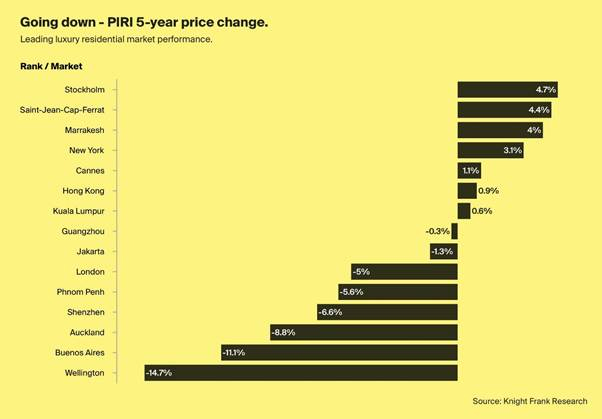
Auckland and Wellington are two of only eight PIRI 100 markets that have declined over the last five years.
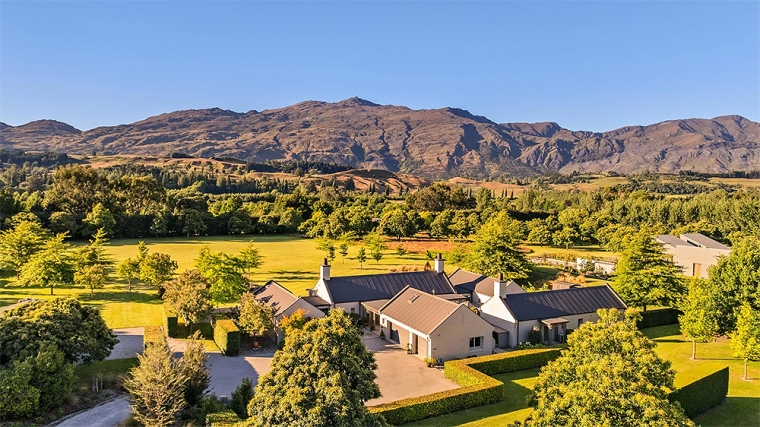
However, the analysts at Knight Frank have some good news for New Zealand. Included in their report is a top ten of the world’s ‘hottest housing markets’. And sitting alongside such international favourites as Lake Como and Manhattan’s Upper East Side is … Dalefield, Queenstown.
Knight Frank is effusive in its praise for Queenstown –
Set against the dramatic backdrop of the Southern Alps, Queenstown remains one of the southern hemisphere’s most established lifestyle destinations, drawing visitors year round for its alpine scenery, winter snow and vibrant calendar of food, wine and outdoor pursuits.
Wine rates a mention elsewhere in the Wealth Report. Investment in vineyards is identified as a global ‘wealth trend’. Specific reference is made to the growing appeal of southern hemisphere vineyards, including those in Central Otago and Marlborough.
More good news for Queenstown.
Also relevant are the new rules allowing foreigners to acquire New Zealand property worth more than NZ$5 million. This is identified by Knight Frank as a likely source of demand for high-end kiwi property.
That’s true, but wealthy Australians and New Zealanders are likely to remain the primary purchasers of such property. The Wealth Report suggests there will be plenty of them.
Knight Frank has a ‘Wealth Sizing Model’ that records the pace of global wealth creation. It forecasts the rise in the number of ‘ultra-high net worth individuals’ (UHNWIs) – people worth more than US$30 million – over the next five years.
The projections for Australia and New Zealand augur well for luxury property in New Zealand.
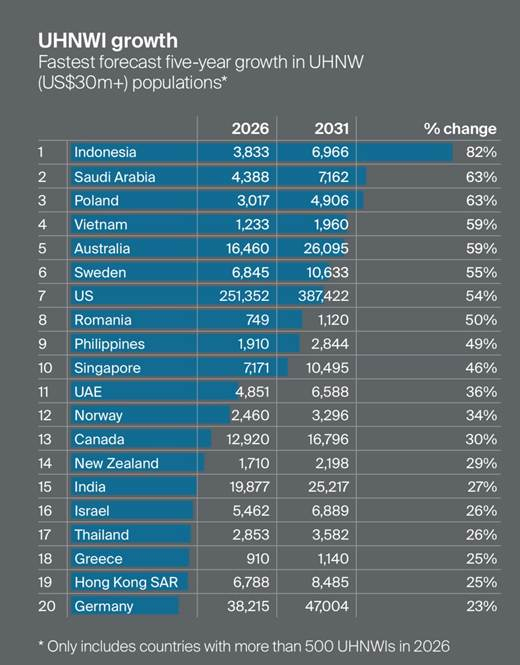
Source: Knight Frank Research
That’s an additional 10,000 Australasian UHNWIs in just five years. Most will be Australian but a significant number of them will have prime New Zealand real estate on their radar. For Sydneysiders and Melburnians Queenstown is closer than much of Australia.
And climate change may increase its appeal.
Knight Frank notes that ‘Australia punches well above its weight in the global wealth landscape’ and ‘stands out for the diversity and durability of its wealth creation story’. That will inevitably have an impact on the luxury property market in New Zealand.
The strength of the Australian dollar against its kiwi counterpart is another important factor. It makes a Waiheke beach house or a Queenstown lake house even more affordable to all those rich Australians.
We haven’t heard the last of Dalefield.
*Ross Stitt is a freelance writer with a PhD in political science. He is a New Zealander based in Sydney. His articles are part of our 'Understanding Australia' series.
We welcome your comments below. If you are not already registered, please register to comment
Remember we welcome robust, respectful and insightful debate. We don't welcome abusive or defamatory comments and will de-register those repeatedly making such comments. Our current comment policy is here.