

New Zealanders are happier than Australians.
Well at least that’s the suggestion of the latest World Happiness Report. According to the report, kiwis rank 11th in the world in the happiness stakes ahead of Australia in 15th place.
(Of course, as with most such research, the happiest, healthiest, most satisfied people, and all round ‘winners’, are the residents of the Nordic countries.)
If kiwis are happier than Aussies, why are so many still making the move across the ditch? Including former Prime Minister Jacinda Ardern who is currently looking for a home for herself and her family in Sydney’s northern beaches. (Some critics of the former PM have reprised Rob Muldoon’s description of westward migrants as ‘raising the IQ of both countries’.)
Ardern’s move has brought international attention to the so-called Trans-Tasman ‘brain drain’ including commentary from the BBC and the New York Times.
One piece in the NYT summed up the motivation for kiwis moving to Australia as ‘more money, better vibes’.
The World Happiness Report certainly supports the ‘money’ explanation. It suggests NZ is more equal and less corrupt than Australia with greater freedom and social support. But these positives appear to be outweighed by per capita GDP.
Comparing incomes between the two countries is difficult. The latest per capita GDP figures from the World Bank relate to the 2024 year – US$64,600 for Australia and US$49,200 for NZ. Neither country experienced much growth in 2025.
One dramatic change over the last twelve months has been the 10% depreciation of the NZ$ against the A$ - from about 92 Australian cents to just 82 Australian cents.
That’s good news for kiwis already holding Australian assets but bad news for kiwis looking to cross the Tasman and buy a house in an Australian capital city. It’s difficult to predict what impact the exchange rate movement will have on migration.
The Reserve Bank of Australia raised the cash rate this week to 4.35% and many commentators are forecasting one or two more rises this year. Accordingly, a dramatic reversal in the differential between the two currencies seems unlikely, at least in the short term.
One factor that has probably influenced the net movement of kiwis to Australia in recent years has been the stronger jobs market in Australia. The NZ unemployment rate was 5.3% in March compared with 4.3% in Australia.
Of course, both numbers may now be rising as the repercussions of the Iran energy shock play out. The RBA is forecasting Australian unemployment to rise to 4.7% by mid-2028. Its own rate setting policy may well contribute to that rise.
But is the New York Times correct in identifying ‘better vibes’ in Australia? That’s hard to measure.
Last month saw the release of a fascinating report by the Australian National University into how Australians are feeling – Holding Together, Just: Wellbeing, Economic Strain, and Democratic Resilience in Australia. The report is based on the polling of 3,662 Australian adults in mid-March (after the start of the US/Israel war against Iran) and incorporates data from 28 previous polls dating back to 2019.
Perhaps the most significant revelation is the declining level of ‘average life satisfaction’ in Australia. It has fallen to the lowest recorded level – below the low reached during the Covid-19 pandemic.
Average life satisfaction, October 2019 – March 2026, Australia (0-10 scale)
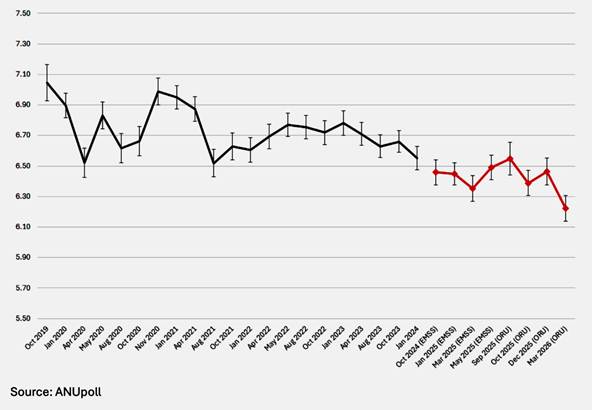
The life satisfaction figures are consistent with polling showing ‘more than one in three Australians are finding life difficult or very difficult on their current income’.
In the words of Professor Nicholas Biddle, Head of the ANU School of Politics and International Relations, ‘Australia in March 2026 is a country under considerable strain’.
That’s an interesting comment for would-be kiwi immigrants.
Finding it difficult or very difficult on present income, February 2020 – March 2026, Australia (%)
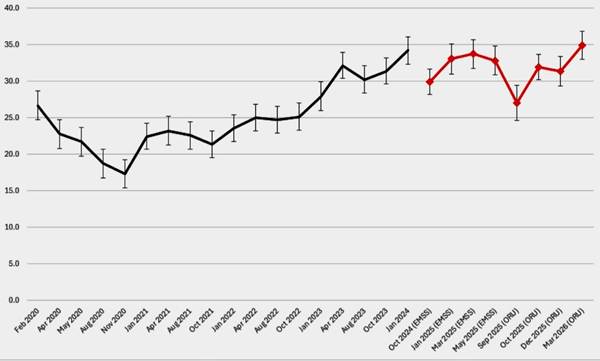
Source: ANUpoll
Another surprising result is that 54% of respondents said that they are ‘not very or not at all satisfied with the direction of the country’ compared with 46% who are ‘very or fairly satisfied’.
Even more surprising is that 59% think life was better 50 years ago and expect it to be worse in 50 years' time.
Not exactly a ringing endorsement of modern Australia.
But there is some good news. Young Australians are more satisfied with the direction of the country and more optimistic than older Australians. Maybe it’s just grumpy boomers dragging down the numbers.
Australia, like New Zealand, has a foreign-born population of more than 30%. Interestingly, the report records that migrants are substantially more satisfied with Australia’s direction than home-grown Australians.
There’s one finding that may not surprise New Zealanders. Australian citizens born in other English-speaking countries (primarily NZ and the UK) ‘report lower levels of closeness to Australia’ than citizens who were born in Australia or migrated from non-English speaking countries.
Clearly many poms and kiwis living in Australia are still torn between their homeland and their adopted country.
*Ross Stitt is a freelance writer with a PhD in political science. He is a New Zealander based in Sydney. His articles are part of our 'Understanding Australia' series.
We welcome your comments below. If you are not already registered, please register to comment
Remember we welcome robust, respectful and insightful debate. We don't welcome abusive or defamatory comments and will de-register those repeatedly making such comments. Our current comment policy is here.