
By Alessio Terzi & Stefano Marcuzzi*
When SpaceX lists a fraction of its shares on the Nasdaq later this week, at an anticipated valuation around $1.75 trillion, it will be the largest initial public offering in history. Investors are being asked to price a company that builds rockets, runs the world’s dominant satellite-internet network, and increasingly underwrites the military communications of the US and its allies (though these successful businesses must be weighed against the cash-burning AI venture that Elon Musk has bundled into the same corporate structure).
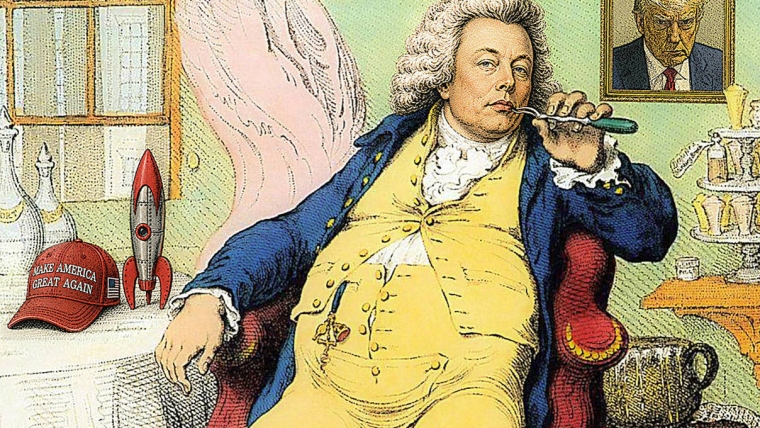
The SpaceX prospectus tells an ambitious, singular story: this is a high-growth technology champion that deserves to stand alongside the world’s largest and most powerful companies. But history suggests another, less reassuring trajectory, because the enterprise that SpaceX most resembles is not Apple or Nvidia. It is the East India Company, which lasted nearly 300 years.
To be sure, SpaceX is not about to tax populations or rule over human subjects, as the chartered companies founded in the early modern era eventually did. Space has no inhabitants (that we know of). Still, we are dealing with a firm that is operating beyond the reach of any sovereign, and which has already accumulated immense powers that governments are belatedly struggling to reclaim.
Between roughly 1570 and 1860, European states projected power into and across ungoverned oceans through chartered joint-stock companies—the British, Dutch, and French East India Companies chief among them.
The chartered companies were hybrid beasts, commercial ventures that also served as instruments of the state. They built monopolies, exploited the absence of law to write their own rules, and carried out sovereign functions—from minting money and policing local populations to fighting wars and signing treaties. Edmund Burke called the East India Company “a state in the guise of a merchant,” and the same configuration is now being reassembled in Earth’s orbit.
First, consider the question of monopoly. By landing and reusing its boosters, SpaceX solved a chicken-and-egg dilemma. Because reusability is profitable only at a high launch frequency, the company built Starlink, a constellation of thousands of satellites whose growth and upkeep guarantees a steady launch cadence. Rivals without both the rockets and the captive demand for satellite connectivity cannot easily break in.
As we document in a new paper, SpaceX’s share of global mass launched into orbit has risen from under 10% in 2014 to nearly 80% today, and to 94% in the United States, where it counts NASA among its biggest customers. In the process, SpaceX has claimed scarce orbital slots and radio spectrum, raising entry barriers for future newcomers. This is not the oligopoly of textbook technology markets. It resembles something older.
Then there is the legal vacuum. The 1967 Outer Space Treaty was written for a world in which governments held a monopoly on space. It states that “outer space is not subject to national appropriation by claim of sovereignty, by means of use or occupation, or by any other means,” and it reserves space “for the benefit … of all mankind”; however, it supplies no machinery for enforcement.
It was into this yawning gap that the US introduced the Commercial Space Launch Competitiveness Act in 2015 and the Artemis Accords in 2020, which assert that extracting resources is not “appropriation.” That was exactly the change SpaceX needed. Likewise, a company’s charter three centuries ago was both a license to trade and a unilateral claim dressed up as law. In both cases, first movers wrote the rules for themselves.
Yet another parallel is the blurring of sovereign and private. Recall that in 2022, Musk refused to switch on Starlink over Crimea to enable a Ukrainian strike on Russia’s fleet. A private individual effectively vetoed the decision of a sovereign state, and not even the US government could easily override it. As activity moves to the moon, SpaceX will be in a position to exert significant influence on setting standards, managing resource claims, and policing the “safety zones” that the Artemis Accords allow states to declare. Thus, a private company may provide the answers to fundamentally sovereign questions.
Just as Britain granted the East India Company its charter to prevent the Dutch from cornering the spice trade, the US has empowered SpaceX in its race to achieve strategic dominance in space before China does. Yet the more indispensable the firm becomes, the less authority the state will retain. This fragility was on full display last year when President Donald Trump and Musk publicly feuded. Trump threatened to cancel SpaceX’s government contracts, and Musk threatened to sever the US government’s access to the International Space Station. A nominally sovereign power found itself dependent on an actor it could court but not command.
The lesson from the era of the chartered companies is that such power, once entrenched, is maddeningly difficult to claw back. Britain reined in the East India Company seriously only in 1858, after a famine, a fiscal crisis, and a violent revolt (what the British call the “Great Mutiny” and Indians “The First War for Independence”) made inaction impossible. Yet by that point, the cost of doing so was ruinous.
The same history also suggests what governments should do now, before it is too late. The aim of restoring control is not to break a champion but to limit the state’s dependence on it. The East India Company’s continental peers are the better guide here. The Portuguese and French crowns each held equity in their respective charter companies, thus securing a measure of strategic control from within. A government-appointed board seat in firms that wield sovereign-like powers, or a minority stake of the kind that the US recently took in Intel, would ensure oversight of safety zones, resource claims, and critical infrastructure without smothering the private incentives that made the sector dynamic.
The window for gaining some control over the behavior of today’s emerging tech sovereigns is closing fast. The question for policymakers is whether knowing what the East India Company became is enough to keep its 21st-century successor off the same path. The SpaceX IPO is a good moment to ask.
Alessio Terzi is an Assistant Professor at the Bennett School of Public Policy at the University of Cambridge and an Adjunct Professor in Economics at Sciences Po. Stefano Marcuzzi is Assistant Professor in History of International Relations at the Centre for Higher Defence Studies (CASD). This content is © Project Syndicate, 2026, and is here with permission.
We welcome your comments below. If you are not already registered, please register to comment
Remember we welcome robust, respectful and insightful debate. We don't welcome abusive or defamatory comments and will de-register those repeatedly making such comments. Our current comment policy is here.