


Many hopeful first home buyers in Auckland, Tauranga and the Kapiti Coast are likely facing a Catch-22 situation, where they can't scrape together enough money for a 20% deposit, but are also unlikely to be able to afford the repayments on a low equity mortgage with a smaller deposit.
Although mortgage interest rates are steadily rising, they are still at a reasonably affordable level compared to previous years.
The average two year fixed rate rose from its recent low point of 4.49% in November last year to 5.24% in May this year.
Although that's up from where it was in May last year (5.01%), it's still well below the level of May 2024 (6.74%) and a high of 9.64% set in March 2008. (Interest.co.nz's records only go back to 2002).
At the same time, housing prices have also fallen back from their recent highs.
According to the Real Estate Institute of New Zealand, the national lower quartile selling price was $600,000 in May this year. That's exactly the same as it was in February 2026, October 2025, December 2024, March 2024 and November 2023.
Essentially, prices at the bottom end of the housing market aren't going anywhere, but they are down from the record high of $670,000 set in November 2021.
Of course lower quartile prices vary greatly at the regional level, and in May this year they ranged from $422,000 in Southland to $790,000 in Auckland.
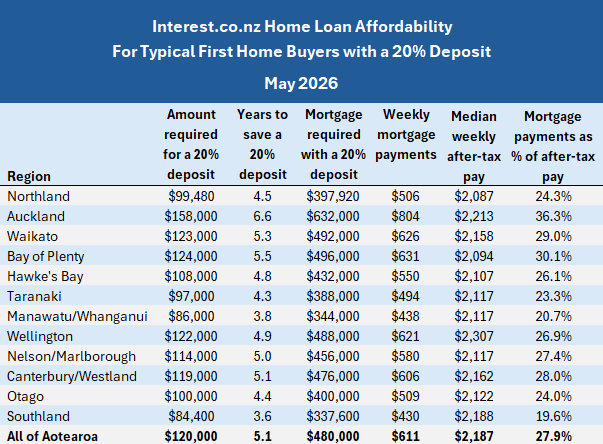
So to buy a lower quartile-priced home with a 20% deposit, first home buyers would need to scrape up (savings, KiwiSaver, mum and dad, favourite aunty and uncle, Lotto) somewhere between $84,400 and $158,000, depending on where they wanted to live.
Getting that sort of money together is no easy feat for a young couple starting out. Interest.co.nz estimates a couple earning median rates of pay for people aged 25-29 would need to save 20% of their after-tax pay for 3.6 years to get a 20% deposit on a lower quartile-priced home in Southland, and 6.6 years for one in Auckland.
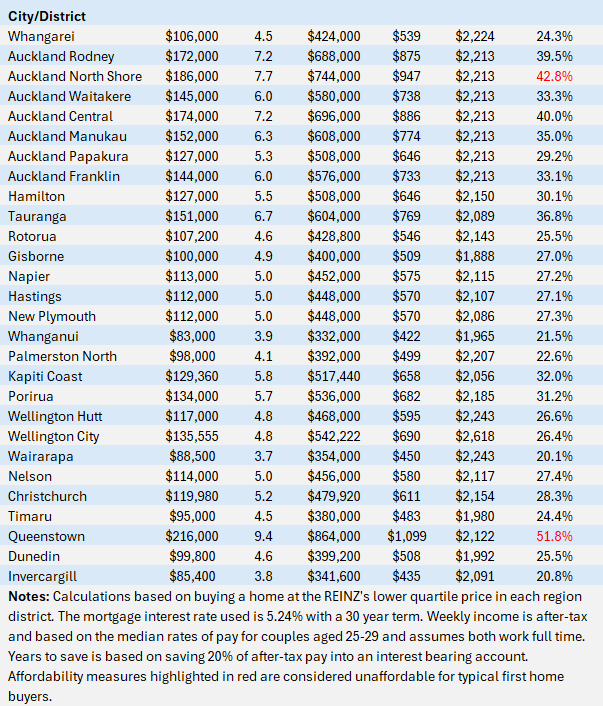
The good news for those buyers is that once they have a 20% deposit, the mortgage payments on a lower quartile-priced home should be well within affordable limits for typical first home buyers on average incomes, and that applies to all regions of the country, including Auckland.
Interest.co.nz estimates that the mortgage payments on a lower quartile-priced home in Auckland purchased with a 20% deposit would be around $804 a week, equivalent to 36.3% of the combined after tax pay of a typical first home buying couple.
That's still well below the 40%-plus threshold at which mortgage payments would be considered unaffordable.
In Southland the mortgage payments would take up just 19.6%, of a typical first home buying couple's after-tax pay and the rest of the country is somewhere in between those two figures.
Clearly, housing at the lower quartile price is affordable for typical first home buyers in all regions of the country, provided they have a 20% deposit.
But what if getting a 20% deposit together is just a mountain that's too high to climb for some first home buyers?
Banks are willing to provide mortgages to buyers with less than a 20% deposit and are actively doing so.
According to the Reserve Bank, 46.2% of the mortgages approved to first home buyers in April were low equity loans where the borrower had less than a 20% deposit.
So a low equity loan provides a way around the lack of a 20% deposit for many first home home buyers.
But it is not a free run, because low equity mortgages are significantly more expensive that those with a regular 20% deposit.
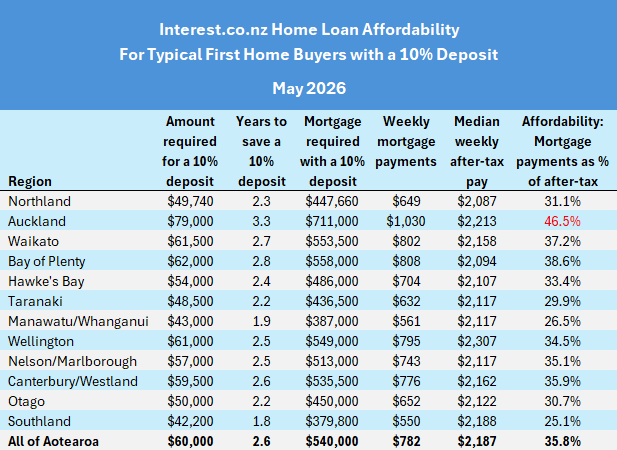
Interest.co.nz estimates the mortgage payments on a home purchased at Auckland's lower quartile price would increase from $804 a week with a 20% deposit to around $1030 a week with a low equity mortgage. That pushes the mortgage payments squarely into unaffordable territory for typical first home buyers.
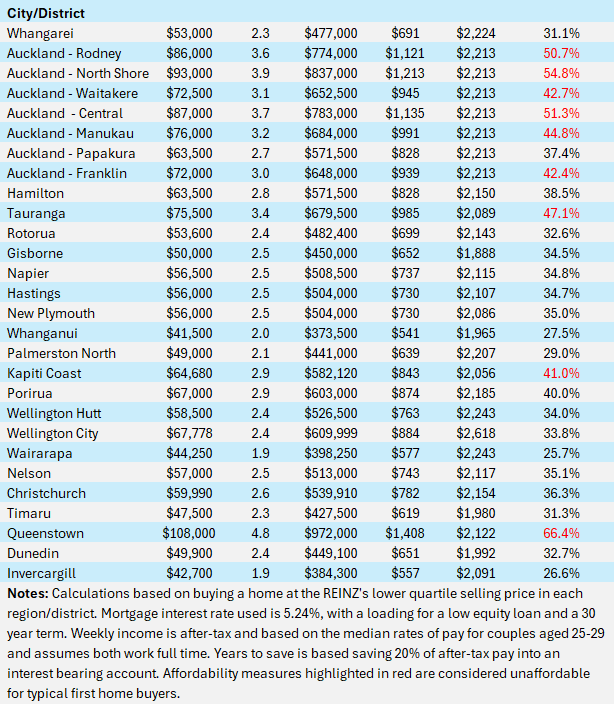
A closer look at the Auckland figures by its main urban districts shows Papakura in South Auckland is the only Auckland district where mortgage payments remain affordable for typical first home buyers with less than a 20% deposit.
That's likely to leave many first home buyers on average incomes trapped between the rock of a mountainous 20% deposit and the hard place of unaffordably high mortgage payments on low equity mortgages.
The same situation exists in Tauranga and on the Kapiti Coast.
And of course there's also Queenstown, where housing prices are so sky high they might as well be on another planet as far as first home buyers on average wages are concerned.
The tables below show the main affordability measures for first home buyers with either a 10% or 20% deposit in all major urban regions.
While there's not much good news in them for buyers in Auckland, Tauranga, Kapiti and Queenstown, homes in the rest of the country should be well within affordable limits for typical first home buyers, even if they don't have a 20% deposit.
The comment stream on this article is now closed.

We welcome your comments below. If you are not already registered, please register to comment
Remember we welcome robust, respectful and insightful debate. We don't welcome abusive or defamatory comments and will de-register those repeatedly making such comments. Our current comment policy is here.