
Recent weeks have seen the biggest change for at least 15 years to future climate-change estimates. The mainstream media is having great difficulty in dealing with this.
A large part of the problem is that the mainstream media, together with most of the population, is not well equipped when it comes to understanding the science of climate and climate change. It has been easier for many years for the mainstream media to simply shout and re-shout the same cataclysmic and superficial headlines.
Those who do enter the fray from a position of reasonable knowledge know that they will be categorised as either sceptics or alarmists. Trying to have an informed debate free of superficialities as to the alternative scenarios of what lies ahead, has been close to impossible.
So, what is the big change in the climate change debate headlined in this article?
The answer is that the influential scientists who, on behalf of the IPCC, estimate future emissions, have said that we have been placing too much weight on outcomes that, if not always implausible, are now clearly implausible. This is going to have a big influence on the forthcoming IPCC-7 reports which supersede the current IPCC-6.
It is also going to have a big impact on risk assessment and management here in New Zealand.
First of all, it is important to understand the role of the IPCC, of which the full name is ‘Intergovernmental Panel for Climate Change’. It is a body of the United Nations.
The IPCC comprises some hundreds of scientists, who largely work pro bono in their home countries on IPCC matters, alongside their professional employment, typically for universities or government research organisations.
The task of the IPCC is to assess the current state of knowledge in regard to current and future emission levels and the consequent atmospheric levels of greenhouse gases.
The IPCC also assesses the effect of various policies on these greenhouse-gas levels, but steers clear of specific policies that should be followed.
The IPCC does not itself undertake research. Rather, it assesses the broad implications of research undertaken by others.
When it comes to the politics of what policies should be followed, it is the UNFCCC (United Nations Framework Convention for Climate Change) that deals with this. It does this largely through the COP (Conference of Parties) get-togethers held each year somewhere in the world, with every year a different location.
These COP get-togethers are attended by more than 50,000 people, including Government officials, activists and media. Most of the time It is pure theatre where the attendees try to work out what the rest of the world should do.
The current key agreement of the COPs, leading through to the UNFCCC, is the Paris Agreement formulated at the 2015 COP in Paris.
Coming back to the current change in thinking by the IPCC scientists, the key issue is that the IPCC-5 and IPCC-6 worst case scenarios, referred to as RCP8.5 and SSP5-8.5 respectively, should be ‘retired’.
Hereafter, I refer to both of these scenarios as RCP8.5 as they have the same scientific metrics.
The key assumption within both of these scenarios is that by 2100 the greenhouse gas levels would create 8.5 watts per square metre of radioactive forcing across the globe. SSP5-8.5 adds more verbiage in relation to what such a world may look like, but the science is the same.
The first point to recognise is that RCP8.5 was never intended as a projection likely to occur. Rather, it modelled the worst possible outcome under extreme circumstances.
Underlying assumptions of RCP8.5 include that global emissions would increase three-fold during the current century. This was in turn based on a global population reaching 12 billion people, plus ten-fold increases in coal-burning, plus a lack of new technologies, and with minimal attempts to reduce emissions.
The RCP8.5 scenario leads inexorably to a likely cataclysmic global warming of approximately five degrees centigrade. However, even this has been widely misunderstood in communication.
The five degrees warming was relative to a pre-industrial baseline of 1850-1900. If measured relative to current 2026 temperatures, it was a scenario for a further increase of 3.6 degrees, given that temperatures have already increased by around 1.4 degrees centigrade since the 1850-1900 baseline.
Somehow, RCP8.5 came to be known as the ’business as usual’ (BAU) projection which was never the intention of the IPCC scientists who devised it. Rather, it was an extreme theoretical projection of what could happen under a set of what are now ridiculous assumptions.
Here in New Zealand, RCP8.5 is widely used to underpin assessments of environmental risk. Large listed companies are legally required to file annual climate statements that must include risks based on the RPC8.5 standards.
NIWA uses RPC8.5 in its climate hazard projections. Local government uses use it to test infrastructure resilience, adapt spatial plans, and develop long-term risk management. All of this now needs to be reassessed using realistic scenarios.
This is not to say that climate change, with the official retirement of the RCP8.5 scenarios, is now somehow unimportant. That seems to be President Trump’s perspective.
That is not what the new reality tells us.
What the numbers now tell us, is that if current global policies on greenhouse gas moderation are followed, then by 2100 it is likely that temperatures will increase by a further 1.2 to 1.6 degrees. This is based on global emissions of carbon dioxide maxing out at around the current 38 billion tonnes per annum, and total emissions of other greenhouse gases also stabilising at current levels.
If countries impose additional policies that they have in principle committed to, but have not yet put in place, then current temperatures are still likely to increase initially through to 2050 with an increase of about 0.6 degrees, but then stabilising thereafter and eventually declining to current temperatures on a multi-century basis. This too is based on carbon dioxide emissions maxing out at around 38 billion tonnes per annum but with a greater rate of subsequent decline.
If we want to state what the global effect of humans is likely to have been since the 19th Century industrial revolution, then we need to add 1.4 degrees Centigrade to all of these numbers. That would mean an increase since the 18th century industrial revolution through to 2100 of 2.6 to 3.0 degrees centigrade.
Of course there is still no certainty with any of these numbers. However, science does tell us with confidence as to what are the wavelengths of infrared energy that carbon dioxide blocks out, and similarly for methane. So, we are not travelling blind.
With methane, there is evidence that methane also blocks inward energy. If correct, this means we are over-estimating the greenhouse effects of methane.
One thing these latest numbers don’t tell us is the effect of President Trump’s energy policies on reducing the American trend to renewable energy, and the global implications thereof. However, President Trump will only be in place for another 2½ years.
Thereafter, it is reasonable to assume that America might get back on track to resource sanity, particularly in regard to coal versus renewables. Without that American sanity, temperature estimates will increase.
Here, I share my own experiences of observing global warming from a lifetime of mountain activities.
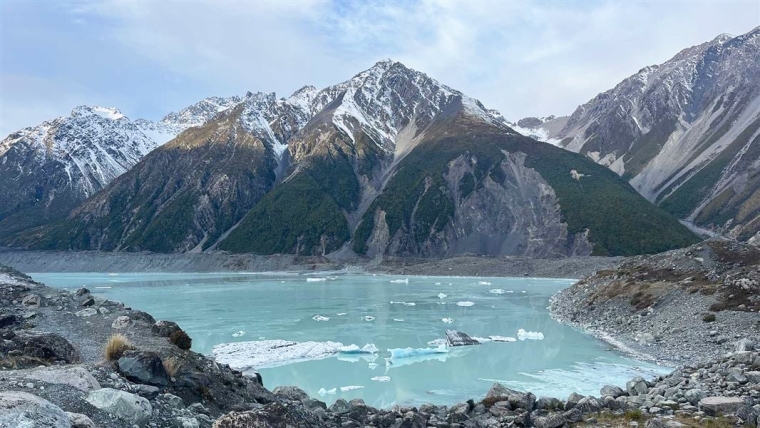
When I was alpine guiding in the early 1970s there was no such thing as the Hooker Lake, the Mueller Lake, or the Tasman Lake within Mt Cook National Park. Those massive lakes, now held back by glacial moraine, were a mass of ice laid down some hundreds and thousands of years ago.
These effects have occurred globally.
For example, in 1974/75 my journeys included a year of adventuring in the Andes, from Peru to Tierra del Fuego. In South Patagonia our group came upon an unnamed valley which I called Valle Olvidado. This is now the official name, with ‘olvidado’ meaning ‘forgotten’.
There was no evidence that anyone had ever been there and we tried to leave it that way after a month of mountaineering. The valley contained a big glacier. Fifty years later there is now a large lake more than two kilometres long at the foot of a considerably smaller glacier. An internet search using ‘olvidado’ and ‘glacier’ records the rate of change.
In 1977 I was on Mount Everest. Current photos show the Base Camp area as a very different place to what we encountered. Much of the ice has gone. It is happening everywhere.
To get back to what this all means in New Zealand, we are not facing a cataclysmic situation. Since the Pakeha came to New Zealand we have experienced a 1.4 degree centigrade increase in temperatures, hardly knowing for most of the time it was occurring.
If temperatures increase by another 1.4 degrees we will manage that too, with the same fortitude we have used in the past. Plant varieties and pests may change, but we will find solutions, albeit with some pain at times. Summer air-conditioning may become more common. Winter-cold will become somewhat less of an issue. Storms will occur much the same as they have always occurred, maybe but maybe not with more power.
For young people it is particularly important that they understand the future does not need to be cataclysmic from climate change. There is a future lying in front of us waiting to be delivered through hard work and rational decisions.
The scenarios referred to in this article are available at https://gmd.copernicus.org/articles/19/2627/2026/
*Keith Woodford ONZM was Professor of Farm Management and Agribusiness at Lincoln University for 15 years through to 2015. He is now Principal Consultant at AgriFood Systems Ltd. You can contact him directly here.
We welcome your comments below. If you are not already registered, please register to comment
Remember we welcome robust, respectful and insightful debate. We don't welcome abusive or defamatory comments and will de-register those repeatedly making such comments. Our current comment policy is here.