

sign up log in
Want to go ad-free? Find out how, here.

Fed delivers the expected rise and sets course for another; markets turn negative; US data weighed by rates & sentiment; EU industrial production soft; UST 10yr at 5.01%; gold falls, oil holds as war flares & Saudi scrambles; NZ$1 = 57.6 USc; TWI-5 = 61

Economy / news
Fed delivers the expected rise and sets course for another; markets turn negative; US data weighed by rates & sentiment; EU industrial production soft; UST 10yr at 5.01%; gold falls, oil holds as war flares & Saudi scrambles; NZ$1 = 57.6 USc; TWI-5 = 61
Breakfast Briefing

Here's our summary of key economic events overnight that affect New Zealand, with news the US is raising interest rates and the Middle East war is spreading.

First, as expected and in a very brief Warsh-style statement, the US Fed raised its key policy rate by +25 bps to 4.0% in a unanimous vote. It was its first rise since 2023. It did note that "inflation remains elevated" and they "will deliver price stability". However their forward looking interest rate 'projections' were raised although only to the new 4% levels. A strong majority of members thing another rate rise is possible this year.

Immediately after their decision was released, Wall Street held its small pre-decision gains. The UST 10 year yield dipped slightly but has since risen back over 5%. The US dollar rose. That USD rise has been maintained but Wall Street has changed direction sharply lower and the UST 10yr has jumped back over 5%.

Trump's reaction to the rate rise, and the prospect of another, has so far been conspicuous silence. He had demanded that rates be cut.

US mortgage applications fell last week, essentially driven by refinance applications. They say their 30 year benchmark home loan interest rate has risen to just under 7% and its highest since January 2025.

US retail sales rose in August and by more than expected, up the most month-on-month in five months following a fall in July. But the monthly +1.2% rise was essentially driven by higher fuel purchases, up +3.1% in the same period. From a year ago, these retail sales are up +5.3% of which fuel was up +20.5% at petrol stations.

US crude oil stocks took another fall last week and by more than the prior week although not as much as was expected. And their strategic reserves fall again, but only marginally this time.

The New York Fed's survey of the service sector activity in the New York region shows the July and August improvements have not continued into September, with a notable backslide in the latest survey.

Meanwhile the NAHB/Wells Fargo Housing Market Index of house builder sentiment has retreated to its lowest level since December 2022 with higher costs and higher interest rates getting the blame.

Canadian housing starts stayed low in August, almost the same as in July and well down on the unusually high year-ago August level.

EU industrial production fell in July from June, but it is still up marginally from a year ago.

The UST 10yr yield is now just on 5.01%, unchanged from yesterday and its highest since 2007. The 30 year yield is at 5.35%, down -3 bps. The key 2-10 yield curve is now at +34 bps (down -1 bp). Their 1-5 curve is now at +44 bps (-2 bps) and the 3 mth-10yr curve is at +111 bps (-5 bps). The China 10 year bond rate is little-changed at 1.69%. The Japanese 10 year bond yield is now at 3.00%, down -4 bps. The Australian 10 year bond yield starts today at 5.31%, down -9 bps from yesterday. The NZ Government 10 year bond rate is now at 5.04%, down -3 bps.

Wall Street was firmish ahead of the Fed decision today, up +0.3% in Wednesday trade on the S&P500, and up +0.8% on the Nasdaq. But then it retreated, now down -0.8% with the Nasdaq down -0.4%. Overnight, European markets were firmer between Lindon's +0.3% rise and Paris's +0.6%. Yesterday Tokyo ended up +0.7%. Hong Kong was up +0.2% and Shanghai rose +0.7%. Singapore was down a minor -0.1%. The ASX ended its Wednesday trade up +0.3%. But the NZX50 rose a full +1.0%.

The price of gold was at US$4328/oz, and up +US$34 from yesterday just after the Fed decision. But now it is at US$4249 and a -US$79 reaction. Silver was at just over US$64/oz and up +50 USc but has subsequently dropped to US$62.50/oz.

Oil prices have eased -US$4 to US$102.50/bbl in the US, while the international Brent price is down -US$4.50 to just on US$104.50/bbl. Hormuz transits are still low today with just seven ships exiting over the past 24 hours, three tankers escorted (3 dark with transponders off) and two entering for new loads (2 dark). The Red Sea activity is now only about 10 each way at the Yemen chokepoint in a sudden shift

Saudi Arabia is scrambling to fix or bypass their war-damaged key oil pipeline, one that delivers as much as 4% of global oil supplies. And for Saudi Arabia this is a major economic threat, choking their revenues in a significant way.

The Kiwi dollar is little-changed from yesterday, now at 57.6 USc. Against the Aussie we are also holding at 80.8 AUc. Against the euro we are unchanged as well at just on 49.9 euro cents. That all means our TWI-5 starts today at just under 61, little-changed and still at a six-week low.

The bitcoin price starts today at US$75,518 and down -1.6% from yesterday. Volatility over the past 24 hours has been modest at just over +/-1.2%.

Daily exchange rates

Select chart tabs
Source: RBNZ
Source: RBNZ
Source: RBNZ
Source: RBNZ
Source: RBNZ
Source: RBNZ
Source: RBNZ
Source: CoinDesk

The easiest place to stay up with event risk is by following our Economic Calendar here ».
We welcome your comments below. If you are not already registered, please register to comment

Remember we welcome robust, respectful and insightful debate. We don't welcome abusive or defamatory comments and will de-register those repeatedly making such comments. Our current comment policy is here.

28 Comments

An anecdote or two that may reflect that.

My second house was an old bach in Sth Brighton (ChCh) and in the process of renovating i lifted the lino in the kitchen to reveal newspapers from the 1950s in which one was describing the arrival of a sewage connection for a suburb near the inner city that had been developed years previously.....another is a friend I had in the 1980s who lived in Halswell that still used the services of a night cart at the time.

This was in NZs second largest city less than a lifetime ago.

Blip.

Up
4

Fed up, and talk of up again before Xmas. Ponzi buster torpedoes in the water, can the SS Debtalot evade... or is the debtberg unavoidable and a Titanic fate approaches...?

🍿 

Up
3

Sam Stubbs has - in my humble opinion - strong reason to avoid the (ramifications of the) links in my first post. 

As do others. 

Their self-justifying narratives don't stack up - Kiwisaver is a collection of forward bets on there being 'more', on and on into an indefinite future. 

Porcus volandum; the safer bet... 

Up
6

Yes, i read that article. Projecting Kiwisaver at $trillion by 2050 is curious given the debt concerns around the world. 

He seems to project the future with little insight into current dynamics. 

Vested interest spruiking in my opinion. 

Up
3

Nothing wrong with a little optimism now and then

Up
2

Not if it is based on a fairy story. 

Up
2

Optimism is based in reality, otherwise its simply fantasy.  

Up
1

somewhat like growth forever in a finite environment

Up
0

Two & a bit more years of Trump mania, but what comes next? To be or not to be that is the question. Suggest that when the likely contender VP Vance exclaims that “Emily in Paris is the Shakespeare of our time,” crass is certainly going to continue to dominate class. It is difficult to imagine that matters of state in the USA could get worse but it is certain that they will if the powers that be, the people’s representatives, can neither see nor accept that there is something rotten in the state of Washington DC.

Up
4

"Trump's reaction to the rate rise, and the prospect of another, has so far been conspicuous silence."

Trump has since commented with a rant on Truth Social: 

"Interest Rates in the United States should be 1%, or less, because we are the Best Credit in the World — BY FAR. Our Country is BOOMING with new Investment! If we stopped Trading with every country that we have a Deficit with, which is most of them, we would make, at least, 1.5 Trillion Dollars a year. The word “Deficit” is nothing more than a fancy word for LOSS. We are “carrying” almost every country in the World, and that cannot go on any longer. LOWER THE INTEREST RATES FOR THE UNITED STATES OF AMERICA, AND FAST! President DONALD J. TRUMP"

Ok then! 

Up
8

Except they weren't 'carrying'. 

They were resource-sucking. 

As hegemonies have tended to do. 

They're in trouble - and we should be disassociating ourselves as fast as possible. 

Up
5

What an incredibly ignorant comment by Trump, he has absolutely no understanding of how an economy works.  

Up
5

Sadly many in his MAGA base believe him, including his $1.3 trillion promise of $5,000 windfall per person if the Senate and House are returned in November, and so vote Republican. 

Up
4

How can we even hope to understand the wisdom of the God Emperor.

Up
4

We are “carrying” almost every country in the World

I believe the need for foreign countries to hold dollars for trade in oil and other goods, is what is carrying the USA Mr Trump. And this is decreasing year on year currently. 

Up
7

"we are the Best Credit"

I'm sure that's what he told his bankers right before they pulled the plug on his credit lines. 

Up
0

I find it interesting that people forget that the current grocery duopoly was created by National in the 90s when they allowed Progressive Enterprises (Countdown) to buy the number three provider, the then independent Woolworths.  Lots of assurances at the time by the Commerce Commission that there would not be any reduction in competition.


Up
11

2001 the merger wasn't it, but the approval was back in the late 90s was it?

Up
0

Multiple UK and international outlets are reporting that the Bank of England is expected to announce this week that it will stop selling its longest-dated government bonds (20‑ and 30‑year gilts), against a backdrop of heavy selling in global bond markets.

https://www.reuters.com/world/uk/bank-england-stop-selling-20-30-year-g…

Up
1

Agreed, Phoenix.

And perhaps the another interesting twist in all of this isn't simply that the BoE is stopping sales of 20- and 30-year gilts - it's why it is becoming increasingly reluctant to put additional supply into precisely the part of the market where yields are already under the greatest pressure.

The 30-year gilt has recently reached around 5.4%, its highest level since 1998, while Reuters reports that 20- and 30-year gilt prices have fallen to their lowest since 1998. 

The BoE has already been progressively shifting its QT sales away from the long end - which is where I think comparisons with Britain's 1970s bond crisis can be very revealing, as to just how different the underlying structural conditions are.

Britain previously experienced interest rates around 15%, but the underlying balance sheet was completely different. In 1976, public-sector net debt was only about 49% of GDP, and it subsequently fell rapidly as growth returned. 

By 1979/80 it was around 39%. The IMF intervention also provided external financing and imposed fiscal conditions while the economy still possessed a substantial productive and industrial base - today's problem is much more deeply embedded.

Decades of financialisation have allowed debt and financial claims to expand enormously while much of the underlying productive economy has been hollowed out or outsourced. 

The issue therefore isn't whether Britain could technically survive a 10% or 15% gilt yield. It's whether an economy carrying today's accumulated public and private debt can absorb rates anywhere near approaching those levels without the interest burden itself becoming another accelerant of the debt spiral - that's a very different proposition.

And there is another important difference - who is going to provide the external balance sheet now that the major Western economies are experiencing these pressures simultaneously?

In 1976 Britain could turn to the IMF in a world where the problem was principally a British balance-of-payments crisis. Today we are looking at highly indebted Western sovereigns facing broadly similar structural problems at the same time.

The BoE's dilemma therefore becomes rather circular...

Sell more long-dated gilts → prices fall → yields rise → government financing costs rise → fiscal pressure increases.

Stop selling them → QT becomes increasingly constrained by the condition of the market.

And if the private market ultimately demands still higher yields to absorb the supply, the central bank faces the uncomfortable choice between allowing the market to impose those rates and intervening to prevent them - I think that is the much bigger story.

The 1970s were a crisis in a highly leveraged economy. Today's problem is what happens when a highly financialised economic model becomes highly leveraged.

Britain didn't choose the latter overnight. It spent decades building its own demise.

Eventually the piper comes for the accumulated debt — and no amount of financial engineering can substitute indefinitely for the productive economy needed to service it.

Good luck, Perfidious Albion in your quest... you are going to need it. 

Up
2

"Nuclear reactors worldwide generated 2,702 TWh of electricity in 2025, beating the previous year's record of 2,667 TWh according to the World Nuclear Outlook Report"

Up
1

"The global stockpile of spent nuclear fuel has reached an estimated record of roughly 448,000 tonnes of heavy metal discharge worldwide"

https://www.iaea.org/


Up
1

Get yourself a fast breeder bro. It ain't spent. India just built one and making hydrogen out of the waste heat, in addition to electricity.

"But after a light-water reactor has run its reactor powered by uranium-235, there is still tremendous amount of energy potential still available in what is left.

“Fundamentally, in light-water reactors, out of the uranium we dig out of the ground, we use a half a percent of the energy that’s in the uranium that’s dug out of the ground,” Gehin told CNBC in a phone interview. “You can get a large fraction of that energy if you were to recycle the fuel through fast reactors.”

https://www.cnbc.com/2022/06/02/nuclear-waste-us-could-power-the-us-for-100-years.html


Up
0

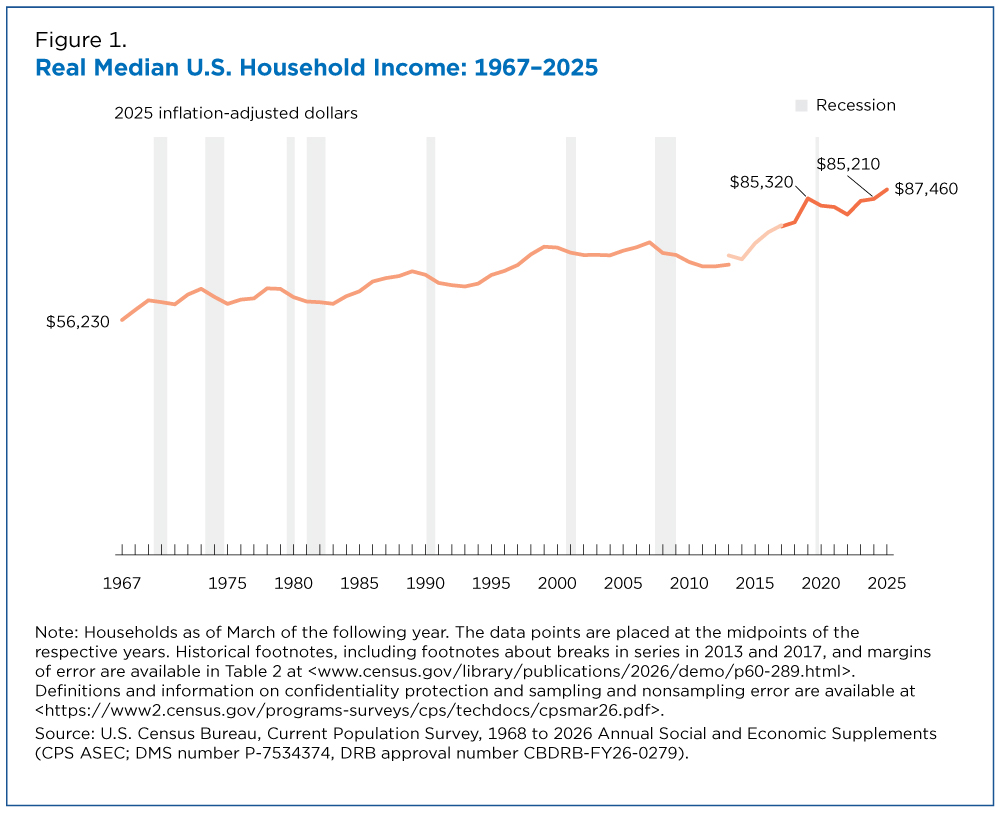
Real U.S. median household income reached a record $87,460 in 2025, marking a 2.6% increase from the previous year after adjusting for inflation.

https://www.census.gov/content/dam/Census/library/stories/2026/09/media…

Up
1

That's about 1/3 more than NZ household median income.

Of course they don't have the range of social services we have or an ACC equivalent, and a lot of their medical costs, insurance etc are way more than here

Up
0

Are both sides of this comparison after tax?

Up
0