
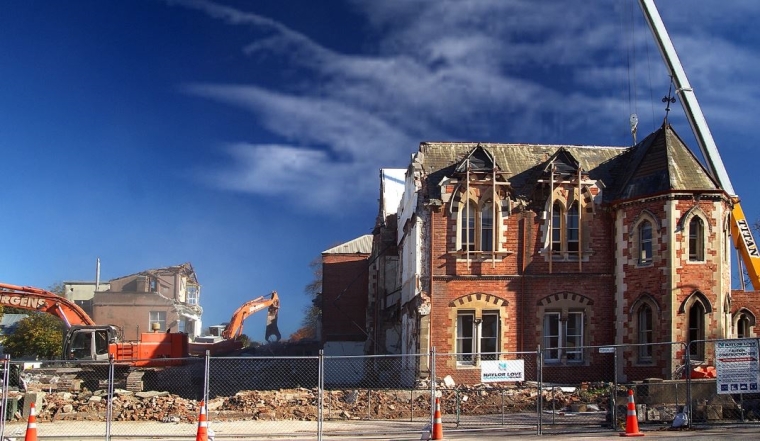
Nine years on from the Canterbury earthquakes, and private insurance companies are still chasing the Earthquake Commission (EQC) for hundreds of millions of dollars related to disputes over how to apportion costs between themselves and the state insurer.
The uncertainty has hit the country’s third largest and only New Zealand-owned insurer, Tower, particularly hard.
Tower on September 24 announced it needed more capital to meet the Reserve Bank’s (RBNZ) solvency requirements, as the regulator decided it couldn’t keep treating nearly $70 million of “receivables” from EQC as solvency capital, when it still hadn’t in fact received the money and might not in the future.
These receivables have for years been included in Tower's balance sheet, with the fine print explaining they represent a contested sum the insurer is confident it will retrieve.
Tower said in its 2018 financial results that it believed it was owed “significantly” more, but adopted a lower figure on actuarial advice.
In its 2019 results, released on Wednesday, it went in to a bit more detail around the dispute. It said it is going through a dispute resolution process with the EQC to try to settle matters around damage to buildings, but this could end up going to court and dragging out. It also issued proceedings against the EQC in regard to land damage.
“[T]here remains risk that any amount ultimately recovered may be less than the amount of the receivable carried in the financial statements,” it said.
A material amount of money in limbo
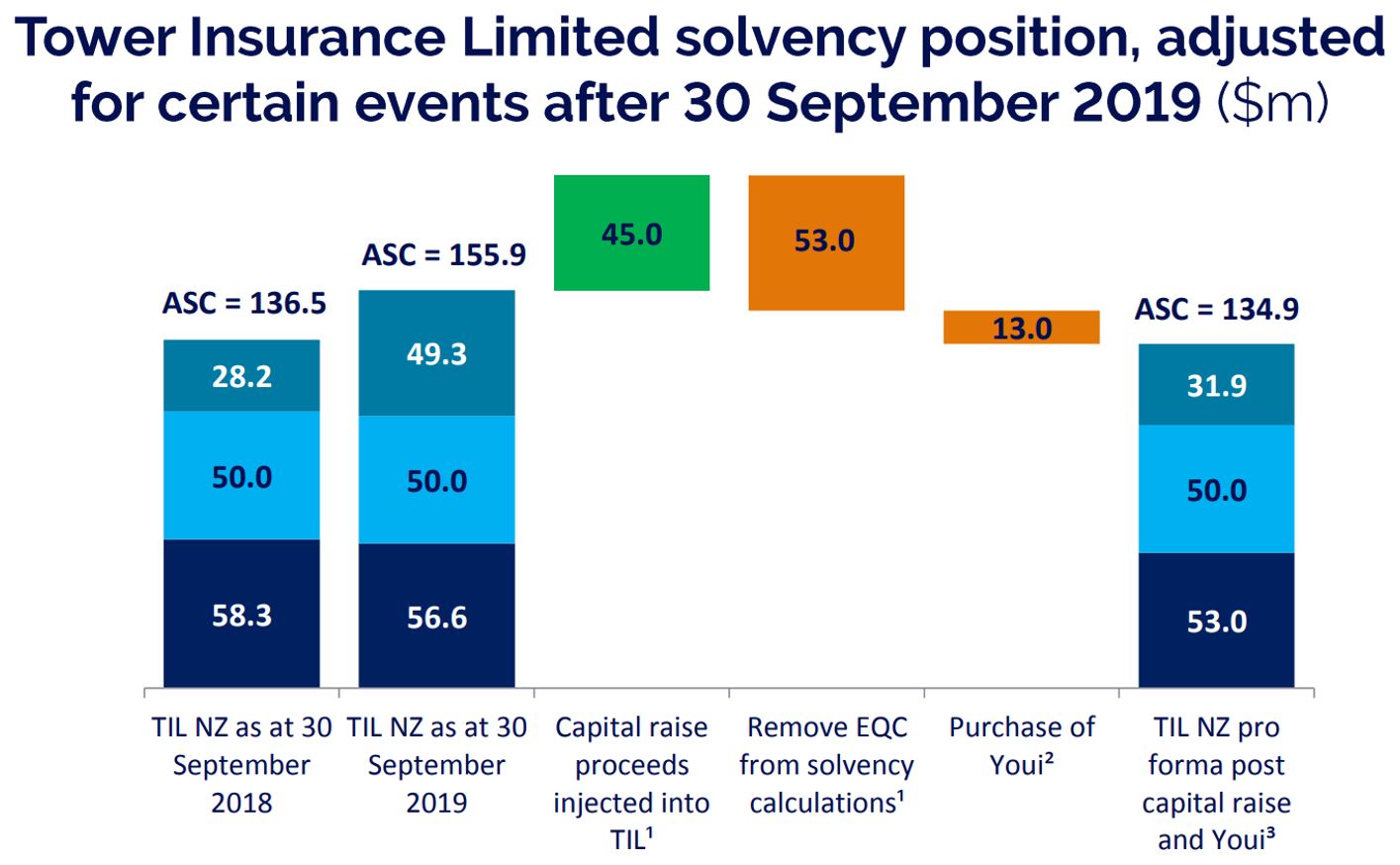
The RBNZ’s move to make Tower exclude EQC "receivables" from its solvency capital was huge. This, along with Tower’s decision to spend $13m buying Youi NZ’s 34,000 in-force policies, prompted Tower to do a $47m capital raise in October.
This came further to Tower in December 2017 putting its hat out to shareholders to raise $71m to keep its head above water.
The outstanding $70m from EQC is a material amount of money for the company.
Put in context, Tower had a market capitalisation of $304m at the time of writing. It had a solvency margin, above what's required by the RBNZ, of $49m as at September 31. In 2017, this buffer fell to $5m, prompting Tower to take out a bank loan.
Because Tower would need to pass on a portion of the $70m to its reinsurers, the RBNZ required it to remove $53m from its solvency calculations.
This means that further to its capital raise, and once the Youi deal gets regulatory approval and is settled, the company will have a comfortable solvency buffer of $32m.
Insurers want to handle claims from the get-go
The bigger picture is that the Canterbury quakes have exposed a lack of clarity in the law that still hasn’t been resolved.
The EQC’s deputy chief executive, Renée Walker, said the EQC has been working with each of the major insurers on the apportionment of costs for some time, and has a pot of funding put aside to settle disputes.
“These discussions are commercially sensitive as we are in ongoing negotiations,” she said.
Insurance Council of New Zealand chief executive, Tim Grafton, estimated the total amount sought by insurers would be in the hundreds of millions of dollars.
Neither IAG nor Vero’s financial results reveal the outstanding sum in the same way Tower’s do.
Neither company would disclose these figures on request. IAG said matters were either still before the court or subject to confidential legal proceedings, while Vero referenced commercial sensitivity.
If there was a major disaster tomorrow, the EQC and private insurers would probably still find themselves squabbling over who pays for what 10 years down the track.
Grafton reiterated that the industry’s solution is for private insurers to handle claims in accordance with their customers’ policies, passing the cost of the first $150,000 to the EQC.
The EQC and private insurers agreed to use a system like this after the 2016 Kaikoura earthquake.
Grafton said the issue otherwise is that damage to a property is assessed according to two sets of terms and conditions - that of EQC and that of the private insurer.
Law change pending further to outcome of Public Inquiry
Treasury started a review of the Earthquake Commission Act in 2015 under the National-led Government.
Further to this, the Coalition Government in March 2018 announced changes to the Act that saw the EQC cap for residential buildings extended from $100,000 to $150,000 and contents cover dropped.
Former governor general, Silvia Cartwright, was in November 2018 appointed to lead a Public Inquiry into the EQC. She has until the end of March 2020 to make recommendations.
A Treasury spokesperson said progress on its review awaits the findings of the Public Inquiry, but the Government hasn’t made any decisions on deadlines beyond March 2020.
Tower’s board chairman, Michael Stiassny, on Wednesday reiterated how the “the system remains fundamentally broken, despite some recent improvements”.
“A true step change in conduct and culture would see the industry join forces with the Government for an honest and transparent appraisal of the EQC and agreement on a sustainable future model for the agency,” Stiassny said.
“An EQC that delivers fair customer outcomes would have the single greatest impact on restoring New Zealanders’ trust in the industry.”
We welcome your comments below. If you are not already registered, please register to comment
Remember we welcome robust, respectful and insightful debate. We don't welcome abusive or defamatory comments and will de-register those repeatedly making such comments. Our current comment policy is here.