
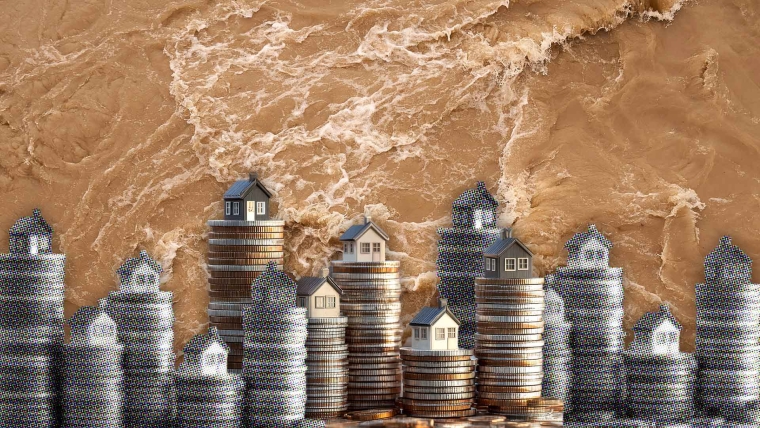
More people and properties are likely to be exposed to flooding and landslides, adding to concerns that the increasing risks of disasters under climate change will lead to homes in “high-risk areas” becoming uninsurable, a new climate report says.
“Much of our infrastructure was not designed for the level of natural hazard impacts we are already experiencing due to climate change.
“These impacts are projected to increase. Increasing numbers of homes and properties are exposed to flooding and landslides, putting people more at risk," the report says.
The report, called Our Atmosphere and Climate 2026, was released on Wednesday by the Ministry for Cities, Environment, Regions and Transport (MCERT) alongside Statistics New Zealand.
This is the fourth report in a series that focuses on the country’s atmosphere and climate, and includes the latest data and scientific evidence to explain how NZ’s climate is changing, what that means and what pressures are contributing to these changes.
The report also includes outlook assessments which describe how the environment may change in the future. It also looks at situations under different climate change scenarios and includes "expressions of confidence" which "give an indication of the reliability and level of corroboration of evidence used in an assessment".
The report makes clear that the future will always be uncertain, so the assessments should not be read as “statements of fact but as assessments of what may occur based on what we know now about the range of possible futures”.
‘The climate we have known is entering uncharted territory’
The report points out that greenhouse gases continue to accumulate, contributing to long-term warming while “multiple climate indicators show that New Zealand’s climate is continuing to change”.
Broken down, the report says gradual changes in the climate include warmer temperatures, rising sea levels, changes in rainfall and warming oceans. Meanwhile, sudden events include floods, drought, severe storms, wildfires and heatwaves.
“The climate we have known is entering uncharted territory."
The report says while NZ’s contribution to global greenhouse gas emissions is small, our emissions per person are high.
“Greenhouse gas emissions arise from activities such as food production, energy generation, transport, housing and land management. At the same time, forests, wetlands and other ecosystems remove and store carbon from the atmosphere. Our emissions are reducing in some areas, but are stable or increasing in others.”
“Climate change is changing the natural systems that sustain life across land, freshwater and marine environments. Native ecosystems and species are facing increasing pressure from changing climate conditions and extreme events,” the report says.
Climate change is also affecting the country’s economy, infrastructure, property and livelihoods, the report says, pointing out that some impacts are creeping up on NZ while others are brought on by sudden events.
“Some impacts develop gradually as temperatures rise, rainfall patterns shift, seas warm and sea levels increase. Others arise through sudden events such as floods, droughts, storms and landslides. These impacts can compound over time and spread across connected economic and infrastructure systems."
Flooding of inland areas presents ‘most widespread risk to people and properties’
The report says: “Since the 28-day national state of emergency declared for Cyclone Gabrielle in 2023, every region except Taranaki has been affected by at least one local state of emergency due to extreme weather or flooding.”
“Region-level states of emergency for extreme weather have affected ten regions, with these declarations lasting two to three weeks for events affecting the Bay of Plenty, Tairāwhiti, Nelson, Tasman and Southland regions.”
The report says modelling estimates that the homes of about 750,000 people are already exposed to inland flooding under a 1% annual likelihood flooding event and regionally, the homes of about 55% of the population of both the Kawerau and Buller districts, and about 63% of the Wairoa district are exposed.
“Exposure of existing homes to inland flooding is projected to increase nationally, with between 815,000 and 839,000 residents exposed by 2050 under a 1% annual likelihood flooding event, under the low and high climate scenarios respectively (low confidence).”
But it’s not just inland flooding the report has looked at.
“For rainfall-induced landslides, modelling estimates that the homes of about 80,000 people are already exposed under a 1% annual likelihood rain event.”
The report projects that this exposure is set to increase, “with between 111,000 and 127,000 residents exposed by 2050, under the low and high climate scenarios respectively (low confidence)”.
As for coastal flooding, current modelling estimates that about 32,000 people’s homes are already exposed under a 1% annual likelihood flooding event.
“Exposure of existing homes is projected to increase, with between 48,000 and 52,000 residents exposed by 2050, under the low and high climate scenarios respectively (high confidence).”
Marae are also vulnerable, with modelling estimating that 12 marae are already directly exposed to coastal flooding and two are already exposed to rainfall-induced landslides, under a 1% annual likelihood of a coastal flooding or rainfall event.
“A total of 100 marae (9%) are at risk of becoming isolated by this level of flooding, and a total of 88 marae (8%) are at risk of isolation by this extent of landslides, due to transport infrastructure exposure.
“This isolation could prevent marae from fulfilling their roles as cultural centres and emergency hubs during disasters, potentially compromising both cultural continuity and community resilience,” the report says.
“Sea-level rise will very likely increase coastal flooding exposure affecting settlements, marae and heritage sites.”
Insurance accessibility
Insurance accessibility and affordability have been an ongoing concern, with premiums rising and insurers increasingly adopting “risk-based pricing”.
The report says some marae have faced challenges accessing adequate insurance, retrofitting capacity and recovery funding, especially if there are multiple landowners or there’s collective governance “in ways that do not meet standard eligibility criteria”.
“These factors can limit the ability of marae to restore function following damage from extreme weather events.”
Aotearoa is viewed as the second riskiest country in the world when it comes to natural hazards, and since 2010, $64 billion has been spent on natural disasters, an average of around $4.2 billion a year.
Since 2000, the price of house insurance has increased 916% - which consumer advocacy organisation Consumer NZ says is the biggest price rise for goods monitored by the Consumers Price Index (CPI) over the past 25 years. Alongside this, premiums have increased three times more than CPI inflation since 2011.
And in February, the Government launched a six-month review into home insurance affordability and costs. This review is yet to be publicly released.
The report says: “The increasing risks of disasters under climate change will result in homes in high-risk areas becoming uninsurable. Without insurance, these homes are ineligible for mortgage lending, making them more difficult to sell and reducing their market value.”
People who want to sell may end up selling at a “considerable loss, reducing their options to purchase homes elsewhere”, the report says.
“As coastal flooding becomes more frequent, around 10,000 properties in Auckland, Christchurch, Wellington and Dunedin may become increasingly difficult or expensive to insure as soon as 2035, with modelling estimating that it is likely they will be uninsurable by mid-century (low confidence).”
‘An unstable climate is a very real threat to New Zealanders' income and food security’
The Science Media Centre has collected comments from experts on the report, with University of Auckland senior lecturer Joel Rindelaub saying the costs of climate change are increasing and New Zealand is already experiencing the impacts in economic terms.
Rindelaub points to the cost of insured losses associated with Cyclone Gabrielle and the Auckland Anniversary Floods as an example. But the costs of climate change are not limited to disaster response and recovery.
“As the NZ economy is heavily reliant on the environment through agriculture, fisheries, and tourism, an unstable climate is a very real threat to New Zealanders' income and food security … It is important to note that New Zealand’s food security can also be affected by disruptions outside the country.”
Rindelaub says “this report indicates that New Zealand is not a leader in climate sustainability”.
Luke Harrington, a senior lecturer at the University of Waikato and a science adviser on the latest report, says people know a lot more about climate change in Aotearoa than three years ago.
“More extreme heat, more flooding, more droughts: the strength of our evidence base is growing all the time,” Harrington says.
But some long-standing knowledge gaps still need addressing, particularly around back-to-back and multi-region extreme events, according to Harrington.
"How long does it take for communities to recover following a significant flooding event? How can we more systematically document this recovery? And what happens if the next event comes along before this recovery is complete?”
“All these worsening hazards have the potential to produce significant impacts, whether for Māori, the economy, our health system, or the most vulnerable members of our communities," Harrington says.
We welcome your comments below. If you are not already registered, please register to comment
Remember we welcome robust, respectful and insightful debate. We don't welcome abusive or defamatory comments and will de-register those repeatedly making such comments. Our current comment policy is here.