
When it comes to insurance New Zealand is at a fork in the road, an economist says, and we’re at a crunch point where we need to do something about it.
Simplicity chief economist Shamubeel Eaqub says when he looks towards the next 10 years, the question for him is: “Are we still going to use insurance as the mechanism of transferring risk or is this going to be the mechanism for us to actually manage risk?”
“The reality is that we’ve run out of runway to simply use insurance as ‘it’s somebody else’s problem. I’m going to keep making stupid decisions and somebody else should take the risk away’.”
“Well that risk is becoming very expensively priced and I think it’s going to be very hard for us to do that,” Eaqub told the audience at the Insurance Council of New Zealand (ICNZ) conference in Auckland on Thursday.
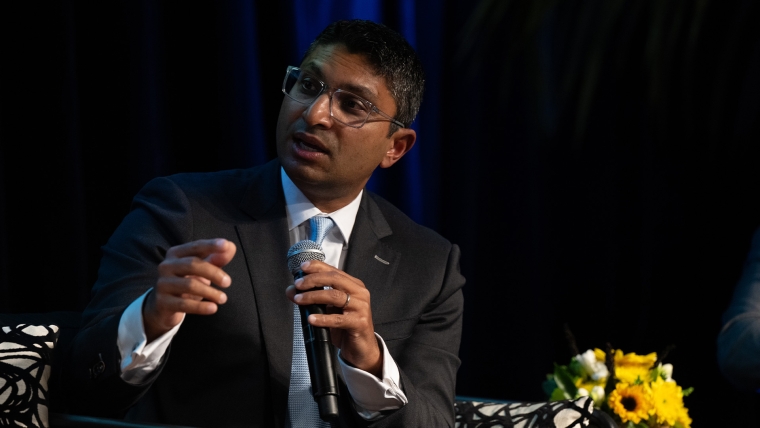
Eaqub, alongside FMG chief executive and ICNZ chair Adam Heath, The Post’s Political, Business and Economics Editor Luke Malpass and Insurance Council of Australia’s general manager of regulatory and consumer policy Alexandra Hordern, were part of a panel discussion on keeping insurance in reach.
Eaqub says he sees very little political appetite to do something when it comes to risk and insurance that’s strong or courageous.
“Or we keep on as we are, and we find ourselves stuck in a cul-de-sac where we only have rich people who can afford insurance.”
He says a good scenario would require a coordinated approach to insurance.
“But there are some really, really big things in front of us which is really around making sure that we are in fact managing our risks in the right places, keeping our assets in the right places and sharing the burden as broadly as possible. Right now, I’m really concerned that we’re not doing those things.”
Heath says insurance is an excellent risk transfer mechanism and risk management mechanism but by definition, it is not a risk reduction mechanism.
He says global reinsurers are “well and truly alive to the fact that we’re getting wetter, we’re getting more cyclonic weather patterns and so they are looking to us as a country to say ‘what are you doing about mitigating the risk’.”
“And at the moment, we have a really good reputation on the global stage around how we do respond, what we do do but it is principally oriented to the recovery aspects of that - not so much the prevention and the reduction - that is I think the nexus and the crossroads that we’re at.”
“We need to do that collectively," Heath says.
‘Storing up this cost for future generations’
The question of who pays for the cost of things like climate adaptation and risk mitigation has long been asked - but there’s never been a solid answer.
Since 2010, $64 billion has been spent on natural disasters - adjusted for inflation this is about an average of $5.5 billion per year.
And while Heath understands what Finance Minister Nicola Willis has been saying around debt, "that will continue to expand if that $5.5 billion starts to turn into $10 billion, $15, billion".
Eaqub says: “My view is that when people say that we don’t have money now to invest in things that will cost us less in the future, it’s wood for the trees … You are storing up this cost for future generations … We all know that money that’s not spent on fixing insurance today is going to be more [costly for] our children and grandchildren.”
Everyone pays
Hordern says the reality is that everyone - insurers, governments, taxpayers - pays one way or another.
“The question has to be, do we take the hit now and pay the big ticket stuff that may make a difference down the track now or do we wait and wait and wait and hope that somehow it's just going to disappear and the climate is going to get better.”
“I mean, that's a great dream, but I'm not sure that it's really effective,” Hordern says.
Eaqub says if New Zealanders want to have basic access to insurance, we have to have a way where everybody shares in the cost.
If we don’t do that, we could lose access to the insurance services we currently have, he says, which are still affordable by global standards and very high quality by global standards.
“We are very lucky to be in this tiny population at the arse end of nowhere to have access to this high-quality stuff, and I would really, really be disappointed if, through our lack of action, we lost access.”
Asked by MC Miriama Kamo if insurance becomes unaffordable for more New Zealanders, who ultimately carries the risk, Heath says we all do.
Speaking as FMG chief executive, Heath says “off the back of that dislocation that we had in reinsurance markets back in 2023, which was the most significant change in 40 years, we were forced to put through our largest rate increases in our history”.
“When you’re a mutual [organisation] that was founded by farmers and growers because they couldn’t get access to affordable or adequate insurance, that’s not a decision you take lightly.”
Heath says what they saw off the back of that was about a 50% increase in cancellations because of affordability and FMG saw “tremendous amounts” of what they assessed as self-insurance.
Heath says that sector generates 80% of the country’s export earnings and if they could not take risk or were taking on too much risk, and starts to have fundamental challenges - that impact ripples across New Zealand.
“I think it’s an issue for all of New Zealand society … We have a highly functioning insurance market that is the envy of most other jurisdictions on the planet, and we are the second riskiest jurisdiction on the planet, so we have something that should be treasured and preserved for as long as possible, so we should be doing everything to look after it.”
‘The people of New Zealand will pay one way or the other’
Eaqub says: “If we want to actually deal with this stuff, there is an upfront cost … This requires an investment … I cannot see a way out of it without making an injection of capital to actually move people to places where they might have better options."
“The people of New Zealand will pay one way or the other, either it will be done individually and unfairly, or it'll be done collectively and fairly, and I suspect the latter will be a hell of a lot cheaper and a lot better.”
We welcome your comments below. If you are not already registered, please register to comment
Remember we welcome robust, respectful and insightful debate. We don't welcome abusive or defamatory comments and will de-register those repeatedly making such comments. Our current comment policy is here.