
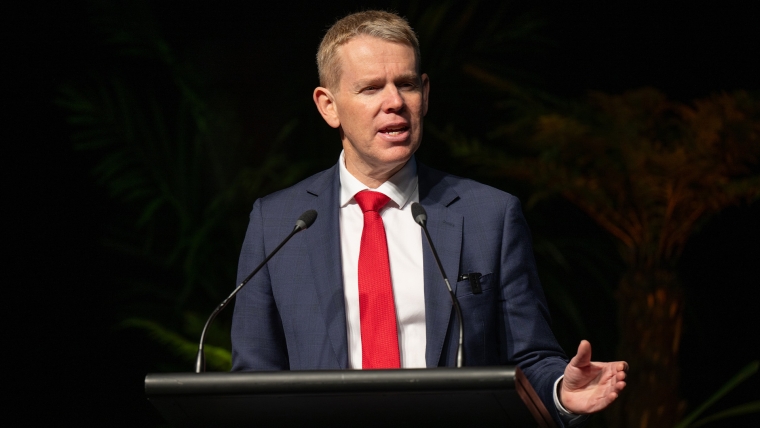
Labour leader Chris Hipkins says he doesn't know if there's one single thing that's going to make a difference to resilience against extreme weather events and natural hazards.
"I think it's a cumulative series of things that make a difference," he said in response to a question asked at the Insurance Council of New Zealand conference in Auckland on Thursday.
But if he had to do one thing right now that would make a change, Hipkins said: "We need to stop building things in areas where we know we can't sustain them."
Speaking to the audience, Hipkins said events like Cyclone Gabrielle and the Auckland Anniversary Floods reinforced something the insurance industry knew well.
"Risk doesn’t stand still. As weather events become more frequent and more severe, as insurance markets continue to move towards more sophisticated, risk-based pricing, we can expect growing pressure on [insurance] affordability and particularly affordability at exposed communities."
"It’s a reality that we’re dealing with, and politicians do need to be candid and upfront in our discussions about that," he said. “Avoiding difficult conversations now only makes the future harder and more expensive."
Hipkins said events that were once treated as once-in-a-generation or once-in-a-lifetime events were happening all that time and this mattered a lot in a country like New Zealand.
“Insurers [and] reinsurers aren't just looking at what's happened in the past, they're also looking at what's happening in the future, whether governments are acting with enough urgency and seriousness to reduce long-term risk.”
New Zealand’s exposure to weather-related risks is continuing to increase rapidly and with that, the urgency to act is increasing as well, he said, but many people are not seeing enough action.
“That should be of concern to all of us because if New Zealand is seen as being too slow to adapt, too slow to invest in our resilience, or unwilling to confront some of those difficult planning decisions, that’s going to have direct implications for insurance affordability and even availability as well,” Hipkins said.
Coordinated approach to managing retreat needed
Having a cohesive national strategy for resilience against extreme weather events and natural hazards was a talking point at the conference.
Asked by MC Miriama Kamo what a potential national strategy on tackling these issues would look like, Hipkins said this strategy needed to have a coordinated approach to managing retreat.
There also needed to be a more coherent, long-term strategy around infrastructure resilience and the strategy needed to map out where the risks are, he said.
“And we need to figure out over time how to pay for that."
Hipkins brought up borrowing, saying that government borrowing to invest in long-lived infrastructure is a legitimate way of funding that.
“It is a relatively economically efficient way of funding the investment in infrastructure that we’re going to need as a country.
"So borrowing to keep the lights on, borrowing to pay the day-to-day bills is a problem if government is doing too much of that, but government borrowing to invest in the assets that the country needs for the future is legitimate.”
Hipkins said he was worried that conversations about government debt were too focused on all government debt being bad when that wasn’t true.
“Actually, government debt that's been incurred because we've been investing in long-lived assets is an absolutely legitimate thing for governments to do.”
Shared responsibility
The topic of shared responsibility came up and Hipkins was asked what that would look like.
He said there was going to be some private risk involved.
“We have to be upfront about that … There are going to be some vulnerable communities, who, through no fault of their own, find that they can’t absorb that risk, and government needs to be a partner in making sure that they are not left behind in this process.”
“The insurance sector is going to, as you already are, have quite a big risk. I guess the real question for me, and it's an open-ended question, is how can we work together with the insurance sector, so that you are a partner in the prevention rather than just in the recovery.”
Focus on both mitigation and adaptation
Hipkins said there had to be a focus on mitigation and adaptation.
“So dealing with climate change, dealing with our climate change emissions is still critically important because as long as we don't mitigate for climate change, the challenge just keeps getting exponentially worse."
He said the country needed to do both - this meant tackling emissions and looking at really big challenges for NZ.
Using land transport as an example, Hipkins said that was still a huge challenge for them "as to how we move to more sustainable ways of getting around, dealing with those big industrial emitters and making sure that we're supporting them to transition to lower emission ways of doing their business".
"Those things are pretty important, and we've got to do more of that.”
We welcome your comments below. If you are not already registered, please register to comment
Remember we welcome robust, respectful and insightful debate. We don't welcome abusive or defamatory comments and will de-register those repeatedly making such comments. Our current comment policy is here.