
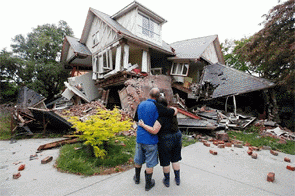
The government has announced its initial plan to help home-owners in the worst-affected Christchurch areas, offering to buy up to 5,100 houses at 2007 values in the first part of a package that could end up costing about NZ$1.5 billion.
The houses are located in designated red zones in the east of the city and the beach area of Waimakariri District.
The Crown has made two offers to homeowners, one where the Crown buys the entire property and assumes all insurance claims, and the second where the Crown would purchase the land only, while the homeowner continued to deal with insurance matters on their own.
Prime Minster John Key said the government hoped to come to home owners in the red-zone and make an offer in the next eight weeks. Home-owners had nine months to make a decision. The eight week delay was because government had not yet finished discussions with insurance companies.
"It will take a number of weeks (perhaps eight weeks) before we are in a position to provide the details around the individual packages being offered to all homeowners in the residential red zone with insurance. Firstly we need to conclude discussions with the insurers and other parties, and then we need to prepare an offer for each individual property owner, which is no small task," it says in a fact sheet accompanying the announcement.
The government has also included another 10,000 properties in a 'orange zone' - areas where engineers needed to make further assesments due to the aftershocks that hit on June 13. Another 100,000 houses in 'green zones' are free to be rebuilt and will not attract government assistance. A white zone had also been set up for areas including the Port Hills and the central business district, which were still being mapped or were not residential land
See the land information and full red, orange green and white zones here.
The Treasury says the net cost to the Crown of the initial package could be between NZ$485 million and NZ$635 million, although the final costs were still to be determined. Factors that may alter the final costs included the take-up of the offer, government property valuations and proceeds from insurers.
Prime Minister John Key and Earthquake Recovery Minister Gerry Brownlee made the announcement this afternoon, although the main details of the plan were leaked last night in advance of today's release.
The government had set aside NZ$5.5 billion in its May 2011 budget for costs it expects to incur from the quakes over and above EQC payments of NZ$3 billion, which began on September 4 when a magnitude 7.1 quake hit the city in the early hours of the morning. A magnitude 6.3 quake on February 22 devastated much of the central city, aftershocks on June 13 added more uncertainty to the timing of any rebuild.
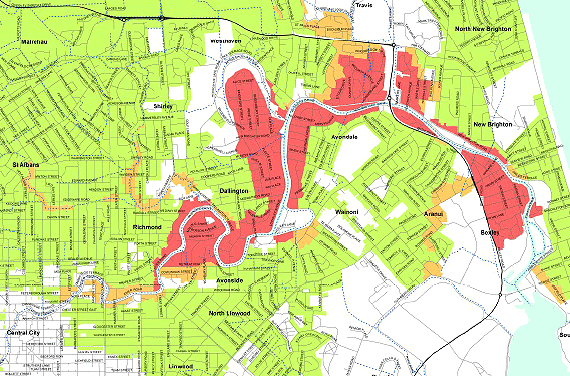
Red zone
The homes the government is offering to buy are in a designated 'red zone'. Prime Minister John Key said the minimum period for rebuilding in this area would be three to five years.
Some land in the Christchurch City and Waimakariri District areas has been so badly damaged by the earthquakes since 4 September 2010 it is unlikely it can be rebuilt on for a considerable period of time. Engineers have mapped these areas and categorised them as residential red zone.
These properties are located in:
- the east of Christchurch (along the Avon and in related areas usually associated with waterways or former waterways);
- in the north-east of Christchurch (e.g. Brooklands); and
- in the beach area of Waimakariri District (i.e. Kairaki Beach).
There are currently about 5000 properties in the Christchurch City Council area and around 100 properties in the Waimakariri District Council area in the residential red zone.
The criteria for defining areas as residential red zone are:
- There is significant and extensive area wide land damage;
- Most buildings are uneconomic to repair
- There is a high risk of further damage to land and buildings from lowlevels of shaking; and
- The success of engineering solutions would be uncertain and uneconomic; and
- Any repair would be disruptive and take a considerable period of time.
Payment options
For people who owned property with insurance in the residential red zones on 3 September 2010 there will be two options:
- the Crown makes an offer of purchase for the entire property at current rating value (less any built property insurance payments already made), and assumes all the insurance claims other than contents; or
- the Crown makes an offer of purchase for the land only, and homeowners can continue to deal with their own insurer about their homes.
See where your property is at www.landcheck.org.nz
For CERA information on the red zone see here.
For CERA information on the orange zone see here.
For CERA information on the green zone see here.
For CERA information on the white zone see here.
For examples of payment scenarios see here.
Reaction
Christchurch resident Vanessa Callaghan, who has two properties in the red zone, and another in the orange, said while she wasn't sure how the buy-out offer would affect the equity in her homes, she was relieved there was a finally decision.
She and her mother were one of several Bexley residents whose home was rendered uninhabitable as a result of liquefaction from the Sept.4 earthquake.
"I'm just in shock really. I knew it was coming but this has been such a long time coming," Callaghan told interest.co.nz.
Stress of not knowing the fate of the neighbourhood - whether the land could be remediated on rebuilt on - and the unrelenting financial obligations in terms of paying mortgages and insurances on homes not fit to be lived in had taken a toll.
She wasn't optimistic that the Government offer would help them recover their losses.
"It'll probably be borderline at the end of the day, I don't think anyone will come out on top like they were before Sept.4," Callaghan said.
Her family would consult with their lawyer and bank to determine the best option. Prime Minister Key, in his announcement, urged residents to work with their insurers and banks to figure out which option would make most sense given their unique circumstances.
Uncertainty to certainty
Insurer IAG welcomed the decision.
IAG CEO Jacki Johnson said it meant that many insured customers could move from uncertainty to certainty around the fate of their home.
"The guidance as to what this means to homeowners, and the options they will have, is equally welcome and will help our response to the needs of our customers in these worst affected areas," Johnson said.
IAG and is affiliates NZI and Lantern would be working directly with customers to sort through the options to help them understand their entitlements, she said.
Clearer picture
Prime Minister John Key said the plan would give people of greater Christchurch a clearer picture of what their future held.
"Since September last year, the government has been working to provide certainty for residents, while recognising many people have their life savings tied up in their homes," Key said.
"Today we have released the most up-to-date information we have about the state of the land in greater Christchurch. Advice from geotechnical engineers has seen all greater Christchurch land divided into four residential zones – red, orange, green and white," he said.
Residential red zones – which involved around 5000 properties – were where the land wass unlikely to be able to be rebuilt on for a considerable period of time. Homeowners in this zone faced lengthy disruptions that could go on for many years, Key said.
For people who owned property with insurance in the residential red zones on 3 September 2010 there would be two options:
- the Crown makes an offer of purchase for the entire property at current rating value (less any built property insurance payments already made), and assumes all the insurance claims other than contents; or
- the Crown makes an offer of purchase for the land only, and homeowners can continue to deal with their own insurer about their homes.
"The varying degrees of damage to the houses and land in the residential red zone mean it will take more time to develop these offers," Key said.
"The reason current rating value is used to assess the property value is because this best reflects the value, and is the most up-to-date information available. Current rating valuations, which are what the Council's rates are based on, date from 2007," he said.
"We hope to be able to come back to residents in the red zone with an offer of purchase within the next eight weeks. Residents will then have nine months to consider the offer of purchase. In the meantime, if residents wish to leave their badly damaged homes in the red zone they should talk to their insurers about accessing any unused portion of their temporary accommodation allowances immediately."
Why it took so long
Key said the size, scale and complexity of the issues the government had been dealing with following the earthquakes meant it had taken some time to get information to residents.
"Each subsequent earthquake since 4 September has made an already large and complex challenge more difficult," Key said.
"To put this in context, Treasury has estimated the combined cost of the first two Canterbury earthquakes to be equivalent to about 8 per cent of New Zealand’s GDP," he said.
"Damage from the 1995 Kobe earthquake in Japan was just over 2 per cent of Japan’s GDP, Hurricane Katrina in 2005 cost about 1 per cent of US GDP, and March’s Japanese earthquake and tsunami disaster was an estimated 3-5 per cent of Japan’s GDP.
"This has been a major event and the government is committed to getting things right for the people of Canterbury. We're moving as quickly as we can to give some certainty to those affected," Key said.
Based on conservative assumptions, Treasury had estimated the net costs to the government to purchase all of the around 5000 properties currently in the residential red zone to be between NZ$485 million and NZ$635 million.
The final costs were still to be determined. Factors that may alter the final costs included the take-up of the offer, government property valuations and proceeds from insurers. The costs were expected to be met from the Government’s $5.5 billion Canterbury Earthquake Recovery Fund.
Brownlee says most up to date info used
Canterbury Earthquake Recovery Minister Gerry Brownlee said the announcement today of zones of land damage in greater Christchurch was the most up-to-date information that can be provided.
"The government will continue to provide the public with timely and accurate information on the state of the land and what it means for residents," Brownlee said.
Red
It was not feasible to rebuild on red-zoned land at the present time, Brownlee said.
"Such wide scale land remediation would take a considerable period of time, and the social dislocation of such massive works would see people out of their homes for at least three years, and in some cases more than five years," he said.
"In some areas we’re talking about the need for up to three metres of compacted fill to bring the land up to compliant height, along with many kilometres of perimeter treatment. Repair in all the red areas would not only require raising the height of the land but also a complete replacement of essential infrastructure like sewer, water, electricity and roading," he said.
"Full land repair in these areas may mean that every house would need to be removed, regardless of its degree of present building damage. The resulting ongoing social dislocation would have major impacts on schooling, transport and employment for whole communities.
"Giving people the ability to relocate on land where they can rebuild immediately is the best option we have," Brownlee said.
"The government hopes to be able to come back to residents in the red zone with an offer of purchase within the next eight weeks. Residents will then have nine months to consider the offer of purchase," he said.
Green
"The majority of greater Christchurch properties – about 100,000 – have today been given a green light to go ahead with their repair and rebuilding of their homes," Brownlee said.
"Insurers have shown a willingness to work with the government and homeowners as we move forward with Canterbury's recovery. Property owners in the green zone no longer have to wait for the results of any area-wide land assessment reports by EQC or their engineering consultants Tonkin & Taylor," he said.
"There will be some isolated exceptions where geotechnical assessments will be required due to major land damage, but for the most part Christchurch can get on with rebuilding. Repair and rebuilding work should take into consideration the risk of ongoing aftershocks, so some finishing tasks such as brick and driveway concrete laying should be delayed until that risk decreases."
Orange
The orange mapped areas were where engineers needed to undertake further investigation.
"Some of the damage in these areas is a direct result of the magnitude 5.6 and 6.3 earthquakes which struck on 13 June, and has not yet been adequately assessed to provide residents with certainty. We’d have liked to have provided clarity for the hundreds of households in orange mapped areas, but we have listened and responded to the many people saying they want information now. This is the most up-to-date information we have," Brownlee said.
"We will progressively announce the outcome of investigations in these orange areas over the coming weeks and months," Mr Brownlee said. There are about 10,000 properties in the residential orange zone," he said.
White
There were also some areas in white on the map, including the Port Hills and the central business district, which were still being mapped or are not residential land.
Info
From today residents will be able to visit the www.landcheck.org.nz website and enter their address to find out what zone their property has been mapped into, and download a fact sheet on what it means for them. Residents can also contact the government helpline on 0800 779 997 if they are unable to access the website or they want more information. The government has commenced outbound calling to those people in the residential red zone to discuss the announcement with them and an information pack will be mailed out to those residents in the next few days.
This is the largest natural disaster we have ever faced in New Zealand. EQC has now received more than 360,000 claims for all the earthquakes since 4 September, one of the highest numbers ever handled by a single insurer in the world. The previous biggest event for EQC was the Gisborne earthquake in 2007 with 6224 claims. There have been more than 7350 aftershocks since the 7.1 magnitude earthquake on 4 September, including 28 that have been magnitude 5.0 or greater.
The mapping released today does not include the Selwyn District Council area as the land in this district was not badly affected by the major aftershocks. Most of the Selwyn area has been mapped as green. Any properties with land damage in the Selwyn District from the 4 September earthquake or subsequent aftershocks are being dealt with on an individual basis.
"The offers of purchase only relate to residential home owners with insurance in the red zone as they were our first priority. We will be considering uninsured homeowners and commercial property owners in the residential red zone over the coming weeks and will get information to them as quickly as possible," Mr Brownlee said.
Questions and answers
The following are taken from the FAQ sheet provided by CERA for issues not discussed above.
5. What if a home owner doesn't agree with the current rating value?
There will be a process through which any property owners who consider that there is a material discrepancy between the 2007 rating valuation and the market value of their property as at 3 September 2010 (e.g. because of significant subsequent improvements) can raise their concerns.
6. How long will it take for the offers to come through?
We anticipate we will be in a position to make an offer for purchase to home owners within eight weeks.
7. Where can people check their current residential valuation?
Christchurch residents can check their current rating valuation through the Christchurch City Council website http://ratesinfo.ccc.govt.nz and Waimakariri District Council residents through the www.waimakariri.govt.nz website.
These are 2007 valuations, which are the most up-to-date available, and what the Council's rates are currently based on.
8. What can people in the residential red zone expect now?
Every residential property owner in the residential red zone will receive information in the mail in the coming days and the Ministry of Social Development has started outbound calling to people in those areas to discuss the announcement. It will also outline where they can go for further information. Anyone in the residential red zone who does not receive a letter by the end of June should call the Government Earthquake Support Line 0800 779 997.
It will take a number of weeks (perhaps eight weeks) before we are in a position to provide the details around the individual packages being offered to all homeowners in the residential red zone with insurance. Firstly we need to conclude discussions with the insurers and other parties, and then we need to prepare an offer for each individual property owner, which is no small task.
Property owners will have up to nine months to accept any offer, and will be able to choose either an early or deferred settlement date. This should provide time for people to choose their next home.
9. What about those living in the orange and white zones?
Property owners in the orange (hold) zone will also be written to shortly, outlining the anticipated timing for the further assessment of their neighbourhood to be undertaken. We are working as fast as we can to gather sufficient information to provide more clarity.
For those in the white Port Hills zone an extensive geotechnical investigation is underway. However, rock fall issues are of a different nature to those on the plains. We are working hard in this area and no timeframe can yet be set. The white zone includes rural areas outside Christchurch City or the Kaiapoi Ward and residents in those areas should continue the normal individual insurance process.
10. Who decided where the different zones begin and end?
The decisions were made by the Government based on technical advice from engineering consultancy Tonkin & Taylor and policy advice from the Canterbury Earthquake Recovery Authority.
11. Can people living in the residential red zone continue living there?
The land in the residential red zone in unlikely to be able to be rebuilt on for a considerable period of time. However, there is no immediate requirement for people to accept the offer being made by the Government.
12. What does this mean for the uninsured?
Our expectation is that the number of uninsured is low. As they self identify, consideration will be given to their situation. At this stage, our priority is working through the options with those who are insured.
13. What is the situation for business owners in the residential red zone?
We will be working through the options for businesses in the coming weeks and will get information to them as soon as possible.
14. Do you expect any schools to have to close as a result of today's announcement?
Many of the schools which draw students from these areas already face real problems and are operating at alternative sites because of the damage to their facilities. This is another challenge that we will have to work through with the Ministry of Education and the schools.
At the moment no schools are being closed. Decisions on the future of schools will be made in due course as the longer-term schooling needs of Christchurch become clear.
15. What will happen to the land in the future?
That is still to be determined. Any decisions in the future will be determined by detailed engineering investigations.
We welcome your comments below. If you are not already registered, please register to comment
Remember we welcome robust, respectful and insightful debate. We don't welcome abusive or defamatory comments and will de-register those repeatedly making such comments. Our current comment policy is here.