

Further reductions to the New Zealand Superannuation Fund’s targeted annual return rate aren’t anticipated in the next five years, according to its chief executive.
Jo Townsend told interest.co.nz after the Fund released its annual results on Wednesday that she’d be surprised if the targeted annual return rate was reduced again, but “you never say never because you never know what can happen in investment markets.”
The NZ Super Fund expects to return at least 7.2% per annum over any 20-year moving average timeframe. This used to be 7.8%, but was lowered earlier this year due to concerns that returns from global stock markets would drop in the future.
“In order for that to be lowered even further, you would have to see continued exceptionally strong performance in global equity markets,” Townsend said.
While a strong performance in the market would be good for absolute returns, she said it would also bring future gains forward, assuming valuations eventually normalise over the long-term. If an investment achieves five or 10 years’ worth of expected investment growth in a much shorter period, its remaining room for growth is considerably reduced.
“I don't anticipate that, at least within the next five years, barring anything extraordinary, that that [annual return rate] number would change again,” she said.
Pleased with the outcome
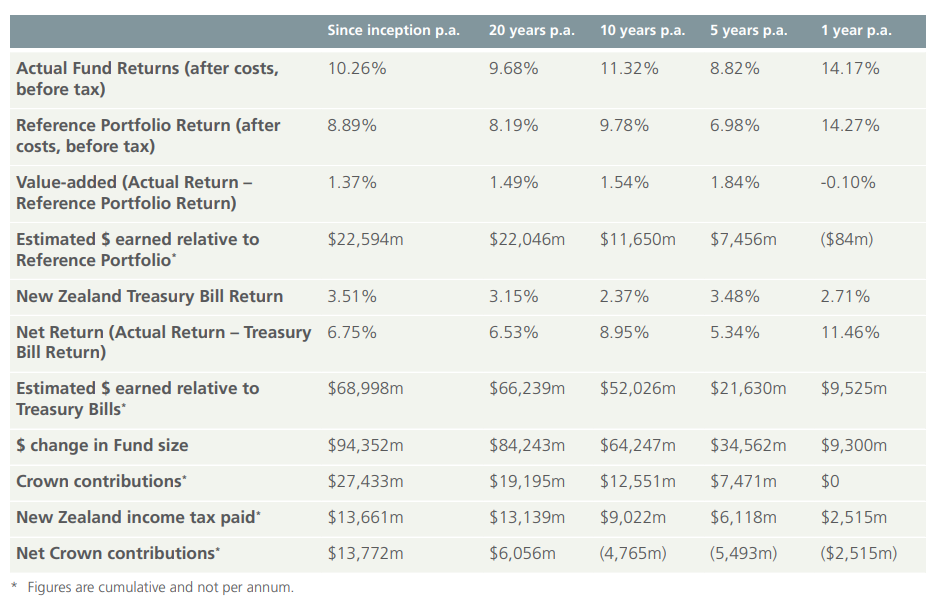
The NZ Super Fund's June-year results show the Fund rose $9.3 billion to $94.4 billion. After costs but before NZ tax, the Fund reported an annual return on investment of 14.17%.
That 14.17% return met one of the Fund's benchmarks – the 2.71% Treasury bills benchmark – but was behind the Reference Portfolio benchmark return by 0.1%.
The Reference Portfolio is a notional, passively managed portfolio of global equities and bonds that is used to determine the amount of value added by the Guardians’ active investment strategies across a portfolio of 80% stocks and 20% bonds.
Townsend said that she was actually pleased about the 0.1% lag in the Reference Portfolio.
“Under the circumstances, we're actually pleased with that outcome because just a little bit over 50% of the portfolio is invested differently to that reference portfolio,” Townsend said.
“So if you think about it in terms of we've chosen to hold a hotel or an infrastructure asset or a timberland asset instead of equities, to the extent that those real assets make a return that is a lot lower than what equities are returning, that's where the difference in returns will actually come in, in any particular year.”
A long-term horizon
The fund noted in its annual results that US equity returns over the past couple of years have been close to double the annualised returns for the past 20 years and the fund expects “some reversion to the mean at some point.”
But Townsend told interest.co.nz that the fund doesn’t have a specific timeframe or forecast of when this is likely to happen.
“When we look at valuations, we really look at them over a long-term time horizon. So, you know, we're using 20-year averages. So I would love to say that it's going to happen within two, three, four, five years, but the reality is no one knows. All we can do is build a portfolio that will do well through all different investment cycles because we don't have crystal balls,” she said.
“But what we have observed is that, you know, returns have been a lot stronger for much longer than anyone would have imagined. In the normal course, we expect to get 8% per annum out of equities. US equities alone last year did 20%, and they've been incredibly strong for a number of years now. So we're humble enough to not say that we think it's going to happen on X-timeframe because we just don’t know, to be honest.”
Tax payments are just a ‘liquidity management issue’
The NZ Super Fund was the country’s largest taxpayer again in the June year.
In the last year alone, the Fund paid $2.5 billion in tax, with tax paid by the Fund now exceeding the Government’s required capital contribution, a trend the NZ Super Fund sees set to continue over the coming decade.
Townsend told interest.co.nz that paying tax is just a liquidity management issue for the fund and nothing more than that.
“We know if we didn't have to pay tax, it would cost us less transition time and effort. The reality is it's a Government decision. We know we have to pay tax. We just need to make sure we have the money available to make the payment on the due date.”
When pressed on whether the NZ Super Fund believes the Government should be reinvesting more of that tax income back into the fund, she said that was up to the Government.
“That is a Government decision, you know, all we can do is take the pot of money that we've been given and do the best job we can with it. We really don't engage in the policy decision side of what we do that much.”
In the next five years, Treasury has forecast that the NZ Super Fund’s tax payments will exceed the Government’s required capital contribution by more than $1 billion a year. Townsend said that difference is expected to top $2 billion in 10 years’ time.
*This article was first published in our email for paying subscribers. See here for more details and how to subscribe.
We welcome your comments below. If you are not already registered, please register to comment
Remember we welcome robust, respectful and insightful debate. We don't welcome abusive or defamatory comments and will de-register those repeatedly making such comments. Our current comment policy is here.