
By Amanda Morrall
 Regardless of whether you’ve binned your annual statement before reading it, you may be forgiven for not having a clue about fees.
Setting aside the tricky task of measuring the true relative performance of your KiwiSaver fund, fees and expenses are the most confounding aspect of the national savings scheme.
That’s because in addition to straight up annual fees, you pay a host of other less obvious costs, the presentation and calculation of which can be mind numbingly complex.
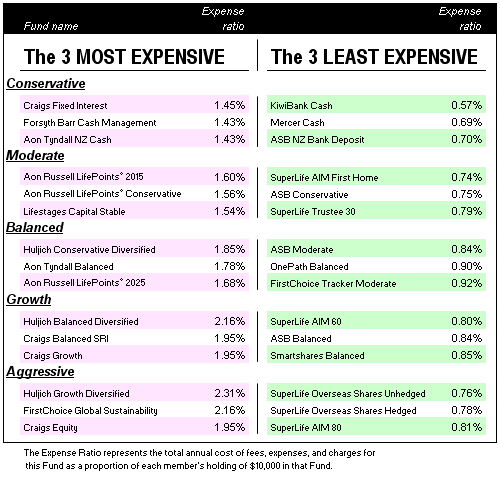
Interest.co.nz has put together a list showing how much KiwiSaver providers across the board charge in fees and expense. all up. We’re calling it the “expense ratio.’’ See more on how fees and expenses are measured here.
From that, we’ve pulled the top three most expensive funds by expense ratio and the top three least expensive, grouping them like with like and assuming they all had $10,000 invested.
We broke it down into five categories; conservative, balanced, moderate, growth and aggressive. Find your fund and its fees and expense here.
Across the spectrum of schemes and funds, it’s a wide divide from 2.31% in fees and expenses for the Huljich Growth Diversified fund to .57% for KiwiBank's Classic Cash Fund.
Huljich also took top spot among growth and balanced funds with 2.16% and 1.85% respectively.
SuperLife enjoyed a sweep on the opposite end, claiming the lowest fees and expenses in three category of funds with its Overseas Shared Unhedged Pool undercutting the Huljich Growth Diversified by a margin of 1.55%, and also claiming second and third spot in the expense ratio for least expensive aggressive funds.
So, on a balance of NZ$10,000 that means you could pay as much as NZ$231 a year in fees all up, or as little as NZ$57. The median fees and expenses among those 200 plus funds we surveyed came in at 1.41%.
SuperLife principal Michael Chamberlain questioned the accuracy of ranking charts that tried to assess fees and expenses, arguing that not all providers disclosed the information required to produce a meaningful comparison. Regardless, he was not surprised by SuperLife's favourable rankings. SuperLife, he maintained, was the “cheapest KiwiSaver scheme on the market.’’
ASB captured both ends of the scale with its FirstChoice Global Sustainability Fund, taking second place behind Huljich as one of the most expensive aggressive funds on the market.
Conversely, it took third place for the lowest fees in the conservative camp.
Fee formula questioned
As the highest fees are typically associated with share oriented funds, a comparison with more cash-based funds might be accused of being unfair because it does not compare like with like. And yet the stark comparison between what Huljich and SuperLife charge to manage the same sort of high-risk fund challenges industry practices.
Chamberlain said the standard industry rationale that growth fees were inherently more expensive to manage had more to do with marketing than economics.
“The market charges more for the aggressive funds because they can get away with it,’’ he said, explaining how SuperLife’s fees for an aggressive fund were well below the median cost.
“It doesn’t cost any more to manage a growth fund. It requires a certain level of skill and intelligence whether you’re buying up a fixed-interest security or a shares-security. Therefore the cost of buying a bond or a share doesn’t really change. If you're in share funds, the market expects to pay more, so you get charged more"
ASB Head of Investments Laurie Mellsop said the nature of most growth funds, such as the FirstChoice Global Sustainability Fund, necessarily required higher fees to compensate for the time, and effort required to manage the risk within them. He said the Global Sustainability Fund was at the high end of the scale because it was, a socially responsible investment fund or SRI.
Ostensibly, SRI type funds invest only in businesses governed by a strict code of ethical covenants and are screened by fund managers to make sure they live up their billing.
“The sustainable guys have to do a lot more research in order to qualify a business as sustainable on a long-term basis. That means they’ve got to go out and visit them and talk about their strategic plans. As a result, one would expect the investment manager fee to be at the top of the range,'' said Mellsop.
The fact that the fund was managed abroad also raised the cost of the fund for KiwiSavers who wanted to buy into it, he said.
The underlying investment manager of the Global Sustainability Fund is Generation Investment Management LLP, co-founded by failed U.S. presidential candidate Al Gore and former global CEO of Goldman Sachs Asset Management David Blood.
Who's managing your money?
While that kind of detail is available for those who go looking for it, those interested in know more can easily find through our KiwiSaver fund manager section.
Mellsop said most of ASB’s FirstChoice KiwiSavers came into the fund through a financial adviser and were therefore well advised of the funds being above average in fees and expenses. Those who came into the fund of their own accord probably were more educated than average and would therefore be braced for higher fees, he said.
Mellsop admitted that fees and expenses were tricky to follow but suggested ASB's new fee schedule and revamp (which takes effect in April) would make fees more easily understood by KiwiSavers.
He deflected criticism that providers were overcharging and deliberating masking expenses to make money. As it stood, he said ABS wasn't expecting to make any money from the scheme until 2015.
It is a point other providers have also been keen to make better understood among the growing criticism about KiwiSaver being a cash cow for providers.
Government Actuary David Benison cautions people about putting too much weight on fees alone. He says KiwiSavers need to weigh fees against the type of fund they are invested in and the returns delivered.
“One of the issues is that it is not about fees, it is about fees and returns. If you have more risky assets then quite often you’re paying for the risk of having the asset. If you look at fees you get a totally wrong impression if you don’t bring fees and returns together.’’
What's a fair fee?
Tables comparing the total fees charged by the various providers help to get a sense of where you sit on the fee scale, but Benison admits it’s a messy bit of business putting it into context.
When KiwiSaver was first introduced, he came up with best practice list that was modeled after the New Zealand Superannuation scheme.
At that time Benison suggested a ‘best practice’ of NZ$3 for monthly membership (NZ$36 annually) with a maximum of NZ$5 (NZ$60 per year). For annual management charges, he proposed 0.2%-1.1% of the amount invested was a best practice range for annual management charges, with employer schemes in the range of 0.2% to 0.8%. The suggested maximum for employer was 1% and retail schemes a maximum of 1.25%.
Best practices figures on trustee fees were 0.03% with a max of 0.075% with non-numeric fees (unanticipated expenses that providers are eligible to claim on top of the other costs) capped at 0.2%.
Benison says the haste at which the KiwiSaver scheme was created and adopted (over a period of two years) meant fees were not as cleanly defined as could have been.
That’s something the Ministry of Economic Development is attempting to change in its upcoming regulatory revamp.
Better transparency is the intended outcome. As a consequence, consumers can expect fees to come down, driven by competition and also economies of scale as KiwiSaver accounts start to grow, said Benison.
Market management
"In time the markets will define what is reasonable. As you grow your fund, you know what you can and what you can’t charge and you know what you need to be able to attract members from other people,’’ said Benison.
Whether markets manage to bring fees down or not, financial commentator Mary Holm, author of three books on KiwiSaver, said fees are a top criterion on which to select a fund.
“I think it’s one of the key things people should be looking at when they’re deciding what provider because it makes a huge difference over the long run. If you have two providers who are exactly the same except one charges a lower fee _ and you’re going to be in KiwiSaver for 20, 30, or 40 years - that can make several thousand dollars difference. It’s a really important issue but yet it’s hard to compare fees because certain people include some items that others don’t, so people are in the dark really.’’
We welcome your comments below. If you are not already registered, please register to comment
Remember we welcome robust, respectful and insightful debate. We don't welcome abusive or defamatory comments and will de-register those repeatedly making such comments. Our current comment policy is here.