
By Amanda Morrall
KiwiSaver proponents will tell you the scheme bodes well for just about everyone regardless of age, but when it comes to retirement planning youth is a distinct advantage.
The earlier you start contributing to your savings, the more time you have to grow your money. It sounds a cheap sales ploy the likes of which you hear from banks trying to lure your business, but long-term mathematical modeling lend this well-worn mantra of the investment community some credence.
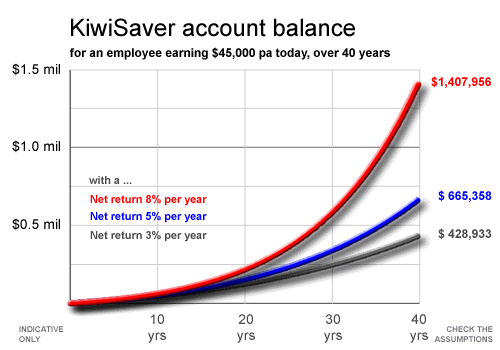
The graph below shows what a stark difference varying rates of return can make over long time frames. For the first 10 years, the differences are marginal and yet going forward nuances between 3%, 5%, and 8% annual rates of return transform into great divides. Although tax, investment fees and inflation haven't been taken into account here, this crude example nevertheless underscores the importance of fund selection.
A 25-year-old employee earning NZ$45,000 a year invested in a conservative fund that could reasonably expect to deliver a 3% annual return could end up with NZ$428,933 at age 65. Whereas someone invested in a more growth-oriented fund that might return 8% per year, will end up with more than three times that amount. Naturally, there are many unknown variables that could alter that equation but in general terms it shows the potency of compounding interest.
Most under 30s are more familiar with the crucifying financial effects of compound interest on credit cards, hire purchase and mortgages. High interest-bearing debt left to languish on a minimum repayment basis is a killer and as such constitutes one of the single biggest impediments to wealth creation for this age group.
Just as the intoxicating effects of consumerism can temporarily blind one to the true cost of borrowing, an awareness of how it can supercharge your long-term savings can be a real motivator to invest smartly.
With the majority of 18 to 24 years-old in the workforce already enrolled in KiwiSaver, under 30s appear to have taken note. And yet most of them remain parked in default funds. These are the kind of funds you end up in automatically if you do not specify a particular preference. That's not a bad thing necessarily as default funds have, ironically, produced the best returns over the three and a half years since KiwiSaver was introduced.
The reason default funds did so well, relative to more grow oriented funds, is because of their composition. Conservative funds, which is what default funds really are, are mostly made up of cash and bonds, what's known in the industry as fixed-interest. When stock markets nose-dived during the financial crisis of 2008-2009, growth funds (more heavily weighted in equities) took a beating while more conservative cash-oriented funds were mostly spared.
There are some good reasons to remain in a conservative fund given continuing economic uncertainty and yet on a long-term basis KiwiSavers with time on their side may do themselves a disservice by staying in a default fund. The rationale is that they could end up missing out on the higher long-term returns that share markets have historically been known to deliver.
Given the diversity of funds in the market (there's more than 200) and the number of competing providers (more than 30) it can be a daunting job choosing a fund. And KiwiSaver
AMP's KiwiSaver scheme manager David Wallace suggests taking it slow and keeping it simple at first to avoid confusion or getting put off the whole idea of retirement savings.
"I think a lot of people are still getting used to the concept of KiwiSaver and that's fine. It's just allowing people to make one decision at a time as they feel comfortable as opposed to making them all at once,'' said Wallace, suggesting that as account balances grew peoples' interest in KiwiSaver would naturally grow.
For those looking to grow their knowledge base, available KiwiSaver resources include the providers themselves (find out more about your provider here), interest.co.nz's comprehensive KiwiSaver's section, Inland Revenue's website, the Retirement Commission's website (sorted.org.nz)
Can you afford to be in KiwiSaver?
There are conflicting views on whether KiwiSaver makes sense for everyone and the national savings scheme is not without its share of critics. (See our interview with Bruce Sheppard).
Also, as an investment vehicle, KiwiSaver entails an inherent element of risk. (For more on the risk question see Diana Clement's opinion piece).
Institution of Financial Advisers President Nigel Tate said for those unable to meet their daily living needs and expenses, it was probably not a good idea. His advise was to consolidate one's debt, if that was an issue, focus on a proper budget (for help see New Zealand Federation of Family Budgeting Services)) and put in place some financial structures that would support the eventual adoption of a savings plan.
Wallace said while that might work for some people, the advantage of staying with KiwiSaver was that it would be a means of forced savings.
"A lot of people continue to put off savings while they continue to amass debt. It comes down to personal behaviours,'' he said.
For those 20-30 years olds committed to the scheme, Wallace said it was a good idea to differentiate between whether KiwiSaver was going to be a long-term savings strategy or a way to save for the purchase of a first-time home. Knowing the answer to that question would help to narrow down the choice of fund.
"For those focusing on saving for their first house, I think the decision is likely to be a more conservative type fund, either cash or conservative. For those long-term savers, it comes down to their personal view on how willing their are to accept short-term volatility.''
Under the national plan, KiwiSavers who are invested for three years are able to withdraw the accumulated savings from personal and employer contributions and use them toward the purchase of a first-time home. Additionally, first-time home buyers with a gross income of less than NZ$100,000 may potentially qualify for a Housing New Zealand Corporation KiwiSaver subsidy on a deposit for the purchase of a home.
The longer you are invested in KiwiSaver, the bigger the deposit subsidy. For example, if you met the income and asset test, after a period of five years in KiwiSaver you could get NZ$5,000 towards a deposit on your first home.
If keeping up with KiwiSaver payments, on top of a mortgage, proved to be too difficult, Wallace said it made sense to take a contribution holiday. Those who were able to keep up a NZ$20 a week payment to their account would still receive the NZ$1,042 annual tax credit from government.
"Lost savings" beckon in Oz
Under legislation that will be finalised this year, New Zealanders who have spent time working in Australia contributing to a compulsory savings plan there, will be able to repatriate their savings and roll them into a KiwiSaver account here. Similarly, Australians who have spent time working in New Zealand will be able to migrate work-related superannuations schemes.
Regardless of whether you decide to put banked Australian savings into KiwiSaver, it could pay just to find out how much you have sitting there. There's close to NZ$16 billion in abandoned retirement savings funds waiting to be reclaimed. It's referred to as the "lost savings.''
Although consolidating one's retirement savings in New Zealand could simplify the management of your investments, some say there is no tax advantage to bringing them home. For more see ("Is it worth bringing funds over the ditch). When you turn 60, you can start to draw down on those funds on an as needs basis and they remain tax free. Prior to that point, they are taxed at a flat rate of 15% as opposed to the income dependent staggered PIR (Prescribed Investment Rate) we have in New Zealand. (For more on PIRs, click here.)
For someone new to the investment sphere, it is a lot to digest. Starting with the basics and working up toward more sophisticated issues is a strategy that will serve you well, says Institute of Financial Advisers President Nigel Tate. (For an overview of some of the basics, see KiwiSaver 101 introduction.
We welcome your comments below. If you are not already registered, please register to comment
Remember we welcome robust, respectful and insightful debate. We don't welcome abusive or defamatory comments and will de-register those repeatedly making such comments. Our current comment policy is here.