

By David Chaston
The COVID-19 pandemic has dramatically affected employment worldwide. Employment has fallen dramatically almost everywhere, causing huge social stress and distress.
Some economies have been hit much harder than others, depending on their pandemic response. China is one place that has suffered relatively lower impacts on employment; the USA relatively higher impacts.
New Zealand can also count itself as a low impact country for employment consequences - so far, at least. Australia is counted in between.
But like all economic events, it is also worthwhile to look at the longer term trends on which the latest crisis has been 'built'.
A top-level framework for judging employment trends is the ratio of employment to the working aged population. It isn't the only (or perhaps even the best) metric but it is useful to give perspective of how the recent crisis can be judged.
Modern statistical data in New Zealand effectively starts after the clean-out of the Muldoon Administration after which our data collection moved out of the stone age.
The mid 1980s was also a time of considerable economic upgrading. Many jobs were lost in these reforms. Fortunately, hundreds of thousands of pointless jobs only possible behind huge tariff and import licensing walls were relatively quickly transitioned into real-world jobs. There was pain and suffering, probably made worse because reform had been resisted for far too long.
Within 10 years, New Zealand's employment-to-population ratio was back to high levels, not only from the local historical perspective, but also on an international perspective.
Not only did the Lange/Douglas Government start the reform process and take some very tough decisions, but the incoming National Government (Bolger/Richardson) stuck with the program which brought a strong rise in employment. The next Labour Government (Clark/Cullen) successfully built on that momentum.
The Global Financial Crisis (GFC) undid some of that progress, but with the help of the huge infrastructure rebuild after the Canterbury earthquakes (funded in part by very strong insurance inflows), the employment growth returned and even reached new highs.
So when the pandemic hit us, we were in an enviable position. And the new Labour Government (Ardern/Robertson) has responded with job-protection policies. The tough 2020 has been hard for many but not as many as first feared.
In the longer term, our pandemic hit to our labour markets still leaves us in a better position than at the peak before the GFC. It has been quite an achievement. In 35 years we are in a better position than where we started.
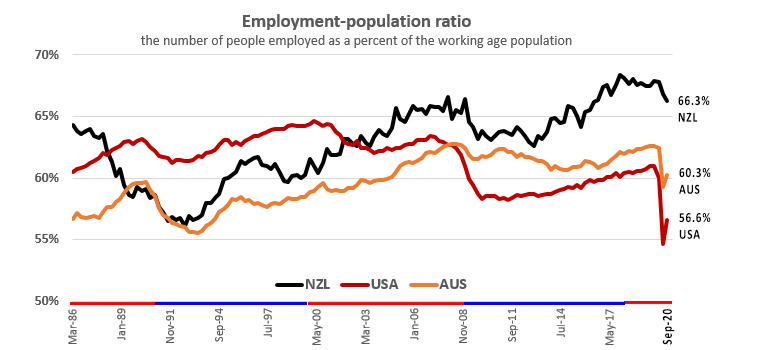
Contrast our experience with Australia and the USA.
Australia made no progress in getting more people into work after the GFC, so the pandemic hit has been a net negative for them. And this is despite the GFC having relatively little impact on Aussie jobs. Shipping outback dirt to China 'saved' them during the GFC.
In 35 years, Australia has made progress so that the pandemic hit still leaves them ahead.
For the USA, the recovery that was so hard to start after the GFC actually gained momentum in the second term of the Obama/Biden Administration, and continued at about the same pace under Trump/Pence.
But this improvement is far less than impressive mainly because the generation before that squandered their labour market strengths. From leading the pack, the US is now a serious under performer.
And it is suffering the consequences. The pandemic hit for them has been fierce on jobs, as we have been reporting this year. More than 10 million jobs have been lost since February.
But as the employment-to-population ratio reveals, things are much worse than that because so many of their working age population has fallen out of the labour force. Given up on getting a paid job, essentially.
In 35 years, the USA labour market has atrophied.
This is their challenge. And it is a monumental challenge for what is the world's largest economy and one whose consumer demand powers world trade, so most countries have a stake in their success. If they fail, China is the obvious alternative and there is plenty of evidence the growth of the Chinese middle class could do the same job, and in fact may be already doing an impressive amount of heavy lifting.
The problem for the world is that China is doing that with excessive amounts of debt. It is a rapid transition for them. Barely 10 years ago, Chinese households were net (aggressive) savers. But now their companies, local and central governments are racing to develop into first-world status with obscene amounts of debt. This is tolerable when interest rates are very low and there are no economic crises. But it carries huge global risks if either of these favourable conditions change.
New Zealand's ability to tolerate a serious Chinese economic wobble will depend not only on maintaining a balanced trade spread, but also how our trading partners are affected by that same risk. It may well hurt them more intensely than it hurts our direct NZ-China trade relationship.
In the long run, our relatively good employment-population ratio can only be maintained by a positive trade performance (for both goods and services).
We welcome your comments below. If you are not already registered, please register to comment
Remember we welcome robust, respectful and insightful debate. We don't welcome abusive or defamatory comments and will de-register those repeatedly making such comments. Our current comment policy is here.