
New Zealand needs to add more value to food exports before shipping them overseas in order to help the economy catch up with Australia by 2025, according to a report commissioned by the government.
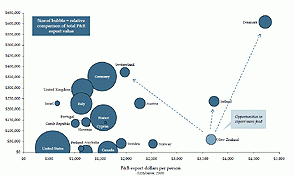
The report focussed on the growth of the country's processed food and beverage (F&B) exports, saying they were the biggest lever available in the quest to double New Zealand exports per capita by 2025.
Based on the experience of its temperate climate, small country peers, New Zealand should be looking to at least double its exports per capita if it wanted a 60% increase in GDP per capita by 2025, the report says.
"To double exports in 15 years, we must work with what we’ve got – the biggest lever available is food and beverage exports (53% of export value)," the report says.
"While New Zealand achieves good F&B exports per capita, it achieves poor F&B exports per square kilometre; we would appear to have “spare capacity” to export more," it says.
"However, declining available farm land and falling overall animal numbers strongly suggest that the path to exporting more F&B in the future is not just “more of the same”."
"In many traditional sectors, New Zealand has failed to forward integrate along the value chain," it says.
"New Zealand still significantly makes ingredients, which are sold to food manufacturers, who add value by turning them into processed foods ready for consumers."
"Relative to peers, New Zealand has good F&B exports per capita; however, our mix is currently skewed towards traditional minimally-processed products; we underperform in added-value processed foods."
"Adding-value is an obvious idea; historically there have been major barriers limiting the ability of New Zealand food processors to move into value-added processed foods; this will not be true in the future."
Minister of economic development Gerry Brownlee said the report identified "a number of reasons why New Zealand can and should build its focus on processed foods, including growing global demand and New Zealand’s strong history of food exports".
“The maths is pretty simple – a kilo of infant formula is worth ten times the value of a kilo of milk powder – so we know which one New Zealand should be selling,” Brownlee said.
Here is the initial press release from economic development minister Gerry Brownlee:
A report released today suggests New Zealand could double the value of its food exports, and offers insights into how this could be done, Minister for Economic development Gerry Brownlee says.
Moving to the centre: the future of the New Zealand food industry was commissioned from Coriolis Research by the Ministry of Economic Development and focuses on food exports to Australia.
It shows that New Zealand’s exports of high-value processed food products to Australia are not just large at $877 million in 2009 (excluding wine), they are also growing rapidly.
“New Zealand is achieving success in Australia across a wide range of non-traditional foods and beverages; these are our growth stars and the foundation of future export growth to the world,” Mr Brownlee said.
“The report is valuable for New Zealand food manufacturers looking to increase their export earnings.
“We know that New Zealand needs to sell more added-value food products, and these exports to Australia show it can be done.
“The government has already invested heavily in a food innovation network to help companies develop innovative, higher-value products.”
The report identifies that there are major opportunities for New Zealand processed food exporters in Australia.
“It is our closest market, culturally similar but with 22.5 million people, and of course low barriers through the CER agreement.
“Processed foods companies can grow their sales in Australia and use it as a stepping stone to other markets.”
Mr Brownlee said the report’s high-level analysis would help individual firms decide where to focus their in-depth research efforts.
The report identifies a number of reasons why New Zealand can and should build its focus on processed foods, including growing global demand and New Zealand’s strong history of food exports.
It focuses on four specific product areas: chocolate and confectionary, baked goods, frozen French fries, and infant formula.
“The maths is pretty simple – a kilo of infant formula is worth ten times the value of a kilo of milk powder – so we know which one New Zealand should be selling,” Mr Brownlee said.
The report’s title, “moving to the centre,” is a reference to the central aisles of supermarkets where processed foods are stocked, rather than the walls where meat, milk, and fruit and vegetables are found.
(Updates with more from the report).
34 Comments
IMO the best value we could have added was to market country and our food stuffs as GE FREE NZ - then working toward fully organic certified production.
But we blew that opportunity too.
Totally agree....we cant produce in quantity like the USA but we can produce in quality and be a large non-GE niche player....The US food is full of GE....yet ppl dont want that where they can afford to pay for GE they do....
Not so sure about organic, except that Peak oil will mean fertilizers and sprays will become un-affordable, this not only means organic production has to grow but also spells the death of some GE foods as it often relies on specific pesticides in the right quantities plus fertilizer....to do better....
regards
.
To Kate,
Oh really? When I lived in Boston, GE free organic NZ lamb used to sit on the shelf for week after week after week after week.
No one was buying it.
And this was in a supermarket that specialised in selling organic 'sustainable' food in one of America's most liberal and aware cities (Cambridge, MA the supermarket was halfway between Harvard and MIT) If you can't sell it there, you can't sell it anywhere.!
GE is not witchcraft you know, so you can put your pitchforks and flaming torches away. There’s no Frankenstein here.
That's the problem right there ! Boston! My god, I doubt many in Boston even know where NZ is EVEN after Lord of the RIngs. Plus it's WELL KNOWN (my wife is American) that Americans love BEEF
World Famous in New Zealand.
Kiwis love to believe that "the whole world is watching us", when in reality the whole world is in almost complete ignorance of our existence.
A few have some vague and hazy recollections, but they are rare.
One day (and this was several years before the Lord of the Rings) I was standing on my local subway platform waiting for the train to come to take me to downtown Boston, when a homeless/ bag guy shuffled onto the platform and stood beside me. After a moment or two he turned and asked me if the train went to South Station. When I said yes it does, he looked up at me more intently and said, “I love your accent, where are you from?”
I said, “See if you can guess. I’ll give you three guesses.
He said “Well you don’t sound Australian, (I almost kissed him) and I don't think you're English either. He paused for a moment again and said, “Are you from New Zealand?” I was actually quite shocked and when I said yes, without even hesitating he said, “Are you from Auckland, Wellington or Christchurch?”
Americans know where New Zealand is, well the smart ones do. And in Boston, even the bums were smart!
Ferchrisake, we've been hearing this for decades - forty years or more. Same with the log exports, wool, you name it.
No one wants to admit the big ugly truth - our cities and their industries are hopelessly inefficient, useless even at transforming our primary produce into products the world wants - we've only got half an economy. All those millions of consumers and bugger all in the way of exports
But, but KD... the Ministry since Gerry hadn't yet wasted enough taxpayer dollars commissioning a report which Gerry himself could trumpet around about!
The funny thing about NZ these days - there are no new ideas from the top - bar maybe a bike path.
Before NZ can export chocolate successfully, it needs to learn how to make it (good quality one I mean)...
Agree Elley, shocking quality standards regarding food (and a lot of other things).
What's wrong with Whittakers, they are getting better, more than just peanut slabs.
Fred, then you have never tasted Austrian, German, Swiss, or French products,
Ditto. Although to be fair to Whittakers I'll say they're probably the best brand over here. But why they package their 72% chocolate in a big, bulky 250g block is beyond me. Don't they understand chocolate at all? Chocolate with a high cocoa % is usually supposed to be for "degustation" (tasting), as in, a small piece with your coffee or whatever. It's meant to be a luxury thing. It's not supposed to be packaged like standard baking/dark chocolate. Just go in a supermarket in one of the countries mentioned above and you'll see the difference.
Which brings me to the next point...tastes and cultures, including food culture, are different depending on the country. For example, not every country has a culture of stuffing themselves with chips and sweet chocolate bars full of crap that should never be called chocolate in the first place. Unless you actually understand your market overseas and the people you're selling to (or trying to sell to), you're not gonna be successful exporting your NZ-made products. [running away from computer now lol...]
You're right Elley. Different cultures, different tastes. I have had some awful (to my mind) European made chocolate as well as good. I'm a bit of a chocoholic but a very fussy one! :-) A young family member has made their home in the UK. When they first went there they really missed NZ Cadbury chocolate. The UK chocolate just wasn't the same. Now that they have been living away from NZ for 8years they have gone off NZ Cadbury (and had done so before the palm oil debacle).
A family member is Canadian and they are horrified that we use butter when making homemade pastry. In Canada they don't. As far as the Canadian is concerned, pastry made with butter just isn't pastry!
Yep, we really noticed that too. Some things that we just couldn't eat, or drink for that matter (eg fresh milk) when we left France we actually like now. And my kids love Marmite. What more can I say?!
Takes a while to move from black singlets and gumboots. Bigger is better, the guy at Mitre10 says so.
Have you tried all truly NZ made chocolate? There is only a handful of manufacturers in NZ who conche & refine cocoa.
We exported $143 million worth of chocolate and confectionary in 2009. That's more than the value of the wine industry 10 years ago (wine exports topped 125 million in 1999) and showing similar double digit growth rates, but not given the same public celebration and profile. Put another way, 143 million is 2.5 times the turnover of Orion healthcare in all markets (including NZ). We *already* export chocolate succesfully. In ten years it could easily be a billion dollar export industry.
Dont get me started I work in the food industry and this is yet another pointless report produced by people who know very little about the subject matter. At least thats how it looks.
Come on
- The raw materials for chocalate and baked goods are imported.
- French fries are hardly value added.
We are a major producer of whey protiens yet we export it as a raw material rather than using it to manufacture higher value supliments and specialty products.
Nobody in their right mind would want to start a food business in this country the cost of compliance is rediculous. The supermarkets hold you to ransom here and abroad. I know of a small business that exports and one of the owners has spent 6 months fulltime working to get there systems that meet all the food safety systems upto the british retail standards.
The milk solids used in the making of NZ chocolate are supplied locally.
You may want to read the actual report, rather than just the press release, before you comment. It is available here:
http://www.med.govt.nz/upload/75420/Coriolis-report.pdfTo your issues:
1) Authors qualifications
I was one of the major authors of the report and I have worked for major food manufacturers (Kraft & Nestle) and retailers (Safeway (USA) & Woolworths (NZ)). I also have a degree from Cornell University in Food Industry Management. You may want to read a couple of the reports here to check what we know about the food industry globally:
http://www.coriolisresearch.com/?page_id=240
So, with that issue out of the way, let's look at your other issues:
2) Baked Goods
a) New Zealand produced 442,000 tonnes of butter in 2009 (Source: UN FAO).
b) New Zealand produced 1,126,468 tonnes of grain in 2009 (Source: UN FAO). Therefore, NZ produces ~3x as much grain as butter.
c) New Zealand is a low cost producer of butter and competitive on grain.
d) Many countries place tariff barriers on butter imports.
e) Many frozen baked goods contain significant amounts of butter and other dairy products. For example, frozen croissants contain more than 50% butter.
f) Many countries have lesser tariffs on frozen baked goods than on butter. Therefore, we can often get our frozen croissants into the countries. This is called a "tariff buster" product.
Can I suggest you review the success of Yarrows (www.yarrows.co.nz) and some of the other companies listed in the report.
3) Chocolate
As another poster pointed out, there is a lot of dairy product in many types of chocolate. Cadbury claims in their advertising that there is "a glass and a half of full cream milk in every half pound."
4) Frozen potatoes
Some people internally within government also mistakenly believed frozen potatoes were not value added. We prepared a rebuttal to them, which I have loaded here:
http://www.coriolisresearch.com/pdfs/coriolis_med_09_1007_sup_potatoes_…
5) Whey - agree. Have you read the report?
Hope this helps. Let me know if you have any additional questions?
Tim
p.s. I believe "rediculous" is spelled ridiculous
Don't blame the teachers. Look to the parents. No books, no expansion of minds, endless 'telly.
Heck, a working (?) majority are stupid enough to have voted for a bunch promising 'growth'.
How dumb is that.
Just remember that half the people you meet will be below average.
The bigger half, by the looks of it.....
Thanks but don't put all parents in the same basket. We've got no TV (well, the kids think we do cos they get a DVD once a week but it's not actually connected and it won't be until they are well into their teens, a decade from now). On the other hand we have a floor-to-ceiling library accross a whole 5m wall. The 6-year-old reads a book a day (a real one, not a picture book), either in French or English (incidentally, her school teacher is also brilliant).
I vaguely remember l'encre being dans l'encrier.
very useful!
Yes, I was generalising, my better half is a teacher, spends much time doing things, shall we say, that have little to do with teaching.
We had telly when the kids were small - gave them a weekly budget (3 hours).
Boy, they sweated over that......
Bioactives are where we should be. There are components in animal tissues worth over $1m/kg, it's just a matter of extracting and purifying them. Unfortunately you kinda need a serious commitment to R&D before the profits flow and that doesn't fit with our short-term thinking and lack of political vision.
As for Brownlees comment about baby formula - on the face of it he is correct. However, I remember being at a Fonterra meeting a few years ago where they put up the costs involved in marketing their Anlene brand in to Asia. It was early in to the launch of that brand and it was going to take years before we broke even in that market once the marketing costs were taken in to account - $10's of millions of dollars. You can't just go in to an export market and expect the big players to roll over and let you in. Fonterra made the decision to be the worlds biggest supplier of dairy based ingredients rather than try to take on the big players like Nestle and Kraft. The reality is they have far more financial staying power than Fonterra has for a market share war.
As for the potatos - I have a friend who grows spuds in Manitoba. They are contracted to McCains who have the contract to supply McDonalds in the USA. This year (after they had planted) their contracts were cut as it was cheaper for McCains to bring in spuds from the UK, than it was to pay the Canadian growers.
Organics is fine from a sustainability viewpoint, however the flip side of it is that less food is usually produced under an organic regime.
Slossy: If you took a poll of this sites bloggers and asked them to name 10% of the 2500+ products Fonterra makes you would be lucky to have more than 10% of them get past the basic milk powders. Until your comment most of them wouldn't know about our whey protein exports.
less food will be produced regardless. Get used to it. Peak Oil means(t) peak agriculture. Whether we are relative to Aus incomes is irrelevant.
Where we win is that we aren't a 'sunburnt country'.
Put us quids ahead.
CO, you provide a great mine of information about Fonterra, and one well beyond that known to most shareholders.This gem included: "the 2500+ products Fonterra makes".
Can you also provide us with the value of those Fonterra's products ranked from 501 down? From 100 down? Can you tell us what percentage of the milk Fonterra processes goes into producing WMP? Do you have any hard numbers to show us that Fonterra is not primarily in the business of processing milk into commodities?
Lets not forget that the industry strategy that drove the formation of Fonterra (and still prevalent now) was one that required the NZ dairy industry to be producing $30 billion (1998 dollars at that) worth of products from NZ milk supply by 2010.
Industry debt did not appear to have been of great concern.
The point I was making is that there is a perception out there that milk is only made in to powder, whereas there are many different products being made. For example, I think some of the bloggers on here would be surprised at the nutriceuticals that are being made. Whilst not a large market compared to WMP or SMP etc it is an important niche market.
one well beyond that known to most shareholders.This gem included: "the 2500+ products Fonterra makes
Gary Romano mentioned this at the 2008 AGM. If suppliers want to be informed they need only attend the company meetings.
Regardless of whether or not Fonterra has made the ideological targets stated at the time of it's formation, I firmly believe I am better off for it's formation.
Apart from the comments from the author of the report and few others, the quality of commentary on this report here is appallingly ignorant. Half of New Zealand's exports are derived from the food industry, and yet most New Zealanders know very little about the structure and dynamics of the industry both within New Zealand and internationally. Interestingly, some people actually in the food industry also appear to have little understanding of how the industry operates internationally - viz the person above from the food industry who suggests that frozen french fries are not value added. Or who complains about the compliance issues - like it or not, the food industry is the biggest string to our bow, and complying with the demands and specifications of the customers (eg Tescos) is one part of that game. Stop complaining about how hard it is and get on with it, or be satisfied with an economy built on property development and bulk (albeit very high quality) milk powder. There are many in the food industry (my comment above not withstanding) who are quietly doing just that. This report mentions many of them. Good on them - we should be grateful for their sweat and perserverance. No-one said it would be easy. It's a big bad world out there, but smart and diligent people can and are succesful in it. Complainers simply complain and repeat the myths we tell ourselves.
One of the points of the report is that "added value" foods is not something we would like or that we should aspire to, it is something that is actually occurring in the NZ food industry now and is experiencing significant growth. The facts tell the story - I don't think anyone can argue with compound annual growth rates averaging 11% for a decade - which is the level of performance of our processed foods industry. This exactly the kind of growth the NZ economy needs - it should be recognised and celebrated.
Exports of infant formual have grown by about $633 million in five years, and with growing demand in Asia this looks set to continue. Why do you think that Bright Dairy bought into Synlait? A smart investor would be looking to get into the NZ infant formula business right now. My advice - read the report and learn something about how the food industry actually works. You owe it to your country, and if you don't believe that, you owe to youself and your own future wellbeing.
Your post is light in a very dark tunnel, angus1.
We welcome your comments below. If you are not already registered, please register to comment
Remember we welcome robust, respectful and insightful debate. We don't welcome abusive or defamatory comments and will de-register those repeatedly making such comments. Our current comment policy is here.