
By Alex Tarrant
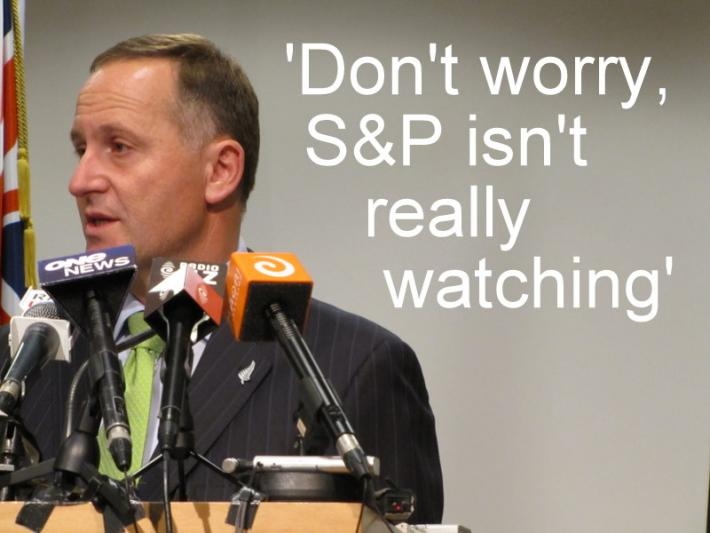
New Zealand's rising debt levels will not bother the international ratings agencies unless government debt hit 30% of GDP from about 18% now, Prime Minister John Key said, adding that debt is tracked to reach as high as 28.5% of GDP.
Key was talking to RadioLive's Andrew Patterson after the release of the government's half-yearly fiscal update. The interview aired on Patterson's Sunday Business show.
Asked about Finance Minister Bill English's comments that there was no buffer room in the government's books for another disaster like the Christchurch earthquake, Key said: “Well I don’t know the context in which he said that and often the context has a big impact on what he actually meant.
"He [English] probably meant, I suspect, that the government doesn’t have room to muck around - just because we might actually get back into surplus quicker or a year earlier than people think, we still owe a reasonable amount," Key said.
"The truth of it is government debt at the moment is sitting at around about 18% of GDP and is likely to top out at, in all the numbers we have, at 28.5% of GDP. Now relatively speaking how does that put us? The answer is in very good shape to a lot of other countries. So the UK on its way to 100% of GDP, the US on its way to 100% of GDP, Japan at 200% of GDP," he said.
"The ratings agencies tell us ‘look if your debt is under 30%, you’re of no concern to them, if it’s between 30-60% they think it might hold back growth a little bit, but again of no major concern, anywhere near 100% then you really get their attention.
There was no question about government not being able to sustain another earthquake in New Zealand if it were to happen tommorrow, Key said. "The answer is yes we can."
"But I think his [English's] main point would be ‘we don’t have any room for anything frivolous. We just simply need to try and build that balance sheet back up so that when the next thing happens, and there will be another thing, we’re in the best position to withstand it,'" Key said.
"But again, if you have a very strong balance sheet, as we effectively have had, if we hadn’t used that and allowed ourselves to continue some expenditure in infrastructure areas or entitlements and benefits, then the impact of the recession would have been much harder felt in New Zealand than it has been," he said.
"So it’s not like we’ve been wasting the money, we’ve just simply been using it for what we thought was appropriate this time."
Last week Key said New Zealanders shouldn't panic about public debt. See more here.
'Surplus track is a commitment'
Meanwhile, Key told Patterson the government's talk of getting back to surplus in five years was "pretty much a commitment" rather than just an aspiration. "Next year when you see what we’re doing, you’ll see that again we’re taking further steps to make that a reality. We have been very disciplined about our spending, we haven’t blown our NZ$1.1 billion [additional budget spending]," Key said.
"The last time Michael Cullen had a NZ$1billion new budget spending initiative I think was in his first budget, and by his second budget he was already breaking that. And from there on it blew out," he said.
"People say ‘well he [Cullen] didn’t cut taxes because he had these surpluses but he didn’t think they were structural’. But he put in place other structural spending. He didn’t cut taxes because he didn’t want to.
"We’ve had three major rounds of tax cuts since we’ve been in government, and you can see that by the fact that if you are a retired New Zealander, the married couple break for superannuation, which is paid at 66% of the net after-tax average wages, it was around about NZ$750 per couple per fortnight.
"Since we’ve been in office it’s now just under NZ$900 – I think it’s NZ$890 last time I looked. Well that is a huge increase for those people and the reason for that is because we have essentially cut taxes and lifted net after-tax wages by so much," Key said.
Patterson: But aren’t you also counting on being able to reduce that deficit as a result of the government bond rate declining, when a number of economists have said in the last few days that may not be a realistic assumption?
“Well there’s a lot of different factors there isn’t there," Key said. "No one really is sure. It’ll depend on what yields are like. What we do know is Alan Bollard had originally written into his bond curve predictions, I think, or certainly the market estimates were, a 1-1.5% tightening in 2011.
"He [Bollard] then scaled that back to 1% and I think now he’s saying that is less likely. So there doesn’t look to me to be a lot of upward pressure on interest rates," Key said.
"That doesn’t mean we don’t pay more on the international markets, but certainly domestically there’s not a lot of upward pressure on interest rates," he said.
"And again, relatively speaking, because New Zealand’s debt at a government level is in good shape, government-issued debt is actually well sought after. Nevertheless those external liabilities – and you go back to that issue of we borrow a whole lot because of our private sector debt and we borrow almost all of it from offshore - it’s not a sustainable position.
"New Zealand has to get on top of its penchant for borrowing so much money from foreigners. You just need to start saving more," Key said.
(Updates with comments on surplus track, bond rates)
We welcome your comments below. If you are not already registered, please register to comment
Remember we welcome robust, respectful and insightful debate. We don't welcome abusive or defamatory comments and will de-register those repeatedly making such comments. Our current comment policy is here.