
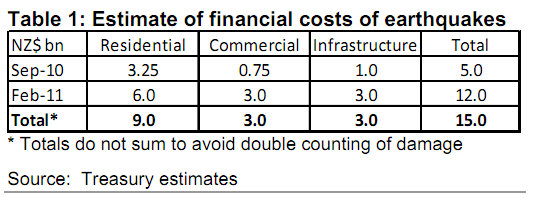
The two Christchurch earthquakes could cost around NZ$15 billion, while the total loss of tax revenue due the quakes could be around NZ$5 billion over the next five years, Treasury says.
In its Monthly Economic Indicators for February, Treasury said there was considerable uncertainty about its NZ$15 billion estimate, "which is best described as a working assumption rounded to the nearest NZ$5 billion".
Finance Minister Bill English said work was still being done on the potential impacts of the quakes, which hit on September 4 last year and February 22 this year, and the flow through to tax revenue.
“But based on these early assumptions, the total loss of tax revenue from all of these factors could be in a range of NZ$3 billion to NZ$5 billion over the five years. This is manageable in the context of the Government’s revenue base of about NZ$330 billion over the five years," English said in a media release.
Nominal GDP, which is not adjusted for inflation, could be down NZ$15 billion over the next five years, English said.
Recovery weaker even before latest quake
Even before the second major earthquake in Christchurch on February 22, the economy had been much weaker in 2010 than Treasury expected.
"As we began to prepare our 2011 Budget forecasts prior to the 22 February earthquake it was our view that the outlook for 2011 was also weaker than in the Half Year Update. The earthquake has now set the recovery back further," Treasury said.
Official figures showed the economy contracted 0.2% in the September quarter, while Treasury is now estimating real GDP growth (which is adjusted for inflation) was zero per cent in the December quarter (down from 0.9% in its Half Year Economic and Fiscal Update in December).
"This result would leave real GDP in the December 2010 quarter just 0.5% higher than the same quarter a year earlier," Treasury said.
In terms of the bigger picture, whether growth in the December quarter was slightly negative or flat was only significant for the near-term economic outlook to the extent that negative data releases can weigh on confidence, Treasury said.
"The more important story is that 2010 was fairly weak as a result of increased household saving, negative events such as September’s earthquake and storms, two droughts that bookended the calendar year, and a further hit to confidence from sovereign debt concerns overseas," it said.
"However, as discussed above, there were tentative signs of recovery taking hold in early 2011 prior to the February earthquake, with growth also expected to be boosted by rebuilding after the September earthquake and the hosting of the Rugby World Cup.
"As a result, we were expecting real GDP in the December 2011 quarter to be around 3.5% higher than a year earlier prior to the recent earthquake," Treasury said.
The February quake would now reduce growth by 1.5 percentage points, meaning real GDP in the December 2011 quarter would likely be 2% higher than a year earlier, as opposed to 3.5%.
Official figures from Statistics New Zealand on December quarter GDP were due on March 24, although it is likely the release will now be delayed due to the February 22 quake.
 Here is the reaction from Finance Minister Bill English:
The Treasury’s preliminary assessment of the Christchurch earthquake’s economic impact confirms the need for the Government to carefully consider its priorities, Finance Minister Bill English says.
It also points out that economic growth was slower than forecast previously, even before the latest earthquake. This reflects soft domestic demand – as New Zealanders save more - despite exporters benefiting from higher commodity prices.
“At this early stage, our immediate focus is on getting good information about Christchurch’s requirements, and that will tell us more about the scope of the prioritising we need to do,” he says.
“Since being elected in 2008, the Government has taken the approach of protecting the most vulnerable and any spending changes we make will ensure that continues.
“Paying for the earthquake will likely involve a balanced combination of a bit more borrowing in the short term and reconsidering our spending priorities, so we can provide the financial resources needed to help rebuild Christchurch and the Canterbury economy.
“And we’ll also press on with our broader economic programme to reduce New Zealand’s vulnerability to foreign lenders, get the Government’s finances in order and build faster growth based on higher national savings and exports.”
In its Monthly Economic Indicators issued today, the Treasury provides a preliminary assessment of two aspects of the earthquake:
- It estimates the total financial cost of damage from the earthquake at between $10 billion and $15 billion – two to three times the estimated $5 billion cost of the first earthquake last September. This will be shared between central government, insurers, local government and businesses.
- In addition, the wider economic impact of the earthquake, combined with already slower economic growth than forecast in the Half Year Update in December, could leave nominal GDP a cumulative $15 billion lower over the five years to 2015. That is equivalent to about 1.5 per cent of the total value of GDP over this period.
“We're still working through the potential impacts of the earthquake on GDP and the flow-through to tax revenue,” Mr English says. “But based on these early assumptions, the total loss of tax revenue from all of these factors could be in a range of $3 billion to $5 billion over the five years.
“This is manageable in the context of the Government’s revenue base of about $330 billion over the five years.
“It’s clear that the earthquake will have an impact on the Government’s finances – through both increased costs and reduced tax revenue.
“We will work through those issues carefully as we prepare for the Budget over coming months,” Mr English says.
(Updates with table, Treasury comments on growth, link to full Treasury document, Bill English comments)
We welcome your comments below. If you are not already registered, please register to comment
Remember we welcome robust, respectful and insightful debate. We don't welcome abusive or defamatory comments and will de-register those repeatedly making such comments. Our current comment policy is here.