
By Alex Tarrant
New Zealand is better placed now than in 2008 to deal with global market turmoil, with a falling exchange rate cushioning export price falls, and room to move still on the interest rate front, Finance Minister Bill English says.
As the Australian government sets itself to revise down revenue forecasts due to the fallout from the European sovereign debt crisis, English said the most recent advice he had received from Treasury before the November 26 election was there were no significant reasons to change forecasts in the pre-election economic and fiscal update (PREFU).
Recent global market events were not as sudden as those following the collapse of US investment bank Lehman Brothers in 2008, although English cautioned current events may be as serious. The New Zealand economy was better placed to deal with the current crisis, he said.
Meanwhile, following reports the IMF might be in talks to help bail out Italy, English said the New Zealand government, as a stake-holder in the IMF, would expect to be part of any bailout talks. He indicated the European Central Bank was considered crucial to helping fix around the European sovereign debt saga, and that the biggest problem was a political one. It was vital Europe took responsibility for the costs and consequences of its actions, English said.
No December update
English will not be asking for December update of Treasury's forecasts for the incoming government, unlike in 2008 after the Lehman Brothers collapse sparked a global credit crunch which sent growth forecasts tumbling.
Treasury usually has to release a half-yearly forecast update in December, although not in election years, when the Pre-election economic and fiscal update (PREFU) serves that purpose.
Despite that, the incoming National-led government in 2008 asked for a December update as Treasury revised down its growth and revenue forecasts due to the international market turmoil that ensued following the Lehmans bankruptcy, which occured after the 2008 PREFU forecasts were finalised.
English's office told interest.co.nz early on Tuesday there would be no December update in 2011. The 2011 election was three weeks later than in 2008, and global events in 2011 since the October 25 PREFU were not considered as being to the same extent as in 2008. The next release from Treasury is set to be a Budget Policy Statement (BPS) in February.*
'It's not as sudden as Lehmans'
Speaking to media in Parliament Buildings later on Tuesday morning, English said global events since the PREFU had clearly not been as sudden as events following the Lehmans collapse in 2008.
"But I wouldn’t say they’re less serious. I would say that New Zealand is in a better shape to deal with those events than it was," English said.
The government had managed to raise NZ$20 billion of debt in the year to June 2011, while this year the net borrowing requirements were between five and six billion. Government had also just dealt with a very large debt maturity so was not under big pressure in the debt market.
“Our banks are similarly in better shape than they were in 2008, although they do have higher refinancing needs than the government does,” English said.
He would be talking to Treasury officials within the next day or two, after first dealing with the transition into a second term of a National-led government.
“The most recent advice I had from [Treasury] before the election was they didn’t see significant reasons to change what had been put in the Pre-election update,” he said.
On top of this, a report released by the OECD today pointed to the resilience of the New Zealand economy.
“They’ve got forecasts that are a bit different from the Treasury forecasts, but not significantly different. They’re a bit lower. We are a resilient economy. For instance, we’ve seen the exchange rate come back in a way that will cushion the effect of any drop in export prices. We’ve still got room on interest rates. We’re reasonably well positioned if things get a bit negative,” English said.
Aussies eye lower revenue due to EU crisis
Australian Treasurer Wayne Swan is set to release a mid-year budget review this afternoon which will show a revenue track A$20 billion lower than previously expected, due mainly to the European crisis. In order to stick to his government's 2012/13 surplus track, Swan is expected to announce spending cuts, with some government agencies expecting to have their budgets cut by up to 5%, the Sydney Morning Herald reports.
English said it did not look like currently that the New Zealand government would have to do the same.
“The Australians did have some fairly bullish growth forecasts early on, so it’s not a surprise that, in the light of what’s happening to their domestic economy, as well as confidence issues out of Europe, that they’re revising their plans downward a bit,” English said (see video above).
'Dear IMF can we have a say in EU bailouts'
Meanwhile, in respone to reports of a possible bailout from the International Monetary Fund for the Italian government, English said the NZ government expected to be part of any discussions on any kind of IMF bailout in Europe. New Zealand makes contributions to the IMF's coffers, and had done very recently.
“We expect to be part of any discussion about its ongoing role in any kind of [IMF] bailout in Europe," English said.
"We do all have a common interest in Europe finding its way through its problems. The IMF has played a growing but still constrained role in that,” he said.
“We have some say. We’re a contributor, we’re effectively a shareholder. I think there would be a collective sense that if the IMF can reinforce European efforts, then there may be a role there. But it is absolutely vital that Europe takes responsibility for the costs and consequences for its own actions. You wouldn’t want to see the IMF moving in to replace that responsibility.”
ECB crucial?
Asked whether his view was the European Central Bank was key to helping fix the Euro crisis, English replied:
“The two countries that have been down this road, the US and the UK, in both cases it took concerted action from the central bank and the treasury to rebuild confidence. In both of those places their actual debt levels are just as bad, if not worse, than Europe’s.
“It’s the kind of solution we know about, because we’ve seen it put in place. The issues in Europe are fundamentally political and about decision-making, rather than whether there are technical solutions. We know what the technical solutions are likely to be, it’s whether they can be implemented,” English said.
History repeating? What happened in 2008:
The 2008 PREFU was released on October 8, with the text being finalised on September 26 and economic forecasts finalised on August 28. It began:
“Between the finalisation of the economic forecasts on 28 August and the finalisation of the text of the Pre-election Update on 26 September, a number of developments have taken place, including:
• The international financial crisis has continued to develop, with the US government taking control of Fannie Mae and Freddie Mac; US investment bank Lehman Brothers filing for bankruptcy protection; retail brokerage Merrill Lynch being bought by Bank of America; the US Federal Reserve announcing a rescue package for insurance company AIG; and the US Treasury developing a comprehensive plan to purchase “troubled assets” in order to stem further financial collapse.
• On 11 September the Reserve Bank of New Zealand cut the official cash rate by 50 basis points to 7.5%.
• The price of oil (West Texas Intermediate) fell to a low of US$91/barrel on 16 September, but increased again to US$111 on 25 September, just below its close of US$116 on 28 August.
• The NZ dollar fell to 61.9 on the Trade Weighted Index on 16 September but strengthened again to 64.2 on 26 September.
These international financial crisis developments, while not leading us to change our overall view of the economy, have increased the risks of a sharper downward correction.”
And they did. On December 18, 2008, Treasury, at the behest of the government, released a set of updated forecasts:
The outlook for global growth continues to weaken…
"The financial crisis has deepened and the outlook for global growth has been revised down significantly since the Pre-election Update economic forecasts were finalised at the end of August. In September, governments in the United States and the United Kingdom were involved in supporting a number of financial institutions and in October the intensified crisis spread to other parts of the world, with financial institutions in Europe and other countries affected. The impact of the financial crisis on the real economy has become more apparent with the United Kingdom, Euro zone and Japan falling into recession in the middle of 2008 and the United States economy contracting in the third quarter. Although governments and central banks have reacted to the crisis with fiscal and monetary stimulus, the outlook for world economic growth has been revised down sharply since the Pre-election Update.
Weaker world conditions are adding to the difficulties New Zealand is experiencing as it shifts to growth that is driven by more sustainable fundamentals than has occurred over much of the past decade. During this time consumers in New Zealand and in many other developed countries have accumulated considerable levels of debt in an environment where credit was easily obtained at attractive rates and rising house prices provided a sense of security for many homeowners.
…resulting in a period of lower growth for the New Zealand economy
New Zealand is forecast to experience a period of weak economic growth over the next couple of years as the economy is affected by low global growth and unwinds past imbalances. Real production GDP is forecast to grow by 0.3% in the March 2009 year. Growth is expected to remain weak over the 2010 March year at 0.8%, down from 1.8% in the Pre-election Update. Real GDP growth is expected to lift to around 3% in 2011 and just below 4% in 2012 and 2013, as growth in our trading partners recovers and monetary and fiscal policy responses help confidence to recover. As this occurs export and investment growth are expected to increase.
Read Treasury’s full December 2008 comments in the December update on its website here.
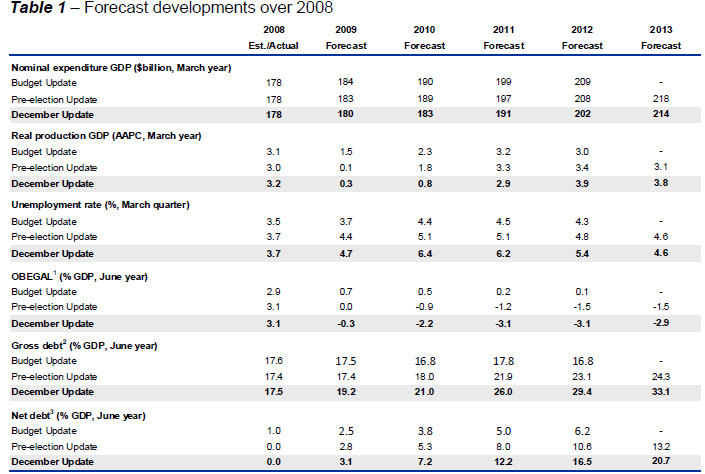
What's happening in 2011:
Outlook for the world economy
The outlook for the world economy is one of the main assumptions in our forecasts and also one of the major uncertainties. The greatest uncertainty is associated with the euro area sovereign debt crisis, which we expect to be resolved only gradually, with risks around key developments. The outcome of meetings of European leaders scheduled to occur between the finalisation of this text and its publication, and in the period closely following publication, could change the outlook for the euro area and the global economy. Future developments and responses will carry similar risks.
Our forecasts for economic growth in our main trading partners have been revised down from the Budget Update as outturns have been lower and the outlook has deteriorated (Table 1.1). While temporary factors, including natural disasters, account for some of the weaker growth to date, there is increasing acceptance that the recovery from the global financial crisis will be more protracted as household income growth is low and governments reduce debt.
Our forecasts for trading partner growth are similar to October Consensus Forecasts (released after we finalised) and the IMF September World Economic Outlook (WEO), released just before we finalised. Our forecasts assume an orderly resolution of the euro area debt crisis, although it is acknowledged that this may take a few years to be fully resolved. Euro area growth is expected to slow to 0.9% in 2012 and to rise to 1.5% thereafter. A scenario where the euro area debt crisis is not contained is explored in the Risks and Scenarios chapter. The scenario is based on the IMF’s recent WEO downside scenario, but the impact of the crisis is twice as large with trading partner output 3% below the main forecasts at the end of the period in our scenario.
The downside scenario does not envisage as sharp a downturn in the world economy as in the Global Financial Crisis (GFC) when our trading partners’ output contracted. In essence, we think policy makers have learned from the GFC and are better placed to respond should financial markets become disorderly. A rapid recovery followed the GFC as authorities responded with monetary and fiscal stimulus and stocks were rebuilt. In the downside scenario presented here, growth dips to 1.7% in 2012 and remains subdued through the forecast period because authorities’ ability to stimulate their economies is more limited now and households and governments still need to strengthen their financial positions.
_____________________
* From Treasury's website: The requirements of the BPS are to:
- state the overarching policy goals that will guide the Government's Budget decisions
- state how the Budget accords with the Government's short-term fiscal intentions
- state any changes to the Government's long-term fiscal objectives
- state any changes to the Government's short-term fiscal intentions, and
- explain how any changes in long-term fiscal objectives and short-term fiscal intentions accord with the principles of responsible fiscal management.
(Updates with video of English in Parliament buildings Tuesday morning)
We welcome your comments below. If you are not already registered, please register to comment
Remember we welcome robust, respectful and insightful debate. We don't welcome abusive or defamatory comments and will de-register those repeatedly making such comments. Our current comment policy is here.